First-year teaching · 6 min read
The ECT Induction: What Actually Matters in Your First Two Years
A guide for early career teachers navigating the formal induction process — and what to actually prioritise
Published 2026-05-14
The ECT (Early Career Teacher) induction replaces what used to be called NQT year. It now runs for two years rather than one, involves a named induction tutor, an ECF (Early Career Framework) programme, and formal assessments at the end of each year.
If you're an ECT reading this, you're probably drowning. The good news: almost every experienced teacher who went through it says the same thing. The paperwork and formal requirements are real but they're not the point. Here's how to navigate the next two years.
What the induction is actually for
The ECT induction exists to support teachers in their first two years and to give schools a formal process for identifying teachers who are struggling. The bar for passing is not high — the vast majority of ECTs pass without drama.
The standards it's assessed against (the Teacher Standards in England) describe competent baseline practice, not exceptional teaching. You are not expected to be brilliant. You are expected to demonstrate that you understand what you're doing, are responsive to feedback, and show improvement over time.
What your induction tutor actually needs from you
Your induction tutor needs evidence that you are reflecting on your practice and acting on feedback. That's it.
They do not need you to be the best teacher in the building. They do not need you to produce beautiful lesson plans for every observed lesson. They need to see that when something doesn't go well, you've thought about why and made an adjustment.
The biggest risk factor for ECTs is not poor teaching — it's defensiveness. Teachers who respond to feedback with "yes, but..." or who never acknowledge difficulty tend to generate concern. Teachers who say "that didn't work and here's what I'll try instead" tend to be fine.
The observations
You'll have a number of formal observations across your two years. These are usually less daunting than they sound if you've been teaching regularly.
Two practical pieces of advice: 1. Don't teach a completely atypical lesson for an observation. Teach a lesson you know well, with the class you know well, at a time of day that suits them. An observed lesson where you're trying something brand new with an unfamiliar class structure is setting yourself up to struggle. 2. Brief your observer. Tell them before the lesson: what the class already knows, what the learning objective is, who you're specifically watching and why, and what you'd like feedback on. This turns the observation into a professional conversation rather than a one-way verdict.
The paperwork
There is a lot. It varies by school and by which ECF programme your school uses (Ambition, Teach First, NIOT, etc.).
A practical approach: block out one hour per week for ECT admin. Don't let it bleed into the rest of your life. Do it at the same time each week so it feels bounded. Most of it can be completed in a focused hour if you haven't let it accumulate.
Protect your other time. The admin is important but it should not expand to dominate your evenings.
What to actually focus on in your first two years
**Year 1:** Routines. Relationships. Classroom management. These are the foundations that everything else rests on. If you come out of Year 1 with a class that works — consistent routines, reasonable relationships, a classroom you can teach in — that is success. Don't worry about differentiation, sophisticated AFL, or inquiry-based learning yet. Get the basics right first.
**Year 2:** Subject knowledge and pedagogical precision. Now you have a working classroom, start getting better at the craft of explanation, questioning, and feedback. Year 2 is when you shift from surviving to improving.
The thing most ECTs don't hear
You are going to feel like you're failing several times in the next two years. This is not evidence that you are failing. It's evidence that the job is hard.
Every teacher reading this has felt exactly what you're feeling. Most of them stayed. A few left. The ones who stayed generally say they're glad they did — but it took time to feel good at it, and that time varied enormously between individuals.
Be patient with yourself. Be patient with your class. Ask for help when you need it. That's the whole job, in two years.
Free bundle for this topic
The Starter Pack
18 free resources spanning every subject — the universal new-teacher starter.
Practical resources for this
Take this further
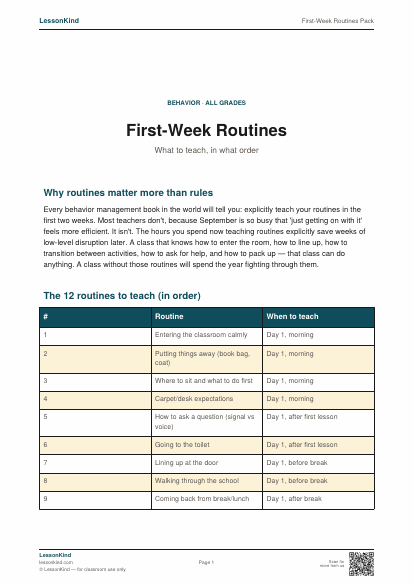
Printable, classroom-ready resources for the topics in this article.
Going deeper
Essential reading for NQTs and ECTs
Books we'd recommend on the topics raised in this article.
Your first years in teaching
- T The Learning Rainforest: Great Teaching in Real Classrooms — Tom Sherrington
- U Unhomework: How to Get the Most Out of Homework — Mark Creasy
- W When the Adults Change, Everything Changes — Paul Dix
-
H
How to Teach — Phil Beadle
Genuinely funny and deeply practical — ideal first year - T Teaching Today: A Practical Guide (5th ed.) — Geoff Petty
Convenience links to Amazon. As an Amazon Associate we earn from qualifying purchases at no extra cost to you. Read our affiliate disclosure.
Keep reading
First-year teaching
Five Mistakes I Made as a New Elementary Teacher
If I could go back and shake my first-year teacher self by the shoulders, here's what I'd say.
7 min read
Teacher wellbeing
Why September Feels So Hard (And Why That's Normal)
Every teacher knows September is hard. Fewer know that October is harder, that November is the lowest point, and that the system more or less requires you to push through. Here's what to expect and how to survive it.
7 min read