Parent communication · 5 min read
The End-of-Year Report That Actually Helps
Why most reports are useless, and what makes a good one
Published 2026-11-07
End-of-year reports occupy a strange place in primary teaching. They take hours to write, parents read them in about 90 seconds, and the children rarely see them at all. Most are exercises in template-filling — not really useful to anyone, but legally required.
This is a missed opportunity. Done well, an end-of-year report is one of the most powerful pieces of writing a teacher does. It can change how a parent understands their child. It can build trust that lasts years. It can correct misconceptions that have been quietly damaging.
What separates a useful report from a useless one?
The useless report
Most reports look something like this:
> "Sarah has had a positive year in Year 3. She has worked hard and made good progress in maths and English. She is a kind member of our class and gets on well with her peers. In maths, she is working at the expected standard. She has shown particular strength in number work. In English, she is working at the expected standard. She enjoys reading and has produced some lovely writing. Sarah's behaviour has been excellent throughout the year. Next year she should focus on reading more challenging books."
Re-read that. What did you actually learn?
- "Positive year" — meaningless without context - "Worked hard" — every child gets this - "Good progress" — measured against what? - "Expected standard" — the grade, not the substance - "Particular strength in number work" — what kind? - "Some lovely writing" — what's lovely about it? - "Read more challenging books" — useless without specifics
The whole paragraph could apply to any of 15 children in the class. That's the problem.
The useful report
Compare:
> "Sarah's year has been quietly impressive. The thing I'll remember about her is the day in October when she sat with a new classmate at lunch — without being asked, just because she noticed they were on their own. She does this kind of thing often. > > Academically, Sarah has made the leap from 'follows the method' to 'understands the maths'. Her work on fractions in March showed real flexibility — she could explain why 1/2 = 2/4 in her own words, not just demonstrate it. This is the cognitive shift that turns confident calculators into mathematical thinkers. She's at expected standard in maths, but I'd watch this — I think there's more there. > > Her writing is where the bigger growth has happened. In September her stories were short and direct. By June, she was writing extended narrative with deliberate suspense, controlled use of dialogue, and unusually careful word choice ('the lake glittered like beaten silver' was her line). She's now writing above the expected standard for Year 3. > > If I had one suggestion for next year, it would be reading. She still tends towards safe choices. Asking the librarian for something a bit harder than she'd normally pick, once a half-term, would push her further. *Murder Most Unladylike* by Robin Stevens, *Cosmic* by Frank Cottrell-Boyce, *Skellig* by David Almond would all be in range."
That's a useful report. It's specific, observed, professional, and actionable. The parent finishes reading it knowing their child better than when they started.
What makes the useful version work
**1. One memorable observation.** The lunch story tells the parent something they didn't know about how their child is in school. This single detail is worth more than any vague compliment.
**2. Specific cognitive shifts, not vague labels.** "Made the leap from 'follows the method' to 'understands the maths'" tells the parent what's actually happening intellectually. "Working at expected standard" doesn't.
**3. Real examples of work.** "the lake glittered like beaten silver" is the child's actual line. The parent might keep this report for years just for that.
**4. Honest assessment of where they are.** Not just "expected standard" — "expected standard but I think there's more there" is more useful.
**5. Concrete actionable suggestion.** Three named books to try. Not "read more challenging books".
How to write reports like this
The craft is in the preparation, not the writing.
**Before you start, gather raw material.** For each child, jot down: - One specific moment from the year you remember - One academic observation that's specific (not "made progress" but "made *this* progress") - One example of their work that captures something - One concrete next step (not vague advice)
This takes 5-10 minutes per child up front. It saves you hours of writing because you're not searching for what to say.
**Write to the child as well as the parent.** Imagine the child reading it in 20 years. Would they recognise themselves? Would they feel seen? If yes, the report is doing its job.
**Avoid template language.** "Has made good progress" / "is a valued member of the class" / "should continue to develop" — these are the verbal equivalent of beige paint. Cut them.
**Be specific even when it's hard.** If a child is struggling, don't soften it into meaninglessness. "Tom has found Year 3 challenging. He's at the lower end of expected for maths and below for writing. The pieces I think will help most are confidence and stamina — these are bigger than any specific skill" is more useful than "Tom continues to develop and is making steady progress."
What about the legal stuff
Schools have report templates and required statements. Use them. Tick the boxes. Then in the comment sections, do the actual writing.
Many schools allow free-form sections. Use those for your real report. Even if your school's template is rigid, the comment sections are where you can be specific.
The practical structure
A good 200-300 word report can follow this structure:
**Paragraph 1 (3-4 sentences)**: One memorable observation — something specific about *this* child.
**Paragraph 2 (3-4 sentences)**: Academic substance — what's actually happening cognitively, with examples.
**Paragraph 3 (2-3 sentences)**: One specific, actionable next step.
That's it. 200-300 words. 20 minutes per child if you've gathered raw material first. The whole class in two solid evenings.
It will be the best report many of these parents have ever received.
The wider point
Writing reports well is professional craft. It's not paperwork. The parents who keep your reports — who read them aloud to grandparents, who pin them to the fridge, who quote them years later — are the ones who got specifics, not platitudes.
Children grow into adults who barely remember what their teachers said about them. Except for the one teacher who saw something specific and named it. That's the report worth writing.
Practical resources for this
Take this further
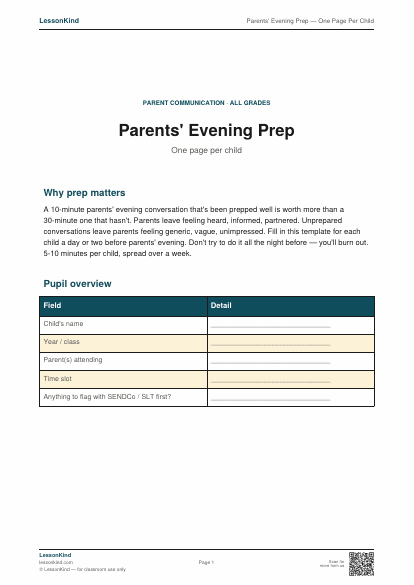
Printable, classroom-ready resources for the topics in this article.
Going deeper
Books on writing and feedback
Books we'd recommend on the topics raised in this article.
Practitioner
Convenience links to Amazon. As an Amazon Associate we earn from qualifying purchases at no extra cost to you. Read our affiliate disclosure.
Keep reading
Parent communication
The Email Your Parents Actually Want
Schools email parents constantly. Parents read approximately none of it. Here's what they actually want — and how to write the kind of message they open every time.
4 min read
First-year teaching
Your First Parents' Evening (And How Not to Dread It)
Parents' evening can feel like 30 high-stakes interviews with strangers. Here's the structure that works, and the phrases that get you out of awkward moments gracefully.
5 min read
Assessment & feedback
How to Give Feedback That Actually Changes the Work
Most marking has almost no effect on student work. Here's what does — and what to stop doing immediately.
7 min read
Assessment & feedback
Feedback That Changes the Work
Decades of research on feedback in education converge on one uncomfortable finding: most feedback given in classrooms produces little or no improvement. Here's what actually works.
7 min read