Parent communication · 4 min read
The Email Your Parents Actually Want
Why most school newsletters fail — and what to send instead
Published 2026-10-28
Schools email parents a lot. Newsletters, reminders, policies, dress code updates, photo permission forms, fundraising reminders, updated procedures, new procedures, revised procedures.
Parents read approximately none of it.
The hard truth is that the volume of school communication has grown so high that parents have triaged it into "delete unless urgent". The good news is that you can stand out simply by writing better. Here's what works.
Why most school emails fail
Look at your school's last six emails to parents. They likely share:
- A subject line like "Newsletter — Week beginning 15th October" - A long preamble about general school happenings - The actual important information buried in paragraph 4 - A list of upcoming dates that's the same as the website
This is the format of a document, not an email. Parents skim, see no obvious "what do I need to do", and close.
What parents actually want from school emails
In rough order of priority:
1. **What do I need to do, and by when?** (Permission forms, payments, kit lists) 2. **Specific things about my child this week.** (Achievements, concerns, interesting moments) 3. **Practical information.** (Dates, reminders, change of routine) 4. **Things to know before parents' evening.** (What's been happening in class)
What they don't particularly want:
- Long descriptions of school events they didn't attend - Photos of children other than their own - Headteacher reflections on educational philosophy - Reminders of policies they already know
The format that works
A good class email is short, scannable, and front-loads action items. Try this structure:
``` Subject: Y4 Update — kit list for swimming Friday
Dear Year 4 families,
THIS WEEK: • Swimming kit needed Friday — full list at end • Spelling test Wednesday — words sent home Monday • Picture day Thursday — uniform please
WHAT WE'RE LEARNING: • Maths: fractions • English: persuasive writing — ask your child about their letter to the head!
NOTICEABLE THIS WEEK: The class has been absolutely excellent during maths warm-ups. Their times tables fluency has visibly jumped since we started daily practice.
DATES: • Fri 17 Oct: swimming starts • Mon 27 Oct: half term • Mon 3 Nov: back to school
Swimming kit list: • Swim suit (one piece for girls) • Towel • Swim hat (any colour) • Goggles (optional) • A bag to bring it all home in ```
That's a complete email. Parents can scan it in 30 seconds. They know what to do. They know one positive thing about their child's week.
The seven small upgrades
**1. Subject lines that name actions.**
"Y4 — Permission needed for trip Friday" beats "Y4 newsletter week 7" every time. The subject line is what determines if the email gets opened.
**2. Bullet points, not paragraphs.**
Parents are reading on their phone, often while doing something else. Paragraphs require sustained attention; bullets allow scanning.
**3. Action items first.**
If something needs doing, put it at the top. Burying "by the way, please send £5 by tomorrow" in paragraph 6 fails everyone.
**4. One specific positive about the class each week.**
"This week the class did X really well." Specific, not vague. Parents love these — they make the email feel like more than admin.
**5. A consistent send time.**
If parents know "the Y4 email arrives Friday afternoon", they'll start to expect it. Inconsistent senders get filtered as random.
**6. Mention learning, briefly.**
Two lines about what the class learned this week is enough. It gives parents a hook for the "How was school?" conversation.
**7. End at the end.**
Don't add long sign-offs, school logos, or "feel free to email if any questions". Trust the reader to know what to do.
What about whole-school newsletters?
Whole-school newsletters are harder, because the audience is broader and the content less personal. They mostly fail. Some patterns that work:
- Keep them under 800 words. - Use clear sections with bold headers. - Front-load anything date-sensitive. - Include one-paragraph summaries from each year group instead of long head's letter. - Send weekly, not biweekly — short and frequent beats long and rare.
The unexpected payoff
Teachers who write good parent emails report a surprising side effect: their parent meetings get shorter. When parents are well-informed by clear, regular emails, parents' evening shifts from "tell me what's happening" to "I have one specific question". The work done in the email saves you time later.
Parent communication is part of the job. Writing it well is faster, cheaper, and far more effective than writing it badly.
Practical resources for this
Take this further
Printable, classroom-ready resources for the topics in this article.
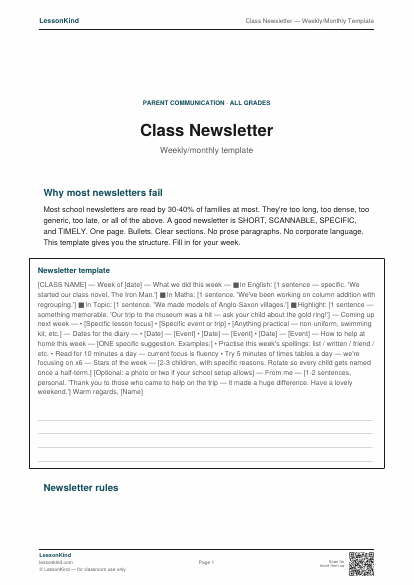
Class Newsletter — Weekly/Monthly Template
A simple, scannable class newsletter template — what we did, what's coming up, important dates, how to help. Designed to actually get read.
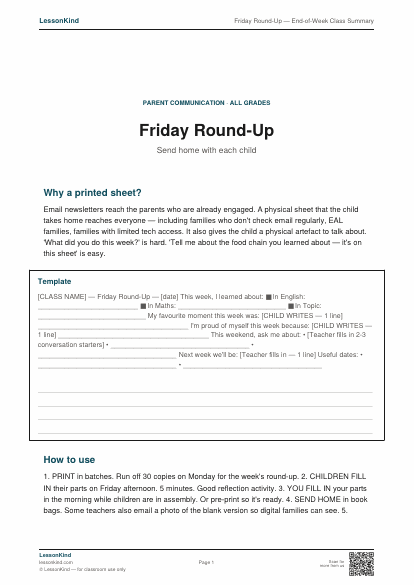
Friday Round-Up — End-of-Week Class Summary
A printable Friday round-up sheet children can take home — what they did this week, what's next, and conversation starters for parents.
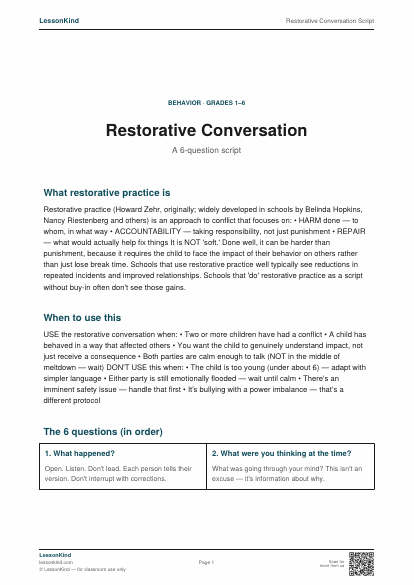
Restorative Conversation Script
A simple 6-question script for restorative conversations after a behavior incident. Follows the standard restorative practice format — focused on harm, accountability, and repair.
Going deeper
Books on parent communication
Books we'd recommend on the topics raised in this article.
Practitioner
Convenience links to Amazon. As an Amazon Associate we earn from qualifying purchases at no extra cost to you. Read our affiliate disclosure.
Keep reading
Parent communication
The Newsletter Nobody Reads (And How to Fix Yours)
Schools spend hours producing newsletters that most parents barely skim. The reason isn't lazy parents — it's that newsletters as a format have stopped working. Here's what works instead.
6 min read
Parent communication
Talking to Parents About Difficult Things
Sooner or later, every elementary teacher has to tell a parent something they don't want to hear. Here's how to do it well.
6 min read
First-year teaching
Your First Parents' Evening (And How Not to Dread It)
Parents' evening can feel like 30 high-stakes interviews with strangers. Here's the structure that works, and the phrases that get you out of awkward moments gracefully.
5 min read