Teaching strategy · 8 min read
The Handover Most Schools Skip
What outgoing teachers actually need to tell incoming teachers — and why most of it never gets written down
Published 2026-10-23
A scene most teachers will recognise. It's late July. You've finished reports, packed up the classroom, said goodbye to the children. The school has handed you next year's class list. You skim it, trying to attach faces to names. Some children you know — they're in your school's older year groups now. Most you don't.
You ask the outgoing teacher about a few of them. Maybe in passing in the staffroom, maybe in a brief 'have you got a minute?' conversation. They tell you Ravi can be tricky after lunch. They tell you Sophie is brilliant at maths. They tell you to watch out for the friendship group at the back left table because there's drama there.
Then term ends. You return in September with a class list and a memory of a five-minute corridor conversation. By half-term, you've worked out most of what you needed to know — except for the things you've already got wrong, and the things nobody told you.
This is the handover problem. Most schools have it. Most don't fix it. And the children pay.
What the data systems give you
In a typical UK primary, the new teacher inherits the following on paper or screen:
- Reading levels / phonics phase from the end-of-year assessment - Maths attainment band - Writing stage - SATs results (if Year 6/7) - A list of children with EHCPs or SEND support plans - Some sort of summary report — often a tickbox spreadsheet - Safeguarding flags via CPOMS / MyConcern
This is the formal handover. It's important, and it's not nothing. It tells the new teacher who is roughly where academically and which children have flagged needs.
It also leaves an enormous amount unsaid.
What the data systems don't give you
The things that take weeks to learn from scratch but minutes to share:
- Friendship clusters and fall-outs - Which children get on with which adults - Family context (a parent recently bereaved, a divorce in progress, a sibling at the secondary school who's struggling) - Behaviour patterns and what works for them ('don't bother with stickers, but a quiet word at the end of the lesson is gold') - Who needs reassurance to start writing and who just needs the timer to go on - Which children are flight-risks for school refusal in winter - Who can read aloud confidently and who will refuse - Which children mask anxiety and which one is the one who genuinely just had a bad day - The class culture — what's working, what's fragile
This is the kind of knowledge a teacher accumulates across a year. It's encoded in their relationship with the class. It rarely makes it into formal records because there's nowhere to put it and nobody asks. The new teacher gets the spreadsheet; the human knowledge dies.
Why this matters
In any school where children are taught by different teachers each year, the new teacher spends substantial parts of the autumn term doing one thing: working out what the old teacher already knew.
For the strong, social children, this matters less. They'll tell you what you need to know. The robust ones will keep being themselves; you'll catch up.
For the children who actually need the handover, it matters most:
- The child whose mum is in the middle of a difficult separation, and who's been told to tell their teacher if it gets bad. Last year's teacher knew. This year's teacher finds out at the parents' meeting in October. - The child whose anxiety presents as defiance. Last year's teacher learned to read it. This year's teacher reads it as defiance for two months and the child gets sanctioned, deepening the anxiety. - The child with a fragile friendship pattern. Last year's teacher seated them carefully. This year's teacher seats them on the same table as the wrong child and a half-term of social difficulty unfolds. - The child whose academic data looks fine but who's been holding it together with help. Last year's teacher knew the help was scaffolding. This year's teacher reduces it; the child collapses.
These are not edge cases. In a typical class of thirty, you'll have at least a handful. The handover gap is therefore one of the most predictable causes of preventable harm in the primary year cycle.
What good handover looks like
A few schools do this well. The ones that do it well share patterns:
**The handover is written, not just spoken.** Verbal handovers are valuable but they're forgotten by August. Written handovers are referenced in September.
**It's structured.** Not 'tell me about each child' (which produces twenty minutes of chat about three children and nothing about the other twenty-seven). A template that prompts the same questions about every child.
**It includes the social map.** Friendship clusters. Fall-outs. Children who do well together. Children who shouldn't sit at the same table. The seating plan that works.
**It includes family context where appropriate.** Not gossip, but the relevant facts. Which parent is the contact. Which family had a hard year. Which child has a sibling who needs different management. The school's pastoral lead can advise on what's appropriate to share in writing versus what stays oral and confidential.
**It includes the 'one thing.'** For each child, the single most important thing the next teacher needs to know. 'Lily's father has cancer. She's holding it together but she'll have bad days.' 'Tom looks lazy but actually has working memory issues — accommodations needed.' 'Alia's reading is fine but she refuses to read aloud — work around it for now, don't force.'
**It includes the whole-class picture.** What's the culture of this class? What's working with them? Where are they fragile? What topics have been covered well; what landed badly. The next teacher inherits a context, not just a list of children.
**It's done in time.** Last week of July is the latest. June is better. Once everyone has left for the summer, handovers don't happen.
**Both teachers meet for thirty minutes.** Even with the written document, a structured conversation surfaces things the writer didn't think to put down. Thirty minutes between June and July, before everyone forgets.
Why most schools don't do this
The reasons are predictable.
**Time.** July is the busiest month of the year. Reports, leavers' assemblies, classroom packing, end-of-year admin. Nobody has thirty minutes per child for handover.
**Tradition.** Most schools have always done it the way they do it. The data system gives the formal handover; the rest is informal. Changing this means changing how the school operates.
**SLT focus.** Senior leaders often don't see the cost of bad handover because it shows up in autumn term as 'the teacher's problem' (settling the class, dealing with behaviour, getting to know everyone). It's not visible as a leadership issue.
**Confidentiality concerns.** Some schools worry about the GDPR and confidentiality implications of written notes about children. These concerns are real but usually overstated — internal handover notes between qualified staff are entirely appropriate.
**Workload pushback.** Adding any new task in July faces immediate resistance from teachers already at capacity. Without leadership prioritising and protecting time, it doesn't happen.
The result: schools accept the cost of unhandover. The cost is paid by the children who needed the handover most.
What teachers can do — even without leadership
You may not be able to change the school's whole approach. But you can change yours.
**Write a handover anyway.** Even if your school doesn't ask for one, write one for the teacher inheriting your class. They'll be grateful, and the children will be served. Use a simple template — name, academic profile, social, family, one thing. 5-10 minutes per child if you know them.
**Read what previous teachers wrote you.** If the handover existed in any form for your incoming class, find it. Read it twice — once now, once in October to see what you've learned that they didn't say (and vice versa).
**Ask specific questions.** Don't ask 'tell me about Ravi.' Ask 'what does Ravi do when he's frustrated?' or 'who does Ravi work well with?' Specific questions get specific answers.
**Write the 'one thing' at minimum.** If nothing else, get the one most important thing about each child. The teacher inheriting your class will treasure it. Future-you would have loved this from your predecessor.
**Pass on, even informally.** If your school has a culture where handover doesn't happen, don't let that stop you. Send the email. Write the note. Pass on the document. Modelling matters.
What leadership can do
If you're a senior leader reading this:
**Make handover a structured task with protected time.** Half a day at the end of the summer term, formally allocated. Templates provided. Expectation set.
**Provide the template.** Don't ask teachers to design their own. A simple, school-wide template that asks consistent questions across classrooms.
**Insist on the meetings.** 30 minutes per outgoing-incoming pair. Diary it. Make it part of the calendar before the summer term starts.
**Receive and read the documents.** The SENDCo and pastoral lead should see them too — they often hold institutional memory beyond any single teacher and can flag continuity needs.
**Review the template annually.** Ask the teachers who use it what worked and what was missing. Iterate.
**Connect handover to your school's improvement priorities.** If you care about behaviour, mental health, EAL or SEND outcomes, handover quality is one of the highest-leverage levers you have.
What new teachers can do in September
Even with a perfect handover, September requires presence and reading the room.
**Don't take the handover as gospel.** It's information, not destiny. Children change. Some children behaviours that were entrenched last year shift in a new room with a new teacher. Read the document, then watch.
**Notice surprises.** If a child is presenting differently from how they were described, that's data. Either the child has changed, or the previous teacher's read was incomplete. Both useful to know.
**Protect the first half-term for relationships.** September isn't the time for ambitious curriculum innovations. It's the time for getting to know each child, establishing the culture, making it safe. Academic ambition starts in October.
**Re-read the handover at half-term.** With a month of your own observation behind you, the handover reads differently. You'll see what was prescient, what was outdated, and what wasn't said.
**Write a better one next July.** Whatever you wished you'd inherited, build the habit of providing.
A final thought
The handover is one of those bits of school life that's quiet, unglamorous, and disproportionately important. It's the institutional memory of how children are known. When it's good, the children get continuity — from one trusted adult to another, with the relationship handed forward as carefully as the academic data. When it's bad, the children start each September from scratch, paying the autumn-term cost in the form of missed cues, misread behaviour, and weeks of avoidable drift.
You can't fix the whole system. You can write a handover for the teacher who inherits your class. You can read the one you were given. You can ask the right questions in the corridor. You can model what good looks like for the colleagues around you.
That's the start. The rest is leadership.
Practical resources for this
Take this further
Printable, classroom-ready resources for the topics in this article.
Class Handover Document — End-of-Year Template
The document the outgoing class teacher fills in for the incoming one. Captures every child's academic level, social map, vulnerabilities, family context, and the one thing the next teacher absolutely must know. Saves the new teacher a half-term of figuring it out.
Transition Day — Running Order Template
A planning template for the in-school transition day at the end of the summer term — when children spend a morning with their next year's teacher. Sample running order, ice-breaker activities, parent-facing letter, and what the lead teacher needs to prep.
First Day Back After Summer — Activity Pack
Six activities for the first day back in September — designed to ease children in without overwhelming them, and give the new teacher useful information about their class. Low-stakes, structured, calming.
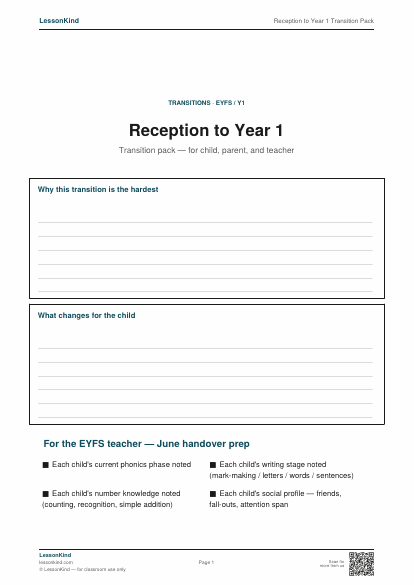
Reception to Year 1 Transition Pack
The single biggest transition in primary — from play-based EYFS to a more structured Year 1 classroom. Activities, parent letter, classroom routines, and EYFS-to-KS1 staff handover sheet for the gentlest possible move.
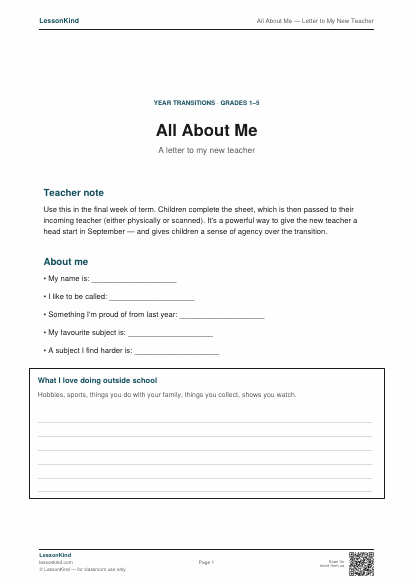
All About Me — Letter to My New Teacher
A printable sheet children fill in for their incoming teacher — interests, strengths, things they find hard, and what helps them learn.
Y6 Reading List — Books for the Year of Secondary Transition
Books for Y6 children — the year before secondary, where reading taste matters most and reading is the strongest predictor of secondary attainment. Calibrated for the Y6 cohort specifically — friendship, identity, change, growing up.
Keep reading
Behavior & classroom management
The First Two Weeks: The Behavior Foundation You Can't Build Later
Most teachers know the first two weeks matter. Few know how MUCH they matter, or what to do with them. The behavior of your class in June is largely determined by what you do — or fail to do — in September.
8 min read
Classroom culture
The Most Important Week of the Year
Most teachers think the first week is for getting to know the children. The teachers whose classrooms run beautifully use it for something quite different.
6 min read
First-year teaching
Five Mistakes I Made as a New Elementary Teacher
If I could go back and shake my first-year teacher self by the shoulders, here's what I'd say.
7 min read