Behavior & classroom management · 9 min read
What 'Restorative Practice' Actually Means in Year 3
Beyond the script — how restorative practice works (and how it fails) in real primary classrooms
Published 2026-09-08
"Restorative practice" is one of those phrases that has been used so often, so unevenly, that it's almost lost meaning. Schools claim to do it. Teachers claim to do it. SLT claim to do it. And yet in real classrooms, what's actually happening under that label varies wildly — from genuinely transformative work to a six-question script delivered without conviction to a child who's already been sent to the head.
This article is an attempt to clarify what restorative practice actually is, why it works when it works, and the common ways it fails in primary settings.
Where it comes from
Restorative practice in education has roots in restorative justice — an approach to crime that grew up in opposition to traditional punitive justice. The argument was simple: when a crime happens, traditional justice asks "who did it and what should they suffer?" Restorative justice asks "who has been harmed, and what would actually repair that harm?"
The transposition into schools was driven by educators (notably Belinda Hopkins in the UK and Nancy Riestenberg in the US) who were noticing the same patterns in school discipline as in criminal justice: punishment didn't seem to change behavior much, often damaged relationships, disproportionately affected disadvantaged children, and frequently reinforced the very dynamics that produced the misbehavior in the first place.
The restorative approach asks different questions:
- What happened? - Who has been affected, and how? - What needs to happen to repair this? - What can prevent it happening again?
Note what's missing: "What's the appropriate punishment?" Not because punishment is always wrong, but because it's not the question that actually changes behavior or repairs relationships.
What it looks like in primary
In a primary school, restorative practice typically shows up in three forms:
**Restorative conversations.** When two children fall out, or one child has hurt another, the teacher (or trained support staff) facilitates a structured conversation using a six-question script. Both children speak. Both listen. They identify what's needed for repair. They agree what's different next time.
**Restorative circles.** A whole-class practice where children sit in a circle and respond to a prompt one at a time. Used for community-building, reflection after incidents, marking transitions. Done weekly or fortnightly, builds relational culture across the year.
**Restorative reflection.** A child who's been involved in an incident completes a written reflection (or has a 1:1 conversation) using the same questions. Used after they've calmed down. Goal is for the child to genuinely understand impact, propose repair, and identify alternatives.
In schools where this works well, restorative practice is part of the daily fabric. In schools where it doesn't, it's a script kept in a drawer for after incidents.
When it works
Two things tend to be true in schools where restorative practice genuinely works.
**It's a culture, not a program.** Restorative practice in genuinely-restorative schools isn't an intervention you do AFTER a problem — it's the way you talk to children all day every day. The teacher who runs a restorative class isn't waiting for someone to misbehave to use the script. They're using restorative language constantly: noticing impact, naming repair, asking children to reflect on choices in low-stakes moments.
**The adults are restorative with each other.** This is the diagnostic test. In schools where restorative practice works, the staff treat each other restoratively. Disagreements are processed through repair, not punishment. Mistakes are met with curiosity, not blame. The culture is consistent. In schools where restorative practice is performative, the adults manage each other through hierarchy and consequence — and children, who watch everything, learn that the restorative talk is for them, not for the grown-ups.
When both these things are true, restorative practice produces results that are surprisingly consistent across studies: reduced repeat incidents, improved relationships, better staff-student trust, fewer exclusions, higher attendance among at-risk students.
When it fails
Restorative practice fails — sometimes spectacularly — under specific conditions. A few common ones.
**It's used as cover for not addressing behavior.** Some schools have adopted "restorative" as a label for not having behavior consequences at all. A child seriously hurts another child. There's a six-question conversation. Both go back to class. Nothing else happens. This isn't restorative — it's permissive with restorative branding. Real restoration requires accountability AND repair, not a substitute for either.
**It's done by adults who don't believe in it.** Children sense when an adult is performing a script versus genuinely engaging with the questions. A teacher who thinks the restorative approach is "soft" but is required to use it will deliver the questions in a tone that signals contempt — and the children will respond accordingly. The script is fine; the disposition is everything.
**It's used in power-imbalanced situations.** A six-question conversation between a child who has been bullied and the child who bullied them is not restorative — it's a re-traumatising performance. Restorative practice works when both parties are roughly equal stakeholders. It doesn't work as a replacement for safeguarding when serious harm has been done. Skilled restorative practitioners know which situations need a different protocol.
**It happens too soon.** A child has just exploded. Five minutes later, the teacher tries to do a restorative conversation. The child is still flooded — the thinking brain isn't online yet. The conversation produces nothing useful, and may harden the child's belief that adults don't get it. Restoration requires calm, which takes time.
**It happens without follow-through.** The conversation ends with "I'll try harder." Nothing is concrete. No one checks back. Two days later, the same thing happens. If the conversation doesn't produce specific behavior changes, monitored and supported over time, it's just talk.
The hard middle ground
Most teachers I know are sympathetic to the principles of restorative practice but uncertain in execution. The script feels artificial. The expected outcomes don't always materialise. Some children just refuse to engage. Some incidents seem to need a consequence as well as a conversation. The boundaries between "restorative" and "soft" feel unclear.
A few practical clarifications.
**Restoration is not the absence of consequences.** A child who has hurt another child can have a restorative conversation AND lose break time. The consequence isn't punishment for its own sake — it's part of the repair (the child uses break time to write a letter, for instance, or do something to make up for harm done). Restorative practice doesn't ban consequences; it makes them meaningful.
**Restoration is not always possible immediately.** Some children, after some incidents, can't engage in restorative work for hours, sometimes days. Wait. Don't force it. Use the time to let everyone calm down, gather information, talk to families, and be ready when the child can genuinely engage.
**Some incidents require additional protocols.** Bullying. Safeguarding concerns. Significant violence. These can include restorative elements but cannot be replaced by them. A skilled restorative practitioner knows which situations need other frameworks layered in.
**Some children take longer to learn restorative habits.** A child who has been told for years that "saying sorry makes it OK" needs to be retaught what apology and repair actually mean. Don't expect Year 3 children to do restorative work as articulately as you'd like in week one. It's a skill that develops over years, not weeks.
What to actually do in a Year 3 classroom
If you want to use restorative practice in a real classroom, a few starting points.
**Use restorative LANGUAGE throughout the day.** Not just after incidents. "I noticed when you helped Sam — that was kind." "When you spoke over Sofia, I think she felt unheard. Can you check in with her?" "What do you think happened between you and Marcus at break? What might help fix it?" The language is the practice.
**Run weekly community circles.** Even just 10 minutes once a week, with a low-stakes prompt. Build the muscle of speaking and listening in turn. By the time you need a circle for a serious issue, the class knows how to do it.
**Save the formal six-question conversation for situations that warrant it.** Not every incident needs a 20-minute conversation. Some need a quick "what happened? What can fix it?" exchange and you move on. Reserve the full structure for incidents where reflection genuinely matters.
**Pair restoration with prevention.** If the same child is having the same restorative conversation every Friday, the conversation isn't the problem — the prevention is. ABC tracking. Behavior plan. SENDCo involvement. Restorative work doesn't replace good behavior infrastructure; it sits on top of it.
**Be honest when it doesn't work.** Some children, in some moments, won't engage in restorative work. That's information, not failure. Try later. Try a different format. Talk to the family. Bring in additional support. The point is not to deliver the script — it's to help the child move forward.
A final note on dignity
The deepest argument for restorative practice — beyond the data — is one of dignity. Children are not problems to be managed. They are developing humans, capable of moral reasoning if it's modelled, capable of repair if it's expected, capable of growth if they're trusted. Restorative practice, at its best, treats children with the same dignity we'd want for ourselves when we mess up: a chance to understand impact, take responsibility, repair what we can, and move forward as a better version of ourselves.
That's not soft. That's hard. It requires more from teachers than punishment does. It requires more from children than detention does. And the children who come through years of genuine restorative practice, in my experience, are notably different from the children who came through years of punitive systems — kinder, more reflective, more capable of repair in their own friendships.
But it has to be real. Performed restorative practice is worse than honest punitive practice, because it pretends to be one thing while being another. If you're going to do it, do it. If you're not, that's defensible too. What's not defensible is half-doing it and calling it done.
Free bundle for this topic
Cover Day Survival Pack
9 resources for any cover day, including behavior strategies and morning meeting scripts.
Practical resources for this
Take this further
Printable, classroom-ready resources for the topics in this article.
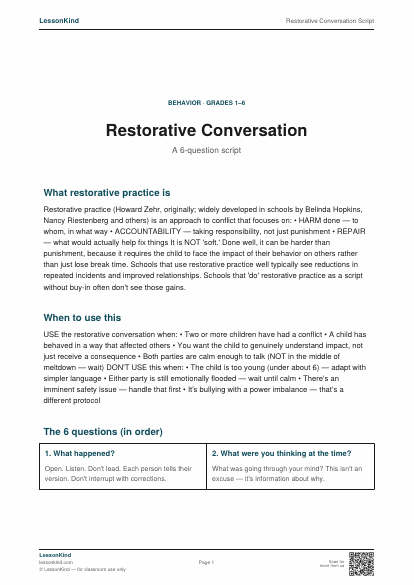
Restorative Conversation Script
A simple 6-question script for restorative conversations after a behavior incident. Follows the standard restorative practice format — focused on harm, accountability, and repair.
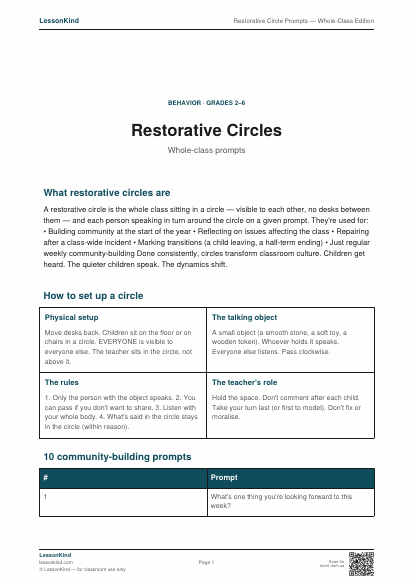
Restorative Circle Prompts — Whole-Class Edition
Whole-class restorative circle prompts for community-building and after class-wide incidents. 30 prompts across 4 categories, plus how to set up and run the circle.
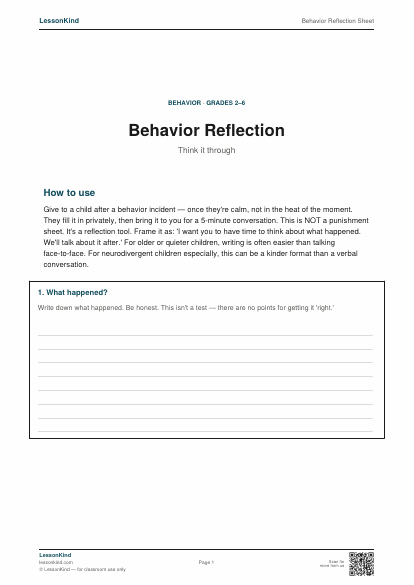
Behavior Reflection Sheet
A child-completed reflection sheet for after a behavior incident — focused on the same restorative questions, but in writing. Useful for older or quieter children.
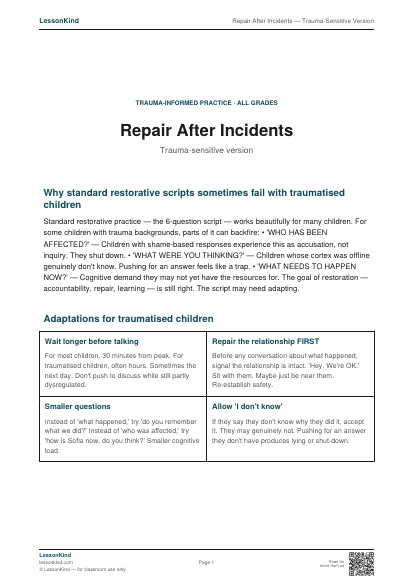
Repair After Incidents — Trauma-Sensitive Version
How to handle the after-an-incident conversation with a vulnerable child — when restorative scripts may need adapting, and when relationship repair matters more than reflection.
Going deeper
Restorative practice — recommended reading
If you want to take restorative practice seriously, start here.
Practitioner foundations
Convenience links to Amazon. As an Amazon Associate we earn from qualifying purchases at no extra cost to you. Read our affiliate disclosure.
Keep reading
Behavior & classroom management
The First Two Weeks: The Behavior Foundation You Can't Build Later
Most teachers know the first two weeks matter. Few know how MUCH they matter, or what to do with them. The behavior of your class in June is largely determined by what you do — or fail to do — in September.
8 min read
Behavior & classroom management
What Trauma-Informed Teaching Actually Means in Year 4
'Trauma-informed' has become a school slogan, sometimes deployed by leadership without actually changing anything. This article is about what genuinely changes when the framework is taken seriously — and what doesn't.
9 min read
Behavior & classroom management
When a Child's Behaviour Is Communication
Most adult responses to children's behaviour assume the behaviour IS the message. The trauma-informed reframe is simpler and more demanding: the behaviour is a SIGNAL of something underneath. The shift in response that follows is enormous.
8 min read