Behavior & classroom management · 8 min read
When the Kids Who Need You Most Are the Ones You Find Hardest
Why behavior systems fail the children they were designed for — and what works instead
Published 2026-08-04
Every behavior system in primary education is essentially the same: rewards for good choices, consequences for bad ones, and an implicit promise that if you stick to the chart, the room will run itself. For roughly 85% of children, this is broadly true. They were going to follow the rules anyway. The chart just gives them a way to feel proud about it.
This article is about the other 15%.
The kids the chart can't reach
There are children in every class who do not respond to behavior systems. Not because the system is poorly designed, but because something else is going on for them. Maybe they're hungry. Maybe they're tired. Maybe they're scared of a sibling at home. Maybe they have undiagnosed ADHD or autism. Maybe they've spent their whole life being told they're bad. By the time they reach you in Year 3, "moving the peg to red" doesn't feel like a consequence — it feels like confirmation.
These are the children who need a teacher most. They're also the children who can drive a teacher to tears by Wednesday.
The hard truth: a child who fights every system has often had every system fail them. The marble jar that worked for Sam down the hall does nothing for Marcus, because Marcus has been called naughty since he was four years old, and a marble jar will not undo that.
What actually works
What works isn't a trick. It's a slow, patient project that rests on three things.
**Connection before correction.** This phrase gets used so often it's lost meaning, so let me make it concrete. The first 60 seconds of every interaction with a "difficult" child should not be about behavior. Greet them by name when they walk in. Notice the new shoes. Ask about their dog. Remember that they like Minecraft. Do this on the days when they've been awful AS WELL AS the good days. Especially on the awful days.
This isn't about being soft. You can love a child and still hold them to high standards. But the standards land differently when the child believes you actually like them.
**Predictability over pressure.** The "difficult" kids are often kids whose lives are unpredictable. School might be the only place where things follow the same pattern every day. So follow the pattern. Don't change seating without warning. Don't surprise them with new rules. When you do need to make a change, tell them first, in advance, when you're calm.
When their behavior escalates — and it will — your response should also be predictable. Not louder. Not punitive. Not theatrical. The same calm voice. The same words. "Marcus, this isn't what we do. Take five minutes at the calm corner. We'll talk in a bit." Every single time. The chaos in their head meets the order in your room.
**Repair, not punishment.** When a child has a meltdown and trashes the book corner, the temptation is to punish — miss break, miss golden time, write a letter home. Sometimes those things are needed. But they don't move anything forward.
What moves things forward is repair. The next morning, when both of you are calm: "Yesterday was hard for both of us. What was going on for you?" Listen. Then: "What can we do to fix the book corner?" The child cleans up. They write an apology — not because you're punishing them, but because making things right is what people do. End it with: "Today is a new day. We're starting fresh."
This isn't going easy on them. It's harder than punishment, because it requires you to stay calm when they were chaotic, and to keep believing in them when they've given you reasons not to.
What doesn't work, and why
A few things that look like they should work but rarely do for these kids.
**Public shaming.** Moving a name down a chart in front of the class. Calling out the misbehavior so everyone hears. This produces compliance in some children and rage in others. The children most worth reaching are usually the ones who choose rage.
**Stickers and stars.** External rewards work for tasks the child already wants to do. They do not magic up motivation that isn't there. A child who is dysregulated will not be regulated by the offer of a sticker. (And the moment the sticker isn't offered, the behavior returns.)
**Calling parents every time.** If the child has a difficult home life, calling home about every incident makes it worse. Save the parent contact for big things, and balance it ruthlessly with positive contact. A note saying "Marcus had a great day today, he was kind to a younger child at lunch" goes further than ten incident reports.
**Sending them to another teacher.** Sometimes you genuinely need to remove a child from the room — for safety, or for everyone's sake. But it should not be the default response, because it teaches the child two things: that they're too much, and that the relationship with you isn't reliable.
The slow truth
Here is the part that no behavior course will tell you straight: the change you're trying to make takes years, not weeks. The child who started Year 3 throwing chairs may end Year 3 still occasionally throwing chairs. But by Year 6, if a series of patient adults have done the slow work, they may be the head boy.
You will not be the teacher who fixes them. None of us are. We are each one teacher in a long chain of adults who, together, decide whether this child grows up believing that adults are mostly safe and that they themselves are mostly good.
That is the actual job, when you strip away the lesson plans. Not all your children will need that level of care from you. But some will. And those are usually the ones you will remember in twenty years, when most of the others have blurred together.
A practical place to start
Pick the one child in your class who currently makes your stomach knot when they walk in. Tomorrow morning, greet them by name at the door, smile, and say one specific thing about them — not their behavior, just them. "Morning, Marcus. How's the new puppy?" Do this every day for two weeks, regardless of how the rest of the day goes.
You won't see a transformation. But somewhere underneath, the foundations of one will start to set.
Free bundle for this topic
Cover Day Survival Pack
9 resources for any cover day, including behavior strategies and morning meeting scripts.
Practical resources for this
Take this further
Printable, classroom-ready resources for the topics in this article.
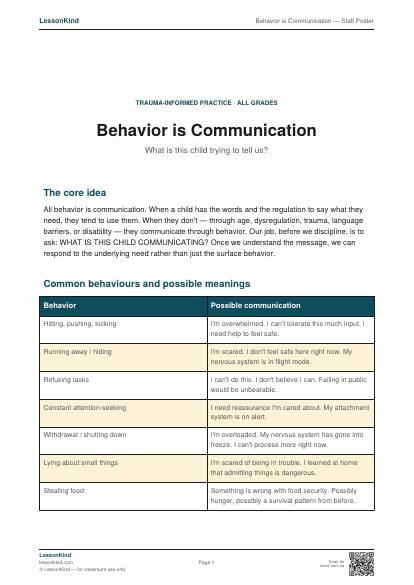
Behavior is Communication — Staff Poster
A staff-room poster reframing common 'difficult' behaviours as communications. The shift in lens is often the most powerful intervention there is.
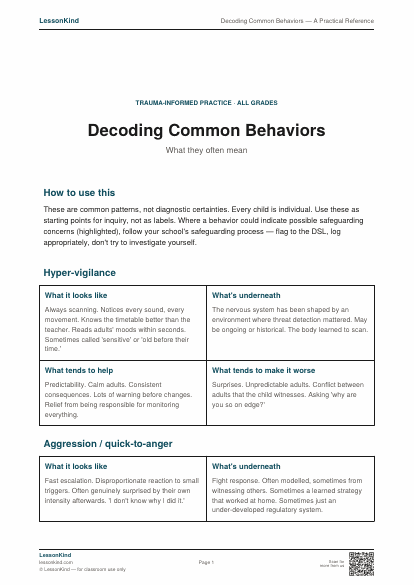
Decoding Common Behaviors — A Practical Reference
A deeper reference for the behaviors most often seen in children with trauma backgrounds — what they often mean, what's often happening underneath, and what tends to help.
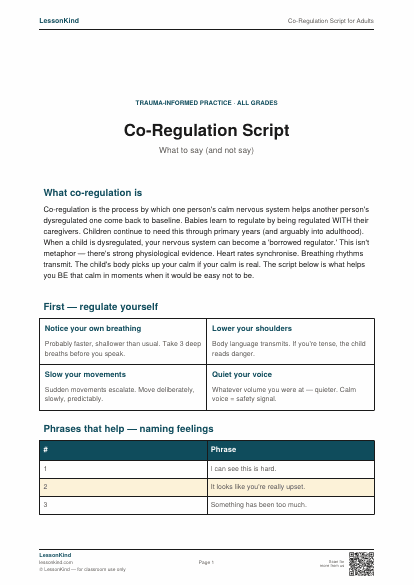
Co-Regulation Script for Adults
What to actually say (and not say) when a child is dysregulated. Phrase by phrase, based on the principles of co-regulation. Useful for the staff briefing.
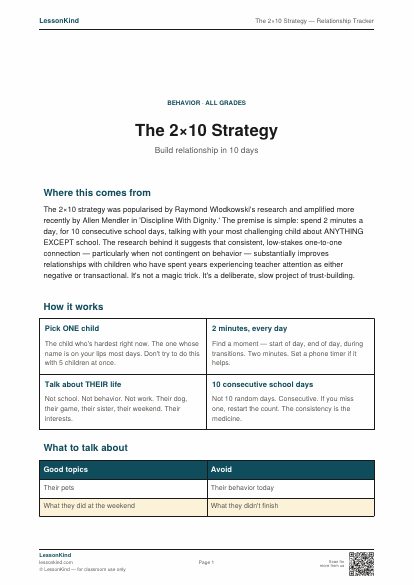
The 2×10 Strategy — Relationship Tracker
An evidence-informed approach to building relationship with the most challenging child in your class — 2 minutes a day, 10 days, talking only about non-school topics. With a tracking sheet.
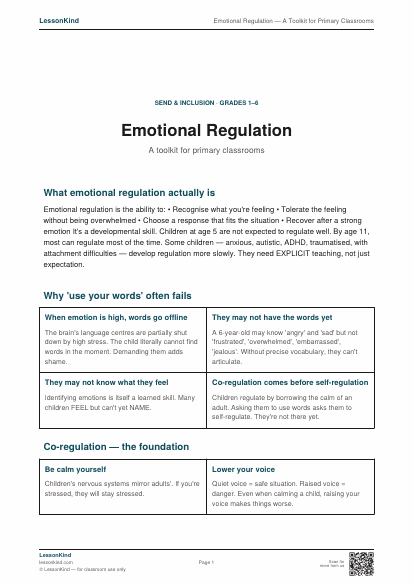
Emotional Regulation — A Toolkit for Primary Classrooms
How to teach and support emotional regulation in primary classrooms — including why 'use your words' so often fails, and what to do instead.
Going deeper
Books on the children behind the behaviour
Practitioner reading on understanding what's actually going on for the children we find hardest.
Foundational
Going deeper
Convenience links to Amazon. As an Amazon Associate we earn from qualifying purchases at no extra cost to you. Read our affiliate disclosure.
Keep reading
Behavior & classroom management
What Trauma-Informed Teaching Actually Means in Year 4
'Trauma-informed' has become a school slogan, sometimes deployed by leadership without actually changing anything. This article is about what genuinely changes when the framework is taken seriously — and what doesn't.
9 min read
Behavior & classroom management
When a Child's Behaviour Is Communication
Most adult responses to children's behaviour assume the behaviour IS the message. The trauma-informed reframe is simpler and more demanding: the behaviour is a SIGNAL of something underneath. The shift in response that follows is enormous.
8 min read
Behavior & classroom management
Anxiety in Primary Children: What's Normal and What's Not
Most primary-aged children worry. Some of them worry in ways that affect their lives. The line between these is the most consequential thing for parents to get right — and the most often blurred by anxiety culture going in both directions.
9 min read
Light reading
Twelve Things Only Elementary Teachers Will Understand
The strange, specific, weirdly wonderful things that come with teaching elementary children — and that nobody else quite gets.
4 min read