Classroom culture · 5 min read
The Quiet Children
Why the quietest children in your class are often the most under-served
Published 2026-11-11
Take a moment to think about a class you've taught. Now picture each child individually. Notice which ones come to mind first.
You probably thought of: - The child with behaviour challenges - The child who's academically struggling - The child who's brilliantly bright - The child with a particular personality (the comedian, the leader, the worrier) - The child whose parents communicate a lot
You probably didn't immediately think of the quiet, conscientious child who sits in the middle of the room, does what's asked, never causes any trouble, has a few friends, and reads quietly at break.
Those children are often the most under-served in primary classrooms — not because they have problems, but because they don't.
Why quiet children get less
Teachers have finite attention. Behaviour-management requirements, SEND demands, parent communications, lesson preparation — these consume most of the bandwidth. The children who don't demand attention often don't get any.
Specific patterns that emerge:
**1. They're not invited to speak.** A teacher running a discussion will often, semi-consciously, call on the children whose hands are up first, or the ones with strong ideas, or the ones who need the engagement. The quiet child who isn't waving their hand might never be called on.
**2. Their work isn't deeply marked.** When a teacher is short on time, marking gets prioritised. The struggling children's books get attention because they need feedback. The high-flyers' books get attention because their parents care. The quiet middle-of-the-road child's work might get a tick and move on.
**3. Their parents don't get contacted.** Behaviour incidents, SEND concerns, gifted programmes — all generate parent communication. The quiet, conscientious child whose work is fine generates no incidents and therefore no parent contact. Their parents may not hear from school all term.
**4. They're not noticed when they're struggling.** Loud children signal distress through behaviour. Quiet children signal it through… quietness, which is invisible. A quiet child who's being bullied at break, struggling with a worry, or hiding genuine learning difficulties can go unnoticed for an entire year.
Why this matters
Several reasons it deserves more attention:
**1. Quiet children are not all the same.** Some are quiet because they're confident and self-contained. Some are quiet because they're anxious. Some are quiet because they don't speak English fluently. Some are quiet because something is wrong at home. Treating them all the same misses the ones who need help.
**2. Quietness isn't always wellness.** A child who is shut down, withdrawn, depressed, or socially excluded may present as "quiet". Without close attention, this can be missed for months.
**3. Quiet children deserve attention as much as loud ones.** The fact that they don't demand it doesn't mean they don't need it. Children who go a whole term without a meaningful one-to-one conversation with their teacher have been short-changed, regardless of whether their academic outcomes look fine.
**4. The under-the-radar high-flyers.** Some of the most cognitively gifted children in your class are quiet ones. They're not putting their hands up because they don't need attention from you to learn. But they may be coasting badly, doing work several years below what they could do, simply because nobody noticed.
Practical strategies
**1. Audit your attention.**
Once a half-term, write down every child's name. For each one, note: - When did I last have a one-to-one conversation with them (more than 30 seconds)? - When did I last give them detailed positive feedback on their work? - When did I last invite them specifically to share an idea? - When did I last contact their parents about something positive?
You'll find one or two children whose names you can't fill in. Those are the children you've been missing. Spend the next two weeks deliberately addressing them.
**2. Use cold-calling intentionally.**
Cold-calling (asking specific children to answer rather than taking hands-up) feels confrontational, but used well, it ensures every child speaks regularly. Use it especially with quiet children. Pair it with thinking time and the option of "pass to a friend" if they're really stuck — never a humiliation, just a normalised way of including everyone.
**3. Lunchtime / break-time check-ins.**
Five minutes a week, walk the playground or eat in the lunchroom and just chat with one of the quiet children. Not about work — about their weekend, their pet, their friends. They will remember this for years.
**4. Vary group composition.**
Quiet children often end up in groups that drown them out. Deliberately pair them with other quiet children sometimes, where they can speak more easily. Or with a confident child you've briefed to "make sure X has a chance to talk".
**5. Notice them in writing.**
When marking, sometimes write a longer comment on a quiet child's work. Not "good work" — something specific they did well. They'll often quietly treasure this.
**6. Tell their parents something positive.**
If you've never contacted a child's parents and there's nothing wrong, find a reason to send a positive note home. "I noticed Sarah was particularly thoughtful when a younger child fell over at break — wanted you to know." Parents of quiet children are often anxious that their child is invisible. A positive note can mean the world.
The watchful test
For each quiet child in your class, ask: if something was wrong — at home, with a friend, with their feelings — would you notice? Would they tell you? If neither answer is "yes", you have work to do.
Building the kind of relationship where a quiet child feels they can come to you takes time. Most quiet children won't volunteer their problems unprompted. They need to be invited, repeatedly, before they trust enough to talk.
A common misconception
Some teachers think quiet children "are just like that" and shouldn't be made to participate or speak. This is half-true. Don't force public performance from anxious children.
But quiet doesn't mean "leave alone". Every child needs to be seen, heard individually, and known by their teacher. The form that takes can vary — a one-to-one conversation, a thoughtful comment on their work, a private acknowledgement at the line — but the connection has to happen.
The child who has been invisible to teachers for years is at the highest risk of academic disengagement when they hit the harder demands of secondary. Connection in primary is the foundation of motivation later.
The long view
The quiet, conscientious children in your class will often grow up to be steady, dependable, perhaps somewhat self-effacing adults. They will not remember every teacher they had. But they will remember the ones who saw them.
Be one of those teachers.
Free bundle for this topic
Cover Day Survival Pack
9 resources for cover days and routines, including behavior systems and morning meeting scripts.
Practical resources for this
Take this further
Printable, classroom-ready resources for the topics in this article.
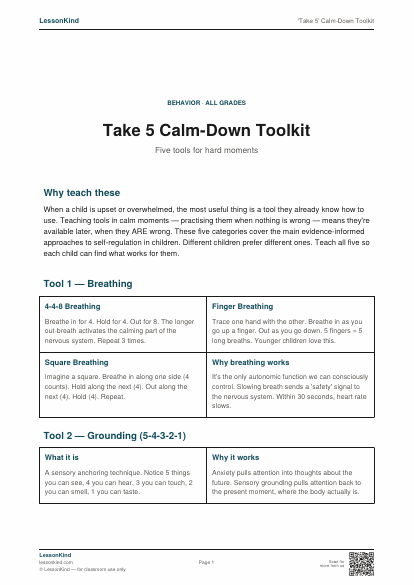
'Take 5' Calm-Down Toolkit
Five evidence-informed calming techniques children can use independently — breathing, grounding, movement, sensory, and cognitive. With age-appropriate adaptations and a take-home card.
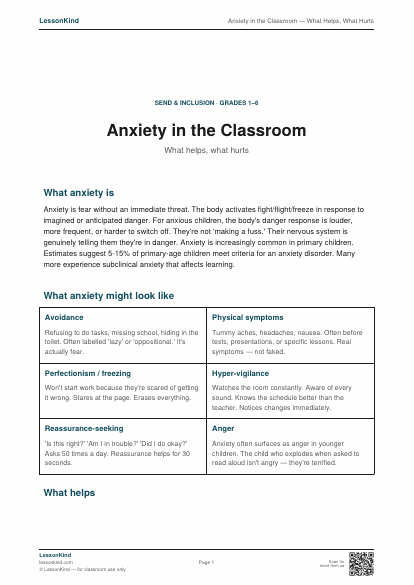
Anxiety in the Classroom — What Helps, What Hurts
Practical strategies for anxious children — including why reassurance often makes things worse, what to do during a panic moment, and the long view.
Going deeper
Books on quiet/anxious children
Books we'd recommend on the topics raised in this article.
Practitioner & background
Convenience links to Amazon. As an Amazon Associate we earn from qualifying purchases at no extra cost to you. Read our affiliate disclosure.
Keep reading
Reading & literacy
The Vocabulary Gap (And How to Close It)
Vocabulary size at age 5 is one of the strongest predictors of academic outcome at 16. Here's why the gap exists, and what teachers can do to close it.
6 min read
Classroom culture
The Classroom Rules Paradox
Many classrooms have detailed rules covering every situation. The research suggests this approach actively backfires. Here's what works instead.
5 min read
First-year teaching
What They Don't Tell You in Teacher Training
Teacher training prepares you for lesson planning. It does not prepare you for what your first term as a class teacher actually feels like. Here's the honest version.
7 min read