Classroom culture · 5 min read
The Classroom Rules Paradox
Why long lists of rules produce worse behaviour than short ones
Published 2026-11-10
Walk into a typical primary classroom and you'll see them: the laminated rules poster on the wall. Often there are 10 or 12 rules. "Always listen to the teacher". "Keep your hands and feet to yourself". "Tuck your chair in". "Walk in the corridor". "Speak kindly to others".
The intent is sensible — make expectations explicit. The effect, often, is the opposite of what's intended.
Why long rule lists fail
Several reasons:
**1. Children can't remember them all.** A class of 30 trying to remember 12 rules is essentially trying to remember zero. The rules become wallpaper.
**2. Each rule invites legalistic argument.** "I wasn't running, I was walking fast." "I wasn't being unkind, I was just telling the truth." Specific rules generate specific evasions.
**3. They focus attention on what NOT to do.** Twelve rules of "don't do X" creates a culture of avoidance rather than aspiration. Children manage rule-following rather than living the values.
**4. They're hard to enforce consistently.** A teacher with 12 rules ends up applying 3-4 of them. The other 8 become dead letters, which children quickly notice.
**5. They don't prepare for novel situations.** What about pinching? Tripping? Whispering rude things behind cupped hands? Each gets added to the list as an incident occurs, until the rules expand into legal code.
The alternative: principles, not rules
Schools and classrooms with the strongest behaviour cultures often have very few rules — sometimes as few as three. But those three are powerful, broadly stated, and rigorously upheld.
A common classic version: **"Be safe. Be kind. Be ready to learn."**
These three cover, between them, almost every behaviour expectation. They're general enough to apply to novel situations. They're short enough to remember. They're framed positively (be X) rather than negatively (don't do Y).
When something goes wrong, the conversation is principled rather than legalistic: - Is what you're doing keeping everyone safe? - Is it kind? - Is it helping you (or others) learn?
If the answer is no, the child knows. They can't argue the technicalities of which rule they did or didn't break.
Why this works cognitively
Educational psychology has a concept of "elaborative processing" — the more deeply an idea is processed, the better it's remembered. Three rules deeply absorbed are far more powerful than 12 rules shallowly memorised.
The brain also handles principles better than checklists. "Be kind" is an organising idea that generalises to thousands of situations. "Don't push" only covers pushing.
Schools that move from long rule lists to short principle frameworks consistently report:
- Behaviour incidents reduce, not increase - Children apply principles to situations the adults didn't anticipate - Conversations about behaviour become more meaningful (less legalistic) - The school feels calmer
How to introduce a principle-based approach
If your classroom currently has a long rule list, here's a practical transition:
**Step 1: Choose your principles.** 2-4 principles, framed positively. Common variants: - Be safe / Be kind / Be ready - Respect yourself / Respect others / Respect learning - Look after yourself / Look after others / Look after the space
Pick one set and commit. Don't expand later.
**Step 2: Teach what each one means concretely.** "Be kind" sounds simple but is actually quite abstract for a 6-year-old. Spend a week teaching what it looks like in practice. - Helping someone who dropped their pencil - Including someone in a game - Saying something that makes someone smile - Not laughing when someone makes a mistake
Build the bank of examples gradually. The children themselves often produce the best ones.
**Step 3: Use the language constantly.** "What does our 'be ready' rule look like right now?" "That was a really 'be kind' moment — well spotted." "Hmm — was that a 'be safe' choice?"
The language has to live in your daily speech, not just on a poster. Children pick up principles by hearing them used in real moments, not by reading them off a wall.
**Step 4: Anchor consequences to principles, not to specific infractions.** Old: "You ran. The rule says 'walk in corridors'. That's a sanction." New: "You ran in the corridor. Was that a 'be safe' choice? What could you have done differently?"
The latter is restorative — it teaches the principle. The former is punitive — it teaches that you got caught.
**Step 5: Praise principle-living, not rule-following.** Praise children who *embody* the principles, especially in unprompted ways. The child who quietly comforts a friend who's upset. The child who picks up litter that wasn't theirs. The child who steps back to let a younger pupil use the lift first.
These behaviours weren't on any rule list. They were principles being lived. Naming and praising them makes the principles real.
Common objections
**"But what about specific situations? We need rules about phones / weapons / online behaviour."**
Sure — there are some specific rules that matter, often safeguarding-related. But these aren't behaviour rules in the everyday sense. They're safeguarding policies, communicated separately. Don't conflate them with the daily classroom culture.
**"My class needs more structure than just three principles."**
Often the opposite is true. What a class needs is fewer, clearer expectations rigorously upheld. More structure usually means more rules they ignore, which is less structure in practice.
**"Senior leadership requires us to display certain rules."**
Display them, but treat them as background. Run your classroom on the principles. The rules-on-the-wall and the rules-in-practice are often quite different in successful classrooms.
The longer view
The classrooms — and schools — with the strongest behaviour cultures consistently look like principle-based environments rather than rule-based ones. They're quieter. They're warmer. The children seem more thoughtful about their choices, not just rule-compliant.
This isn't permissive — the standards are high. But the standards are about *being* the kind of person you want to be, not about avoiding specific infractions. That distinction is everything.
Three good principles will outlast twelve good rules every time.
Free bundle for this topic
Cover Day Survival Pack
9 resources for cover days and routines, including behavior systems and morning meeting scripts.
Practical resources for this
Take this further
Printable, classroom-ready resources for the topics in this article.
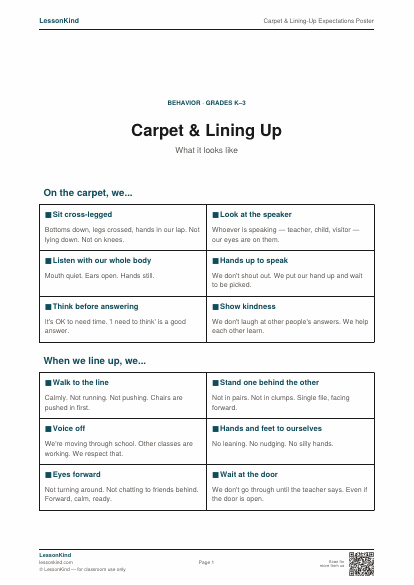
Carpet & Lining-Up Expectations Poster
A two-poster set showing exactly what 'good carpet' and 'good lining up' look like. Visual support for younger children — print A3, mount where children can see.
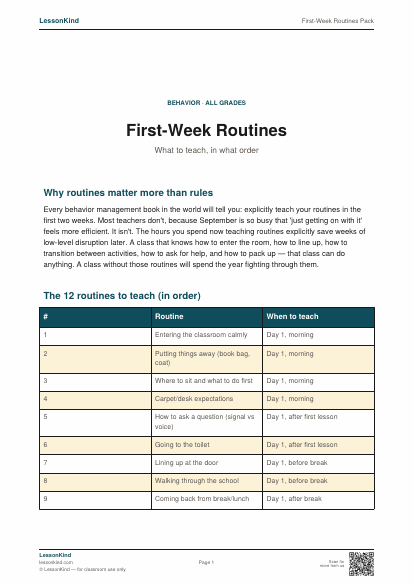
First-Week Routines Pack
The 12 routines you must establish in the first two weeks — entry, transitions, lining up, asking for help, finishing work, end of day. With explicit teaching scripts.
Going deeper
Books on classroom culture and behaviour
Books we'd recommend on the topics raised in this article.
Practitioner
Convenience links to Amazon. As an Amazon Associate we earn from qualifying purchases at no extra cost to you. Read our affiliate disclosure.
Keep reading
Classroom culture
Why Your Routines Matter More Than Your Lesson Plans
First-year teachers spend hours on lesson plans and almost no time on routines. The teachers whose classrooms run beautifully have it the other way around.
6 min read
Classroom culture
The Most Important Week of the Year
Most teachers think the first week is for getting to know the children. The teachers whose classrooms run beautifully use it for something quite different.
6 min read
Classroom culture
What Makes a Good Classroom Display
Pinterest shows you beautiful displays. The best classrooms often have plainer ones — because they're working harder. Here's what actually helps children learn from a wall.
5 min read