Behavior & classroom management · 9 min read
What Good Wraparound Care Actually Looks Like
Breakfast club, after-school club, holiday club — what separates the calm, well-run settings from the chaotic ones
Published 2026-10-23
Most discussions of school quality focus on the teaching day. Curriculum, results, behaviour, the quality of the lessons. The 9-to-3 part. Fair enough — that's the part with statutory frameworks, inspection regimes, and league tables.
What gets discussed less is the part that bookends the school day: breakfast club from 7:30, after-school club from 3:15 to 6:00, and holiday clubs that fill in half-terms and summer. For many families, this isn't an extra — it's a structural necessity. Both parents working, no nearby family support, no way around it. Children who do the full wraparound stack spend roughly 50 hours a week in their school setting. About 25 of those are lessons. The other 25 are wraparound.
The quality of those 25 hours matters. Sometimes more than people admit.
This article is about what good wraparound care actually looks like — what the calm, well-run settings have in common, what the chaotic ones lack, and how parents and school leaders can tell the difference.
What we mean by 'good'
It's worth being explicit. Good wraparound care isn't:
- A second school day with curriculum and lesson plans - A childcare warehouse where children are contained until pickup - Enrichment-heavy programming that wears children out further - A constant stream of structured activities back-to-back
Good wraparound care is something more specific. It's a calm, low-demand environment where tired children can recover, eat properly, play in mixed-age groups, and transition into or out of the school day without additional stress. It's safe. It's predictable. It has rhythms but not rigid timetables. It's staffed by adults who are present, attentive, and unbothered by ordinary childhood mess.
This sounds simple. In practice, achieving it consistently requires real thought.
What the calm settings have in common
Across many primary settings — varying in size, budget, ethos — the well-run wraparound care has predictable features.
**Predictable rhythm.** Every session has the same beats. Children walk in and know what comes next. Breakfast club: arrive, sign in, hands washed, breakfast at the table, free choice activities, line up for school. After-school: arrive from class, snack, settle, main activity choices, free play, pickup window. The order doesn't change. Children arriving in dysregulated states find their way back to baseline through the structure.
**Adults who eat with the children.** This is one of the clearest markers. In good settings, staff sit at the breakfast or snack table with the children, eating the same food. In poor settings, staff stand at the side or sit at a separate table on their phones. The difference reads to children immediately. Sharing food is one of the oldest forms of relational signalling. Children behave better when adults eat with them, and adults end up knowing children better.
**Mixed-age groupings.** Younger children often thrive at after-school club because for once, they're not in a rigid year-group bubble. They play with older children, watch how things are done, get gently mentored. Older children benefit from being looked up to. The setting that splits everyone strictly into year groups misses this.
**Activity choices, not enforced participation.** A planned art activity is offered. Children can join, or do something else. Some afternoons three children paint, others read, others play Lego, others sit by an adult and chat. This feels chaotic to inexperienced staff but actually works. Forcing all 30 children into the same activity at 4pm is rarely successful.
**Calm. Genuinely calm.** Walk into a well-run after-school club at 4:30pm and the noise level is low. Children are absorbed in things. Conversation, not shouting. Music possibly playing softly. Staff moving between groups, checking in, joining briefly, moving on. The room has the feeling of a Sunday afternoon, not a playground.
**Tidy-up as routine.** Children pack down what they used. Not always cheerfully, but reliably. The setting where the same staff member tidies up after everyone is exhausted by Friday and resentful by Christmas. The setting where children consistently tidy is calmer for everyone.
**Allergy awareness as default.** Snack time pauses for the allergy folder check. Cross-contamination is taken seriously. No outside food. Alternatives prepared without fuss. Children with allergies don't feel singled out — the system accommodates without making a scene.
**Visible safeguarding.** The DSL's name and contact are posted somewhere visible. Sign-in/sign-out is rigorous. Unfamiliar adults are checked. Late pickups have a clear protocol. None of this should be visible to children, but the systems exist and staff understand them.
What the chaotic settings have in common
The opposite is also recognisable.
**No predictable rhythm.** Each day plays out differently. Children arrive uncertain about what's happening. Activities start late, finish abruptly, change without warning. Staff improvise.
**Adults sat at the side on phones.** Not all the time, but often enough that children notice. Disconnection is the default mode. Children's behaviour escalates without anyone responding until something significant happens.
**Strict year-group separation.** Younger children are in 'their' room, older in another. The mixing that benefits everyone doesn't happen.
**Forced whole-group activities.** 'Everyone is doing X now.' Children who don't want to do X disrupt. The activity becomes about behaviour management instead of the activity. Staff burn out from the constant enforcement.
**Loud.** Often very loud. Voices raised across the room. Adults occasionally shouting. The sensory environment overwhelms children who are already tired from the school day.
**Adults clean up after children.** Children leave their mess. Staff resentment builds. The pattern entrenches over the term.
**Allergy awareness when remembered.** Most days fine, but occasional misses. Outside food appears. Cross-contamination not always considered. The child with the nut allergy carries the responsibility instead of the system.
**Safeguarding as theory.** Posters somewhere. Procedures somewhere. But sign-out is loose, unfamiliar adults aren't always checked, late pickups handled differently each time. Most days fine. Occasionally — not.
The difference between these two pictures isn't budget. It isn't building quality. It isn't curriculum. It's almost entirely about staff approach, leadership clarity, and the systems that turn good intentions into reliable practice.
The role of the wraparound care manager
The single most important factor in wraparound care quality is usually one person: the manager or lead.
A good wraparound lead does several things consistently:
- Sets the tone with their own behaviour (eats with children, stays off phone, tidies, models the standard) - Inducts new staff properly (not 'shadowing for a week,' but written procedures, expectations, allergy folder, safeguarding briefing) - Plans activities ahead (a 30-day rotation of types, not improvising daily) - Maintains the systems (sign-in, allergy folder, incident log, late pickup protocol) - Communicates with parents (clear notes when something happens, calm escalation when needed) - Supports tired staff (the 4:30pm slump is real; how the lead supports staff in it shows in the room)
Settings without this kind of leadership are managing day-to-day. They're not bad — most aren't — but the quality varies week to week. Settings WITH this kind of leadership feel different. The variation is small. The standard holds.
Many wraparound care managers are paid less, recognised less, and trained less than they should be. Schools that wrap them in the same professional infrastructure as teaching staff — proper job descriptions, real CPD time, paid planning hours — usually run better wraparound care.
What parents can look for
Most parents don't get to choose their wraparound care — they take what their school offers, or what they can find nearby that has spaces. But where you do have a choice, or are evaluating whether to raise concerns about your existing provision, the markers are observable.
**Visit at a busy time, not a setup time.** 4:30pm at after-school club, not 3:15pm. 8:15am at breakfast club, not 7:30am. The crowded middle is when quality shows.
**Watch the adults' eyes.** Are they on the children, or on phones? Are they moving between groups, or stationary? Are they engaging, or supervising at distance?
**Listen.** Calm conversation, occasional bursts of laughter, the sound of children absorbed in things — these are good. Constant raised voices, repeated 'sit down' instructions, audible adult frustration — these are warning signs.
**Look at one child eating a snack.** Are they sitting at a table with others? Is an adult nearby? Is the food appropriate (not just biscuits)? Is the child eating, or just nibbling? Children don't eat well in environments that feel unsafe.
**Look for the systems.** Sign-in clipboard visible? Allergy folder accessible? Fire procedure on the wall? Activities laid out, not chaotic? These are quiet markers of operational competence.
**Check the tidy-up.** The room at 5:55pm tells you a lot. If it looks like a tornado hit it and one staff member is despairing, the systems are weak. If it's mostly back to baseline by pickup, the routines are working.
**Talk to your child.** Not 'how was after-school club?' (gets one-word answers) but specific questions: who did you sit with at snack? What did you build today? What did the adults say to you? Patterns over weeks tell you more than any one conversation.
What schools could do better
Schools running wraparound care often treat it as a service rather than a part of the school's pedagogical and pastoral offer. This shows.
Things that genuinely help:
- Proper induction for wraparound staff — written, structured, allergy-aware, safeguarding-aware - Treating wraparound staff as part of the school team — invited to staff meetings, included in CPD where relevant - Clear escalation routes from wraparound to school day staff (the after-school club lead should know who to talk to about that child whose behaviour is changing) - Communication between class teachers and wraparound staff (a Year 4 child whose father has just left needs the after-school club to know — discreetly) - A written wraparound care policy reviewed annually - A dedicated budget for resources, snacks, and staff - A complaints / suggestions process for parents that's responsive
Things that produce poor quality:
- Treating wraparound as the cheapest possible add-on, staffed by whoever's available - Outsourcing to a third party with weak coordination back to the school - No communication between school day and wraparound staff - Reactive complaints management rather than proactive parent communication - Letting allergy management or safeguarding run on assumption rather than process
The bigger picture
Wraparound care is a quietly enormous part of children's primary years. For some families, more enormous than the lessons themselves. The quality of those hours shapes how children experience their childhood, how families experience the school, and (often) whether parents can keep working.
The best wraparound care doesn't try to be school. It doesn't try to be home. It's a third space — calm, predictable, low-demand, with adults who are present and food that's decent. Children who experience that consistently for years are luckier than they know. Children who experience the chaotic version absorb a lot of low-grade stress they shouldn't have to.
The good news: getting wraparound care right is achievable. It's not budget-bound, it's not building-bound, it's not curriculum-bound. It's largely about leadership, systems, and staff who understand that what they're doing matters — even when it doesn't look like teaching.
If you're a parent in a setting that's getting it right, treasure it. The staff often don't hear enough about what they're doing well.
If you're a setting working on improving — start with the rhythm. Predictable beats. Adults who eat with the children. Visible systems. The rest follows from there.
Free bundle for this topic
Cover Day Survival Pack
9 resources for any cover day, including behavior strategies and morning meeting scripts.
Practical resources for this
Take this further
Printable, classroom-ready resources for the topics in this article.
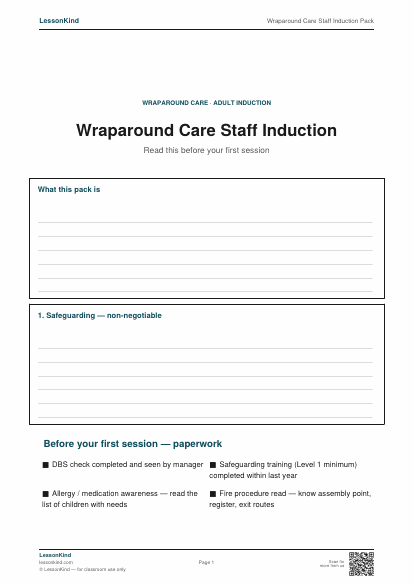
Wraparound Care Staff Induction Pack
A comprehensive induction pack for new wraparound care staff — breakfast club, after-school club, holiday club. Covers safeguarding, behaviour expectations, allergies and medication, fire procedures, and the rhythm of a typical session.
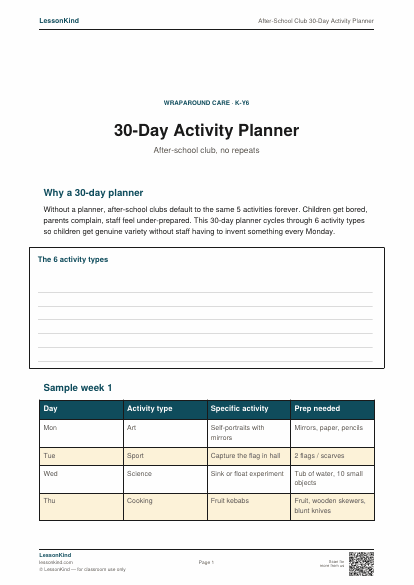
After-School Club 30-Day Activity Planner
A 30-day activity planning grid for after-school club leaders — variety across art, sport, science, cooking, free play. Stops the trap of 'colouring sheets again' and gives staff a clear what-to-prep-when template.
Breakfast Club Arrival & Settle Routine
A clear arrival routine for breakfast club — what children do when they arrive, in what order, with adult supervision points marked. Stops the chaotic 7:30am free-for-all and gets children eating, regulated, ready for school.
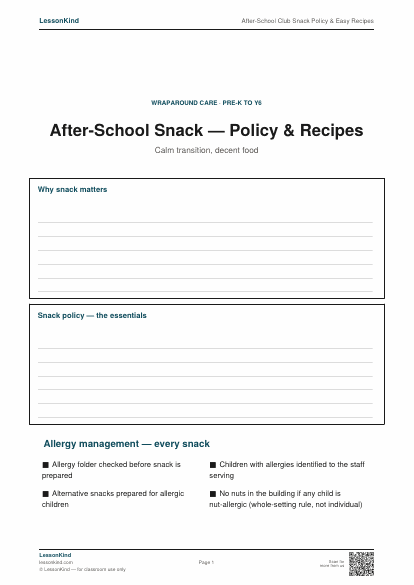
After-School Club Snack Policy & Easy Recipes
An after-school snack policy template plus 10 easy, allergy-aware snack recipes children can help prepare. Covers nutrition guidelines, allergy management, and the kinds of snacks that don't crash children's regulation.
After-School Club Behaviour Expectations — Child-Friendly Poster
A simple, child-friendly poster of after-school club behaviour expectations — different from school day rules, written in language children of 5+ can understand. Use it as the visible standard.
Keep reading
Behavior & classroom management
The First Two Weeks: The Behavior Foundation You Can't Build Later
Most teachers know the first two weeks matter. Few know how MUCH they matter, or what to do with them. The behavior of your class in June is largely determined by what you do — or fail to do — in September.
8 min read
Behavior & classroom management
The Supply Teacher Who Makes Them Want to Listen
Most supply teaching advice focuses on rules, threats, and 'taking control.' The supply teachers schools beg back are doing something different. This is about that something.
7 min read
Behavior & classroom management
What Trauma-Informed Teaching Actually Means in Year 4
'Trauma-informed' has become a school slogan, sometimes deployed by leadership without actually changing anything. This article is about what genuinely changes when the framework is taken seriously — and what doesn't.
9 min read