Classroom culture · 5 min read
What Happens When the Teacher Gets It Wrong
On the professional and human value of apologising to children
Published 2026-05-20
At some point in every teaching year, you will be wrong. In front of thirty children.
You'll misremember a fact ('actually, that's the River Nile, not the Niger'). You'll mark something incorrectly. You'll lose your temper when you shouldn't, or raise your voice at a child who didn't deserve it. You'll make a judgement that turns out to be wrong.
What you do next is one of the most powerful teaching moments of the year — and most teachers are not taught how to handle it.
The reflex to cover it
The instinct, in many teachers, is to minimise. To move past the mistake quickly. To not draw attention to the fact that the adult in the room was wrong. This instinct is understandable and almost always counterproductive.
Children notice. They always notice. A teacher who was wrong and glosses over it teaches children that admitting mistakes is shameful — that the response to being wrong is to hope no one mentions it.
The alternative
A teacher who says, clearly and specifically, 'I got that wrong — I told you the Battle of Hastings was in 1067 and it was 1066. My mistake' teaches something quite different. They teach that: being wrong is survivable. That admitting it clearly is possible. That it doesn't diminish you — in some ways it increases you.
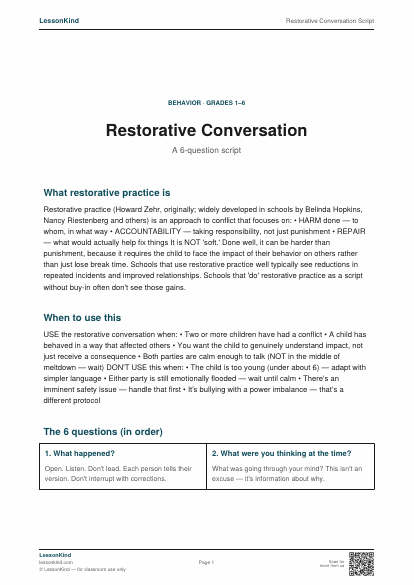
This is particularly powerful when the mistake involves a child directly. A teacher who snaps at a child, and then later says — privately or publicly, depending on what's appropriate — 'I was unfair earlier. You didn't deserve that and I'm sorry' models repair. It models that relationships can withstand difficulty. It models that adults can be accountable.
For children who have not experienced accountable adults in their lives, this is not a small thing.
The quality of the apology
A genuine apology is specific ('I was wrong to say...'), accountable ('that was my fault, not yours'), and not over-explained. It does not make the child responsible for managing the teacher's feelings. It does not turn into a lengthy discussion of the teacher's stress levels.
A phrase like 'I was wrong to do that and I'm sorry' is complete. It requires no response from the child. It closes the loop.
What it builds
Classrooms where teachers model accountability have different cultures from those where they don't. Children in accountable classrooms take more academic risks (they've seen that being wrong isn't catastrophic). They give better feedback to each other (they've seen what honest, non-defensive feedback looks like). They apologise to each other when they should.
None of this requires a teacher to perform exaggerated self-criticism. It requires saying, plainly and without drama, the true thing. That is enough.
Free bundle for this topic
Cover Day Survival Pack
9 resources for cover days and routines, including behavior systems and morning meeting scripts.
Practical resources for this
Take this further
Printable, classroom-ready resources for the topics in this article.
Keep reading
Classroom culture
Building Classroom Community: Practical Strategies That Actually Work
The quality of relationships in your classroom determines how much learning is possible. Here are the specific, practical strategies that build genuine community — not just a pleasant atmosphere.
6 min read
Teacher wellbeing
When a Child Gets Under Your Skin
Almost every teacher has a child they find genuinely difficult to warm to. Acknowledging this is not a failure — it's the beginning of doing something about it.
6 min read
Teacher wellbeing
When a Child Gets Under Your Skin
Almost every teacher has a child they find genuinely difficult to warm to. Acknowledging this is not a failure — it's the beginning of doing something about it.
6 min read