Classroom culture · 5 min read
What Makes a Good Classroom Display
Beyond Pinterest — the difference between displays that teach and displays that decorate
Published 2026-10-27
There's a particular Instagram aesthetic of primary classrooms — boho-neutral colour palettes, flowing fabric, plant corners, hand-lettered chalkboards, every surface coordinated. They are gorgeous.
They are also, in most cases, no better for children's learning than a much plainer room. And sometimes worse.
The visual aesthetic of a classroom is largely a teacher-pleasing aesthetic, not a child-learning aesthetic. The two can overlap, but often they don't.
What displays should actually do
A classroom display has three possible jobs:
1. **Teach** — children learn something by looking at it. 2. **Reference** — children can find information when they need it. 3. **Belong** — children see themselves and their work valued.
Every wall in your classroom should be doing at least one of these jobs. Walls that aren't are decoration. Decoration isn't bad — but it's not why we have walls.
The "teach" wall
A wall that genuinely teaches is rare. Most "teaching" displays are too busy or too pretty to actually teach.
What works:
- **Sequential, large, simple.** A multiplication strategies wall that shows 4 strategies, each in a clear box, each with a worked example, with enough size to read from anywhere in the room. - **Linked to current learning.** A wall about WW2 during the WW2 unit. After the unit, take it down and replace it with the next unit's content. Walls that stay up all year about a topic from October become invisible. - **Used by the teacher.** "Look at the strategies wall — which one did you use?" If you never reference it, the children won't either.
What doesn't:
- "Inspirational quotes" walls. Children rarely read these once. - Cluttered "everything we've learned" walls. The brain can't distinguish what's important. - Pretty hand-lettered headers with sparse content. Decoration disguised as teaching.
The "reference" wall
Reference walls are the most useful, and the most underrated. These are the walls children physically *use* during lessons.
Examples:
- A times tables grid where children can look up 7×8 if they're stuck. - A vocabulary wall with the unit's key words and a child-friendly definition. - A handwriting reference showing the school's expected letter formation. - A 100-square for KS1 maths. - A phonics sound mat.
These should be:
- **At child eye-level**, not above the whiteboard. - **Clear and large enough** to read from a working position. - **Permanent fixtures** the children get used to using. - **Referenced often** by the teacher in the first weeks ("If you forget how to spell 'because', look at the word wall").
A class of 30 with confident use of reference walls is doing visible cognitive work. A class that ignores them might as well not have them.
The "belong" wall
Where children's work is displayed. This matters more than people realise — children whose work appears on the wall feel valued; children whose work never appears feel invisible.
The trap: only displaying perfect work. The "best 6 pieces" approach is well-intentioned but excludes the children who never produce "the best". Their work needs to be on the wall too.
Better: rotate. Every child's work appears on the belong wall once per half-term, regardless of quality. Use one wall for "best of" and one for "current work from everyone".
For SEND children especially, having their work displayed publicly — *their* work, not a sanitised version — is hugely important.
The cognitive load problem
There's a less-discussed argument against pretty classrooms: visual clutter increases cognitive load.
A small but genuine body of research suggests classrooms with heavy visual decoration, especially for younger children, can reduce focus. The brain has to filter out the irrelevant visual information to attend to the lesson.
This doesn't mean classrooms should be sterile. It means: be intentional. Every visual element should be there for a reason. If you can't articulate what it's for, consider removing it.
The best classrooms often look slightly under-decorated to a Pinterest eye — but every wall is working.
What to do this term
If you do nothing else with displays, do this:
1. **Walk into your classroom and stand at a child's table.** Look around. What do you see? Is it readable? Is it useful? 2. **Identify one decorative wall and replace it with a genuine reference wall.** Word wall, times tables grid, sound mat — whatever your class needs most. 3. **Plan a rotation for the belong wall.** Every child's work on the wall once a half-term, no exceptions.
The classrooms children remember years later aren't usually the ones that looked best on Instagram. They're the ones where the walls helped them, and where their work was visible.
Free bundle for this topic
Cover Day Survival Pack
9 resources for cover days and routines, including behavior systems and morning meeting scripts.
Practical resources for this
Take this further
Printable, classroom-ready resources for the topics in this article.
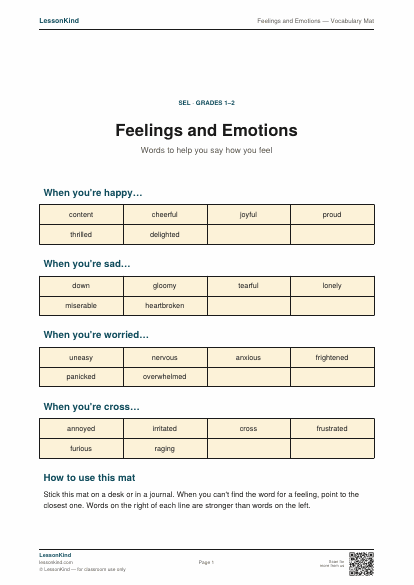
Feelings and Emotions — Vocabulary Mat
Twenty emotion words grouped by intensity. Helps children name and talk about feelings.
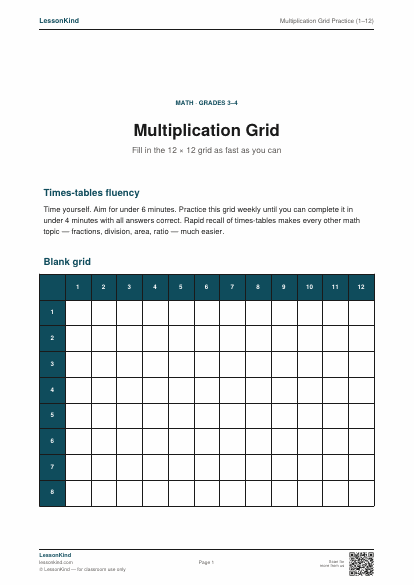
Multiplication Grid Practice (1–12)
Two blank 12×12 grids for timed times-tables practice.
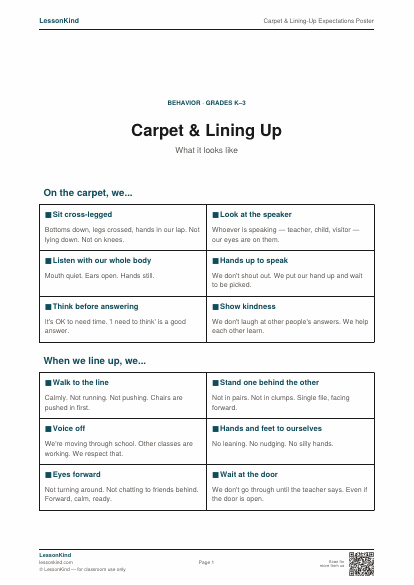
Carpet & Lining-Up Expectations Poster
A two-poster set showing exactly what 'good carpet' and 'good lining up' look like. Visual support for younger children — print A3, mount where children can see.
Going deeper
Books on classroom environment and culture
Books we'd recommend on the topics raised in this article.
Practitioner
Convenience links to Amazon. As an Amazon Associate we earn from qualifying purchases at no extra cost to you. Read our affiliate disclosure.
Keep reading
Classroom culture
Why Your Routines Matter More Than Your Lesson Plans
First-year teachers spend hours on lesson plans and almost no time on routines. The teachers whose classrooms run beautifully have it the other way around.
6 min read
Classroom culture
The Most Important Week of the Year
Most teachers think the first week is for getting to know the children. The teachers whose classrooms run beautifully use it for something quite different.
6 min read
Teaching strategy
What I Wish I'd Known About Classroom Talk
We ask thousands of questions a year. Most of them produce shallow answers. Here's how to ask better ones — and what to do with the answers.
6 min read