Reading & literacy · 8 min read
When to Worry About a Five-Year-Old Who's Not Reading Yet
What's normal, what's worth watching, and when to push for help
Published 2026-10-15
A common scene in any Year 1 playground. A parent at the gate, a bit anxious. 'Sophia from next door is already reading proper books. Mine still gets stuck on three-letter words.' Or: 'My older one was reading independently by now. This one isn't even close.' Or: 'I don't know if it's the school or my child or me, but something's not working.'
Reading anxiety is one of the most common parent worries in the early primary years. Some of it is well-founded. Most of it isn't. The challenge is telling them apart — and the cost of getting it wrong, in either direction, is real.
This article is about how to tell whether your 5- or 6-year-old's reading development is on track, when to start asking questions, and what to actually do.
What 'reading' looks like at age 5-6
Children's reading develops along a fairly predictable trajectory, although the timing varies enormously between individuals. Roughly:
**Age 3-4 (pre-reading).** Recognising some letters, especially in their name. Knowing some letter sounds (the most common ones). Starting to recognise familiar words by shape (mum, the supermarket logo). Understanding that words on pages mean things. Loving stories.
**Age 4-5 (Reception/Pre-K).** Most letter sounds known. Beginning to blend simple CVC words (c-a-t → cat). Recognising some words at sight. Writing their name. Telling stories from pictures. Understanding longer stories read to them. Asking questions about words and stories.
**Age 5-6 (Year 1 / Kindergarten).** Decoding most CVC words. Starting on more complex sounds (sh, th, ch, ee, oa). Reading simple books with growing fluency. Recognising 50-100+ words at sight. Beginning to read for meaning rather than just word-by-word. Writing simple sentences.
**Age 6-7 (Year 2).** More fluent reading. Tackling longer, more complex texts. Reading silently. Reading for pleasure (some children). Understanding what they read with discussion.
The key word here is ROUGHLY. Some children read independently at 4. Some don't get fluency until 7. Both can become brilliant readers. The wide range is normal.
What matters is not whether your child fits one specific point on the timeline, but whether they are MOVING ALONG it. A 5-year-old who knew 5 letter sounds in September and 15 by Christmas is on their way. A 5-year-old who knew 5 sounds in September and 5 in March may need closer attention.
The things parents worry about that probably don't matter
A list of worries that come up often, with the truthful answer about each.
**'They don't know all their letters yet.'** At 5? Mostly fine. By 6, you'd want them to know most letter sounds (not necessarily letter names — sounds matter more for reading). By 7, all letter sounds and most letter combinations. Don't drill at 5; build through reading and games.
**'Their friend is reading whole chapter books and mine isn't.'** Comparison to outliers is almost always misleading. Some children read early because their brain happens to grab onto reading at 4. This often doesn't indicate higher overall ability and doesn't predict long-term reading outcomes. Don't measure your child against the most advanced reader in the class.
**'They confuse b and d.'** Almost universal at 5-6. Most children sort this out by 7-8. It's only a flag if it persists past 8 alongside other markers.
**'They guess at words instead of sounding them out.'** Common phase. Children often try whole-word recognition before they have systematic decoding. The teacher should be working on it. Worth gently encouraging 'sound it out' at home.
**'They read slowly.'** Reading speed at 5-6 is a poor predictor of anything. Comprehension matters more. Don't push for speed.
**'They lose the plot of a long book.'** At 5, listening comprehension for a 30-page chapter book is a lot. They might genuinely not be ready. Choose shorter books. Don't worry.
**'They read the same book over and over.'** Excellent. Re-reading is one of the most evidence-supported ways to build fluency. Let them.
**'They want to be read to even though they can read themselves.'** The two activities are different cognitively. Listening to stories above their reading level builds vocabulary and comprehension. Don't stop reading to them when they start reading themselves.
The things that are worth watching
Some patterns are more concerning. Not necessarily emergencies, but worth paying attention to and asking the school about.
**Very limited progress over a year.** A child whose reading hasn't visibly improved between September and July despite weekly phonics teaching may need a closer look. Schools track this; ask what their data shows.
**Inability to hear sounds in words.** Phonological awareness (hearing rhythm, rhyme, sounds) is the foundation of phonics. A 5-year-old who genuinely can't hear that 'cat' and 'hat' rhyme, or who can't tell you the first sound in 'sun,' may have a phonological awareness weakness that needs targeted support.
**Confusion with similar-sounding words.** Persistent inability to distinguish between sounds that should be discriminable by their age (e.g. /m/ vs /n/, /b/ vs /p/). May indicate hearing or speech-and-language issues.
**Strong avoidance of reading.** Some children dislike reading mildly. If your child shows strong avoidance — running away, melting down, becoming distressed — there's something wrong. Either the activity is too hard, or there's been a bad experience that needs addressing. Don't push through avoidance.
**Reading effort disproportionate to overall ability.** A child who's clearly bright in conversation, problem-solving, and other areas, but is genuinely struggling with reading specifically, may have a specific learning difference (often dyslexia). Worth investigating.
**Difficulty with rhyme and rhythm.** Children who consistently can't generate rhymes by 5, or can't clap the syllables in their name, often have weak phonological foundations that will affect reading.
**A family history of reading difficulties.** Dyslexia and related conditions are heritable. If a parent, uncle, sibling has had significant reading struggles, the chance of similar difficulties in your child is elevated. Worth flagging early to the school.
**Speech and language delays.** Children with speech difficulties or language delays at 3-4 are at higher risk of reading difficulties at 6-7. The two are related, and early speech-and-language intervention can make a difference to later reading.
If two or more of these patterns are present, talk to the school. Specifically the SENDCo, who can advise on appropriate next steps.
When to push for action
Some indicators warrant pushing for SPECIFIC action — not just monitoring, but actual intervention or assessment.
**By the end of Reception:** Your child should know most letter sounds, recognise their own name, and be beginning to blend simple words. If none of these are happening, ask the school what they're doing about it.
**By the end of Year 1:** Your child should be reading simple books, decoding most CVC and CCVC words, and starting on more complex phonics. If they are still very early in phonics — still working on basic letter sounds — push for a closer look.
**By the end of Year 2:** Your child should be reading age-appropriate books with growing fluency. If they are still significantly behind their peers, ask the school about formal assessment.
**Reading screening checks:** UK children take a phonics screening at the end of Year 1. Failing this isn't a disaster, but persistent failure (Year 1 AND Year 2 retake) usually indicates a significant difficulty. Push for assessment if your child fails twice.
What 'pushing for action' looks like:
1. SPEAK TO THE SENDCo — not just the class teacher. The SENDCo coordinates SEN provision and can make formal arrangements.
2. ASK FOR A WRITTEN PLAN. Verbal reassurance ('we'll keep an eye on it') isn't a plan. Ask: what specific intervention, how often, with whom, for how long, with what review point?
3. ASK ABOUT ASSESSMENT. For specific reading difficulties (dyslexia, dyspraxia affecting reading), specialist assessment can help. This may be through the Educational Psychology service, a private assessor, or specialist teacher.
4. UNDERSTAND THAT WAITING ISN'T NEUTRAL. Children with unaddressed reading difficulties fall further behind every year. Acting in Year 1 is far easier than acting in Year 4. Don't accept 'let's wait and see' for more than a term.
What you can do at home
Whatever level your child is at, the home things that help reading are remarkably consistent across the research.
**Read TO them every day.** This is the single most consistently-evidenced positive thing you can do for a child's reading. It builds vocabulary, comprehension, and a love of stories. 10-15 minutes minimum. Daily.
**Let THEM read to you, gently.** Books at their independent level (where they can read about 95% of words). Don't push books that are too hard. Don't correct every error. Encourage. Praise effort.
**Talk about books.** 'Why did he do that?' 'What might happen next?' 'Have you ever felt like she does?' Comprehension is built by conversation about texts, not by comprehension worksheets.
**Build vocabulary in conversation.** Use rich words. Explain unusual ones. Don't dumb down your speech to them — children's vocabularies are built by being exposed to varied language.
**Take them to the library.** Free, full of books, builds the IDENTITY of being a reader. Don't underestimate this.
**Model reading yourself.** Children who see adults reading become readers more readily.
**Don't drill phonics worksheets.** Especially not at home, especially not as a punishment for not 'getting it' at school. The drilling produces short-term gains and long-term aversion.
**Keep it joyful.** Children who associate reading with pleasure read more. Children who read more become better readers. Children who associate reading with anxiety read less. Children who read less become worse readers. Joy is not the soft feature; it's the engine.
A final word
Most 5-year-olds who aren't yet reading become competent readers within a year or two. Variation is enormous and mostly meaningless. The exception is the smaller group of children with specific reading difficulties — and for that group, early identification and specific intervention make a huge difference.
The hard part is telling which group your child is in. The patterns to watch are above. Most of the time, the answer is: relax, read with them, give it time, keep enjoying books together.
When the patterns suggest something more, the answer is: act early, push for specifics, don't accept vague reassurance.
Both responses are right. The skill is knowing which one to use.
Free bundle for this topic
EYFS Essentials Pack
8 early-literacy essentials — provision, phonics-readiness, mark-making and storytime support.
Practical resources for this
Take this further
Printable, classroom-ready resources for the topics in this article.
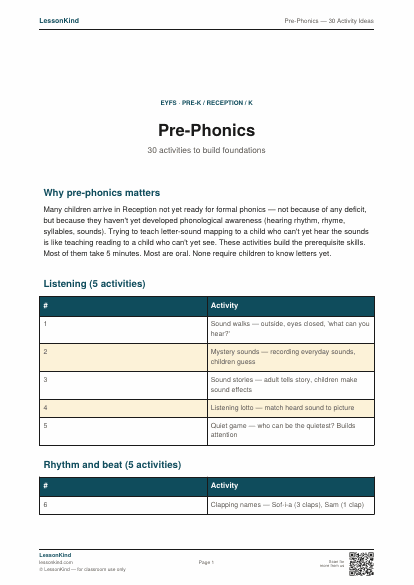
Pre-Phonics — 30 Activity Ideas
30 activities to develop the foundations BEFORE introducing letters — listening, rhythm, rhyme, alliteration, oral blending. The skills that determine how well phonics will land later.
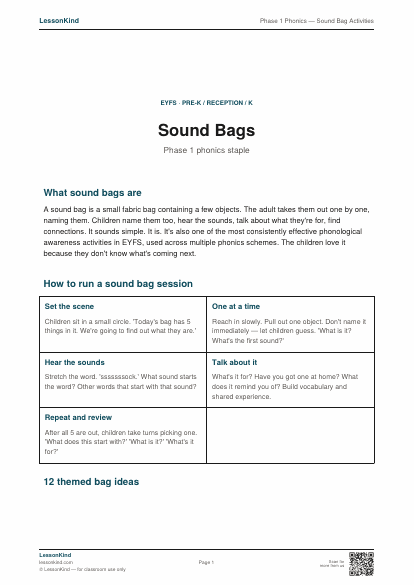
Phase 1 Phonics — Sound Bag Activities
How to set up and use sound bags — a Phase 1 phonics staple. With 12 themed bag ideas and how to scaffold across the year.
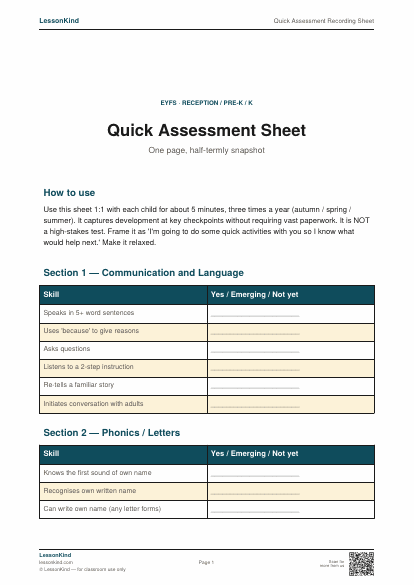
Quick Assessment Recording Sheet
A one-page recording sheet for quick formative assessments — phonics, number, fine motor, name writing. Use as a snapshot every half-term.
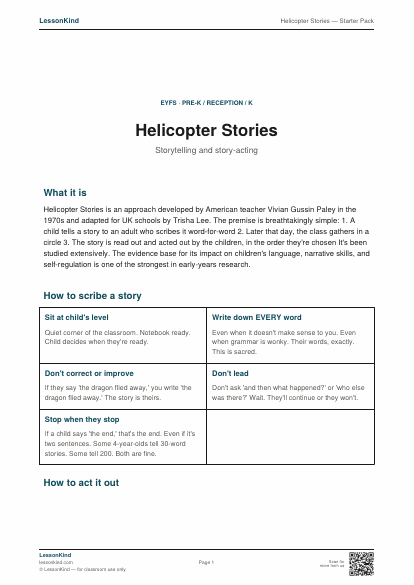
Helicopter Stories — Starter Pack
An introduction to Helicopter Stories — Vivian Gussin Paley's storytelling-and-story-acting approach. One of the most evidence-informed early-language interventions there is.
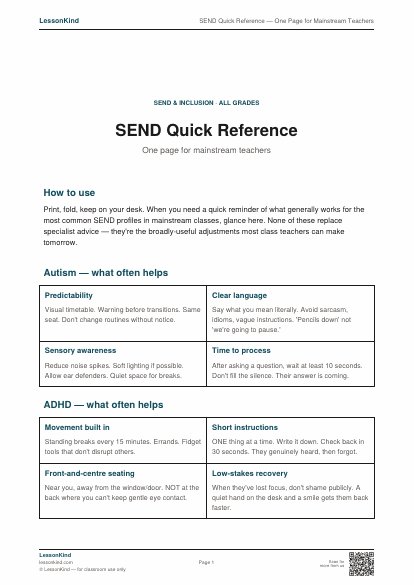
SEND Quick Reference — One Page for Mainstream Teachers
A one-page reference summarising the most useful adjustments for the four most common SEND profiles — autism, ADHD, dyslexia, anxiety. Print and stick on your desk.
Reception Classroom — Essential Picture Books
The 30 picture books every Reception classroom should have — read-aloud favourites, repeat-read classics, and the books that build the foundational vocabulary, rhythm, and story-sense Reception children need.
Keep reading
Reading & literacy
Phonics Screening: A Parent's Honest Guide
Every June, parents of UK Year 1 children worry about a 40-word test their child has to take. Here's what it's actually measuring, what the result means, and what to do about it — including the bit most schools don't tell you.
8 min read
Reading & literacy
Phonics vs Whole Language: The Fight Is (Mostly) Over
The 'reading wars' tore at education for decades. Here's where the science of reading has actually landed — and what it means for your classroom.
8 min read
Reading & literacy
What to Do When a Year 4 Child Still Can't Read
It happens in every primary school: a child arrives in Year 4 with reading two or three years behind. Here's what's likely going on, and what you can actually do about it.
9 min read
Behavior & classroom management
When to Worry About Your Child's Handwriting
Most concerns about handwriting at primary age are about pace, not problem. But some patterns are worth taking seriously — and the pencil grip thing is more interesting than most parents realise. Here's how to tell the difference.
7 min read