Behavior & classroom management · 8 min read
When a Child's Behaviour Is Communication
The single most important reframe in trauma-informed practice — and why it changes almost everything
Published 2026-10-01
There's a moment most teachers know. A child is doing something inexplicable — refusing to come in from break, hitting another child, hiding under a table, screaming about something tiny. The temptation, in the moment, is to address what's visible: the behaviour. Stop the hitting. Get them out from under the table. Make them come in from break.
This response treats the behaviour as the problem. It tries to suppress the behaviour. Often it works — for that incident. The behaviour stops, sometimes through compliance, sometimes through escalation, sometimes through the child eventually getting tired.
But the behaviour comes back. With the same child, or sometimes a different child, in a different context but the same shape. Suppression hasn't changed anything. The child has just moved on to the next moment carrying the same underlying need that's now still unmet.
The trauma-informed reframe is simple to state and surprisingly hard to practise: the behaviour is not the problem. The behaviour is a signal of something underneath. The work isn't to suppress the signal — it's to understand and address what the signal is pointing at.
What this actually means
Imagine a child throwing a chair. The visible behaviour is throwing a chair. Things that might be underneath:
- Cognitive overload — the task was too hard, escape was impossible, the body chose discharge - Sensory overload — too much noise, too much visual stimulation, the threshold was crossed - Social rupture — a friend hurt them, an exclusion landed, the chair came after the rupture - Emotional flashback — something in the room reminded the body of an earlier hurt, often unconsciously - Physical state — hungry, tired, ill, in pain — body capacity for regulation reduced - Power threat — a sense of being trapped, controlled, having no agency - Attention need — but rarely just attention; usually attention to one of the above
The same surface behaviour — throwing a chair — has very different appropriate responses depending on what's underneath. If the child is overwhelmed, more demand makes things worse. If the child is hungry, food helps more than discipline. If the social rupture is the cause, the consequences need to address it, not just the chair.
This is why simple behavior policies — same consequence for same behaviour — work less well than they look like they should. They suppress the visible while leaving the underneath untreated.
Why this is hard
A few reasons this reframe is harder than it sounds.
**It requires you to stop and think.** When a child is escalating, the time-pressure to respond is intense. The 30-second pause to ask 'what's underneath?' feels impossible. But it's the most important 30 seconds in the whole interaction. Without it, your response is to the surface, not to the child.
**It requires you to NOT take it personally.** When a child is being aggressive, defiant, dismissive — the temptation is to read it as about you. Often it isn't. Children frequently dump dysregulation onto whoever is in their proximity, especially adults who feel safer than home. Holding this without taking it personally is genuinely hard.
**It requires emotional capacity you sometimes don't have.** When you're tired, stressed, dealing with multiple children, regulating yourself — the trauma-informed response is more demanding than the punitive one. There are days when you can't manage it. That's human. The work is to get back to it the next day.
**It feels like it's letting them off the hook.** This is the most common worry. If we focus on what's underneath rather than punishing the behaviour, are we teaching that the behaviour is OK? Don't they need to learn there are consequences?
The answer to the last one is important: NO, you're not letting them off. The behaviour still needs to be addressed. There are still consequences. The repair still has to happen. What changes is that you're addressing the surface AND the underneath, not just the surface.
A child who has thrown a chair will need to: - Be calm before the conversation happens - Acknowledge what they did - Understand who was affected - Make repair (apologise, clean up, address harm) - Identify what they could do differently next time - Sometimes face a consequence (loss of free time used to make repair, for instance)
ALL of this still happens. What's different is that the conversation also addresses what was underneath — what overwhelmed them, what was happening before — so the underlying need is met or at least named.
The diagnostic question
The simplest version of the reframe is to hold a single question, especially when behaviour is challenging:
**'WHAT IS THIS CHILD COMMUNICATING THAT THEY DON'T HAVE WORDS FOR?'**
It's a powerful question. It assumes the child has SOMETHING they're communicating. It assumes the absence of words isn't moral failure. It opens the inquiry rather than closing it.
Holding this question, even for 30 seconds, before responding changes the response. The voice softens. The body language opens. The questions you ask become more curious than accusatory. The child feels it, even pre-verbally. The escalation slows.
This isn't magic. It's the cumulative effect of being treated as a person whose behaviour has meaning, rather than as a problem to be managed.
What underlies what — common patterns
Some common surface-to-underneath patterns:
**Aggression often signals overwhelm or a perceived threat to identity.** The child feels too much, OR feels unsafe in a specific way (often relational), and the body discharges through fight. Reducing demand and reassuring safety helps more than punishment.
**Refusal often signals shame or task-overwhelm.** 'I won't' is sometimes 'I can't, and I can't bear failing in front of everyone.' Reducing the public stakes — privately offering an entry point, reducing the task — helps more than insistence.
**Withdrawal often signals overwhelm leading to freeze.** Sitting silently, head down, not responding — the child has gone offline. Approaching with quiet patience helps more than demanding response.
**Constant attention-seeking often signals attachment insecurity.** The child needs reassurance, not less attention. Counterintuitively, MORE consistent low-level attention often reduces the desperate big-event behaviour.
**Lying often signals fear of the consequence.** Especially in children whose home consequences have been disproportionate or unsafe. Lowering the stakes — making truth-telling SAFE — helps more than catching them out.
**Stealing food often signals food insecurity.** Past or present. Available food, no shame around it, removes the underlying fear.
**Cruel comments often signal the child's own pain projected outward.** Especially if directed at children with particular characteristics. Worth investigating gently — what's the child carrying themselves?
These are patterns, not certainties. Every child is individual. But these patterns recur often enough that holding them in mind helps you ask the right questions.
The conversation that matters
The reflective conversation after an incident — done well, with timing — is where the reframe pays off.
Not 'why did you do this?' (the answer is often 'I don't know' — the cortex was offline).
Not 'what were you thinking?' (same problem).
Better:
'I wondered if you were feeling overwhelmed when this happened. Does that fit?'
'I noticed that you were quiet for the whole morning before this happened. Was something hard?'
'It looked like you were really angry. Sometimes anger is the top feeling when there's a different feeling underneath. Anything come to mind?'
These are HYPOTHESES the adult offers. The child doesn't have to come up with the answer alone. Adults with more reflective capacity can offer hypotheses; children try them on; over time, children develop their own reflective capacity by borrowing the adult's.
This is how children become more self-aware. Not by being demanded to introspect when they don't have the resources for it. By having adults model reflection, gently, repeatedly, in moments that matter.
What this isn't
Some clarifications that sometimes get lost.
**This isn't 'all behaviour is trauma.'** Some children's behaviour is just developmental. Some is age-appropriate exuberance. Some is teenage rebellion in younger packaging. Don't pathologise everything.
**This isn't a substitute for limits.** Children still need clear expectations. The reframe changes how you respond to crossing them, not whether limits exist.
**This isn't about being soft.** As discussed earlier, trauma-informed practice is harder than punitive practice. The reframe demands more of the adult, not less.
**This isn't always about deep trauma.** Sometimes the underneath is just 'I'm hungry,' or 'I had a row with mum this morning,' or 'this is too hard.' These aren't traumatic. The reframe helps with these too — they still respond better to addressing the underneath than suppressing the surface.
A final note
The single most useful framing I've found for new teachers struggling with behavior is: **'Behaviour is communication. Your job is to be a translator.'**
Translators don't take what they're hearing personally. They listen carefully, including for what's not being said. They render the message into something the speaker themselves can understand. They build vocabulary. They model nuance. They are calm when the speaker is not.
That's the work, applied to children. It's not soft, not therapeutic, not abandoning expectations. It's seeing children as humans whose actions have meaning, even when they can't articulate it themselves. Meeting them in that space is, often, the start of the change you've been hoping to see.
Free bundle for this topic
Cover Day Survival Pack
9 resources for any cover day, including behavior strategies and morning meeting scripts.
Practical resources for this
Take this further
Printable, classroom-ready resources for the topics in this article.
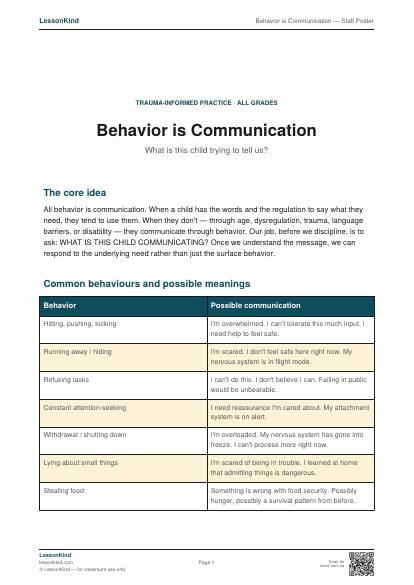
Behavior is Communication — Staff Poster
A staff-room poster reframing common 'difficult' behaviours as communications. The shift in lens is often the most powerful intervention there is.
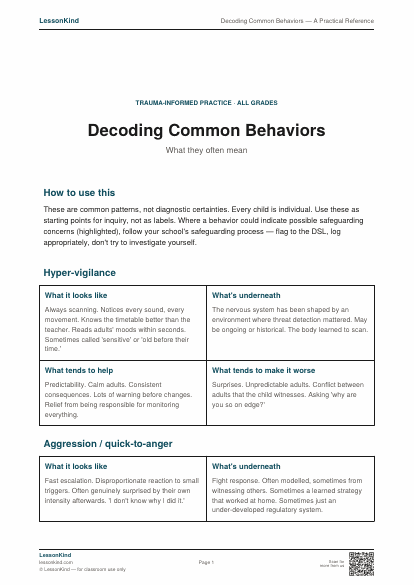
Decoding Common Behaviors — A Practical Reference
A deeper reference for the behaviors most often seen in children with trauma backgrounds — what they often mean, what's often happening underneath, and what tends to help.
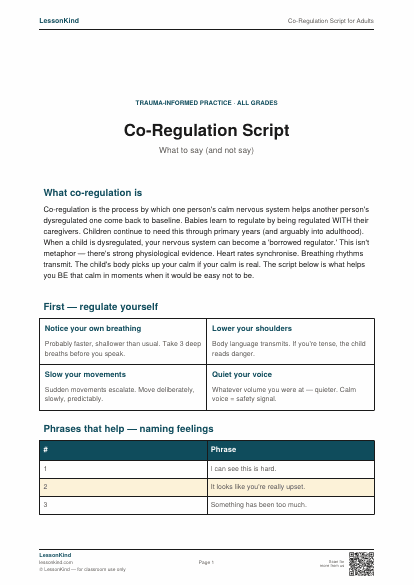
Co-Regulation Script for Adults
What to actually say (and not say) when a child is dysregulated. Phrase by phrase, based on the principles of co-regulation. Useful for the staff briefing.
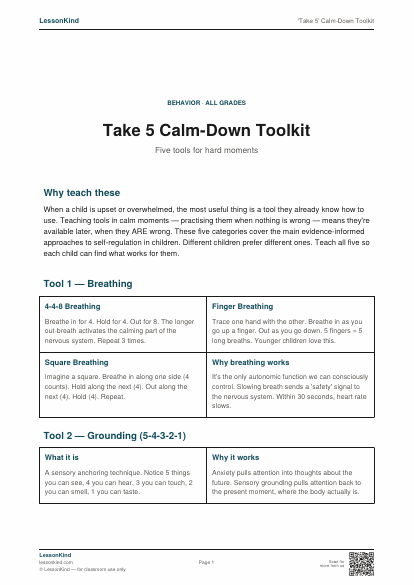
'Take 5' Calm-Down Toolkit
Five evidence-informed calming techniques children can use independently — breathing, grounding, movement, sensory, and cognitive. With age-appropriate adaptations and a take-home card.
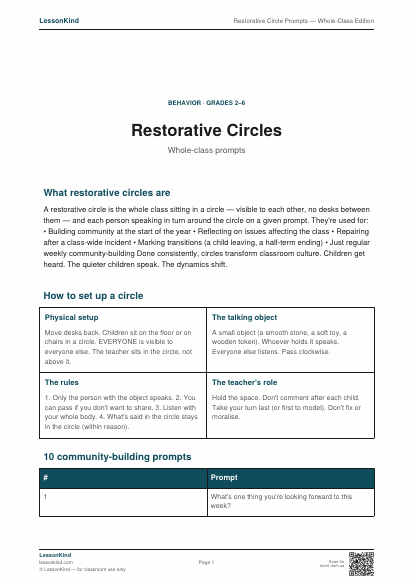
Restorative Circle Prompts — Whole-Class Edition
Whole-class restorative circle prompts for community-building and after class-wide incidents. 30 prompts across 4 categories, plus how to set up and run the circle.
Going deeper
Books on behaviour as communication
Practitioner reading on the question 'what is this child telling us?'
Foundational
Convenience links to Amazon. As an Amazon Associate we earn from qualifying purchases at no extra cost to you. Read our affiliate disclosure.
Keep reading
Behavior & classroom management
What Trauma-Informed Teaching Actually Means in Year 4
'Trauma-informed' has become a school slogan, sometimes deployed by leadership without actually changing anything. This article is about what genuinely changes when the framework is taken seriously — and what doesn't.
9 min read
Behavior & classroom management
Why Your Child Is Different at School and at Home
If your child is angelic at school and a wreck at home (or vice versa), the explanation isn't about parenting failure or spoiled behaviour. It's about a phenomenon called 'after-school restraint collapse,' and once you understand it, almost everything makes more sense.
7 min read
Behavior & classroom management
Anxiety in Primary Children: What's Normal and What's Not
Most primary-aged children worry. Some of them worry in ways that affect their lives. The line between these is the most consequential thing for parents to get right — and the most often blurred by anxiety culture going in both directions.
9 min read
Behavior & classroom management
What 'Restorative Practice' Actually Means in Year 3
Restorative practice is the trendy approach in primary behavior. It works brilliantly when implemented well and disastrously when implemented as a cover for inaction. Here's what it actually is, what it isn't, and how to get it right.
9 min read