First-year teaching · 6 min read
Your First Challenging Class: What Actually Helps
The practical strategies that work — and the ones that feel good but don't
Published 2026-05-24
There is a class in almost every teacher's career that they look back on as the hardest thing they've done professionally. High-need children, difficult group dynamics, or a class that arrived with an established culture of disruption from the previous year.
Here is what experienced teachers report actually helps — not what sounds good in a PSHE meeting.
Do not attempt to replicate the last teacher's approach
Even if the previous teacher's approach was excellent, it was theirs. The relationship was theirs. Children who are used to a specific adult's rhythms, humour, and expectations will not respond to a replica of those qualities in a different person. Start from who you are, not from who they used to have.
The first two weeks are a different job
For a challenging class, the first two weeks are almost entirely about relationships and routines. Lesson content is secondary. The curriculum can be covered in September through July; trust cannot be rushed.
This means: over-explain every routine until it is automatic. Greet children at the door every morning. Notice and name the good things you see. Do not introduce consequences before you have built any currency.
Individual children are not the class
A difficult class dynamic often exists because several children have mutually reinforcing behaviours. Addressing the dynamic without addressing the individuals doesn't work. Identify the two or three children whose cooperation would change the class significantly — invest disproportionately in those relationships first.
The 2×10 intervention
Spend 2 minutes each day for 10 consecutive school days talking with your most challenging pupil about anything other than their behaviour or schoolwork. No agenda, no correction. Just genuine interest in them as a person. This works more reliably than any sanction system.
What doesn't help
Escalating consequences when the relationship is already poor. Consequences without relationship produce compliance in the short term and resentment in the long term. A child who feels genuinely respected and seen by their teacher will be harder to replicate with a sanction.
Comparing the class unfavourably to previous years or other classes. Children respond to identity: if they are told they are a problem class, many will fulfil that identity. If they are told they are a class that can be brilliant, some will try to be.
Referring everything upward. Sending children out, calling parents for every incident, involving senior leadership constantly — signals to the class that you cannot manage them yourself, and to the children that they have power they will test repeatedly.
Free bundle for this topic
The Starter Pack
18 free resources spanning every subject — the universal new-teacher starter.
Practical resources for this
Take this further
Printable, classroom-ready resources for the topics in this article.
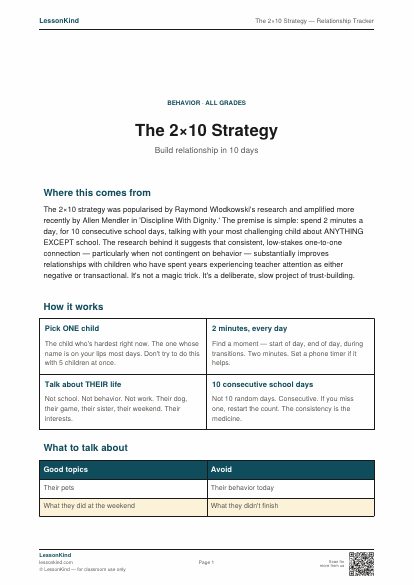
The 2×10 Strategy — Relationship Tracker
An evidence-informed approach to building relationship with the most challenging child in your class — 2 minutes a day, 10 days, talking only about non-school topics. With a tracking sheet.

Praise Script Bank — 50 Specific Phrases
50 specific praise phrases you can use in the classroom — focused on effort, strategy, and behavior, not ability. Built around the research on what kinds of praise actually motivate children.
Going deeper
Books on behaviour and class management
Books we'd recommend on the topics raised in this article.
For teachers
Convenience links to Amazon. As an Amazon Associate we earn from qualifying purchases at no extra cost to you. Read our affiliate disclosure.
Keep reading
Classroom culture
Building Classroom Community: Practical Strategies That Actually Work
The quality of relationships in your classroom determines how much learning is possible. Here are the specific, practical strategies that build genuine community — not just a pleasant atmosphere.
6 min read
Teacher wellbeing
When a Child Gets Under Your Skin
Almost every teacher has a child they find genuinely difficult to warm to. Acknowledging this is not a failure — it's the beginning of doing something about it.
6 min read
Teacher wellbeing
When a Child Gets Under Your Skin
Almost every teacher has a child they find genuinely difficult to warm to. Acknowledging this is not a failure — it's the beginning of doing something about it.
6 min read