EAL & inclusion · 6 min read
ADHD in Primary Classrooms (What Actually Helps)
Beyond 'sit still' — practical strategies that work for children with ADHD
Published 2026-10-23
The standard advice for teaching children with ADHD is usually delivered in a tone of mild bewilderment: "Try seating them at the front. Give them frequent breaks. Be patient." All true, all wildly insufficient for the actual day-to-day reality of having an ADHD child in a class of 30.
ADHD isn't a deficit of attention. It's a *dysregulation* of attention — children with ADHD can hyperfocus for hours on something they're interested in but cannot summon focus for things they're not. Understanding this changes how you teach them.
Why "concentrate harder" doesn't work
Telling a child with ADHD to concentrate harder is like telling someone with shortsightedness to look harder. The mechanism isn't broken in a way that effort fixes.
ADHD brains have low resting levels of dopamine — the neurotransmitter associated with motivation and reward. Their brains are *seeking* dopamine, which is why ADHD children chase novelty, stimulation, and immediate gratification. When something is boring, their brains literally aren't producing the chemical that makes "boring but necessary" feel manageable.
This is why the strategies that work for ADHD aren't really about willpower. They're about restructuring the environment so the brain *can* focus.
What actually helps in the classroom
**1. Make tasks shorter and more visible.**
A child with ADHD who is told "do these 20 maths questions" sees an overwhelming wall of work. Their brain shuts down before starting.
Instead: "Do these 5. Then come and show me. Then I'll give you the next 5." The same total work, broken into achievable chunks with check-ins. Each completed chunk gives a tiny dopamine hit, which fuels the next.
**2. Build in movement.**
Most schools' default for "challenging" children is to *reduce* physical movement (no playtime, sit alone, stand still). For ADHD children, this is exactly backwards. Movement helps them focus.
Practical: standing desks, fidget cushions, brain breaks every 15 minutes, errands ("could you take this to the office for me?"), permission to stand at the back of the carpet. Children burn off the agitation through movement, then can sit and listen.
**3. Use external structure.**
ADHD brains struggle to internalise routines. They need external scaffolding: visible timetables, written instructions on the board, specific desks for specific subjects, end-of-day pack-up checklists.
What feels like "babying" the child is actually compensating for an executive-function deficit. Take the structure away and they unravel.
**4. Notice the good days.**
ADHD children get told off a *lot* — research suggests they receive significantly more negative feedback per day than neurotypical peers, just because they're noticed misbehaving more often. Over time, this is corrosive: they internalise that they're "the bad kid".
Counteract this aggressively. When they're focused, sitting nicely, working — name it. "You've been working really hard for the last 10 minutes." Not patronising — specific. Notice the small good things.
**5. Help them with transitions.**
Transitions (moving from one activity to another) are where ADHD children fall apart. They were focused on one thing, now they have to disengage and engage with something new — the executive demand is enormous.
Two-minute warnings before transitions. "We're going to finish this in two minutes, then move to maths." Visual countdowns. Predictable transition routines (always to the carpet, always in the same order). The disruption that a smooth transition prevents is far cheaper than the meltdown of an abrupt one.
What doesn't help
**Behaviour charts that publicly track the child against peers.** ADHD children miss the mark constantly. Public charts show this off and humiliate them. If you must use them, make them private (just between you and the child).
**Removal of breaks as punishment.** This is counterproductive — they need movement, and removing it makes the next session worse.
**"Just one more thing" demands.** If a child has done 4 of 5 tasks and is starting to wobble, accept the 4. Don't push. The cost of forcing the 5th is often a meltdown that derails the rest of the day.
**Comparison with siblings or peers.** "Your sister managed this fine." This adds shame to a brain that already feels deficient. Not motivating; deeply demotivating.
The conversation with parents
Parents of ADHD children are exhausted. They've often been told for years that they're "just bad parents" by teachers, family, and strangers in supermarkets. When you talk to them:
- Lead with what you've noticed working ("She really focuses when she has the squishy cushion.") - Avoid the language of deficit ("Difficulties with focus" not "can't concentrate"). - Ask what works at home. Parents have usually figured out something — adopt those strategies in school. - Don't push for diagnosis as the only solution. Diagnosis helps some families and traumatises others. Strategies work whether or not there's a label.
The biggest mindset shift
The teachers who work best with ADHD children share a particular mindset: they don't see the child's ADHD as something the child is doing *to* them. They see it as something the child is dealing with, all day, every day, and they see themselves as part of the team helping.
That shift, more than any specific strategy, is what changes outcomes.
Free bundle for this topic
SEND Inclusion Toolkit
7 essential SEND resources covering autism, ADHD, dyslexia and emotional regulation.
Practical resources for this
Take this further
Printable, classroom-ready resources for the topics in this article.
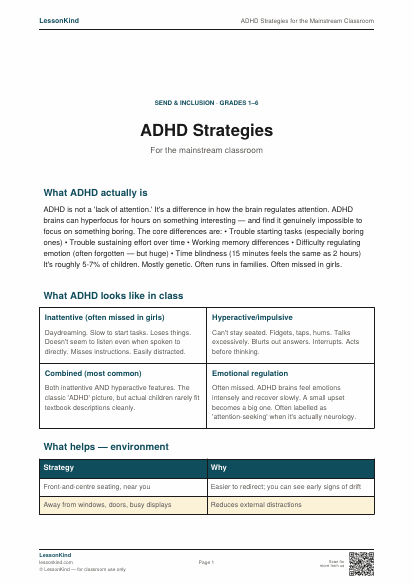
ADHD Strategies for the Mainstream Classroom
What ADHD actually looks like in primary school (it's not 'lack of focus'), and the practical strategies that consistently help in mainstream classrooms.
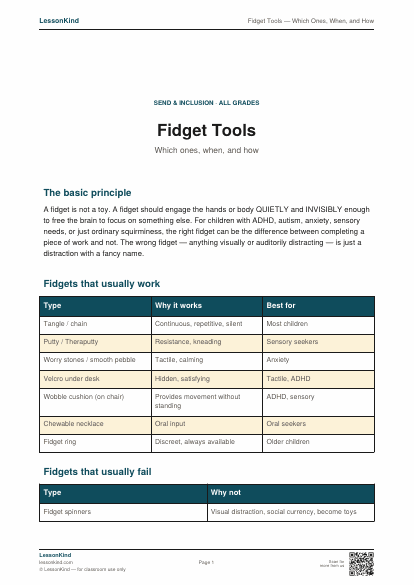
Fidget Tools — Which Ones, When, and How
Fidget tools: which ones genuinely help, which become distractions, how to introduce them, and how to handle 'I want one too'.
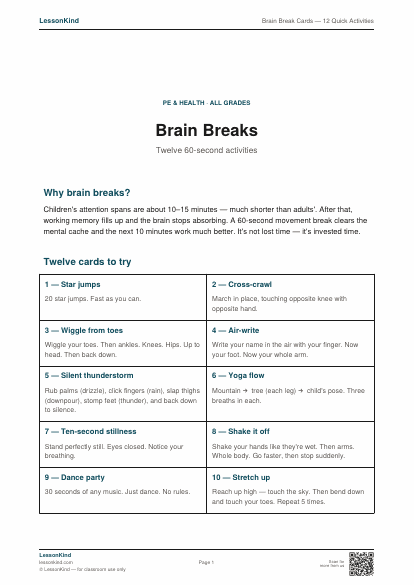
Brain Break Cards — 12 Quick Activities
Twelve 60-second movement breaks for the classroom — perfect for resetting attention mid-lesson.
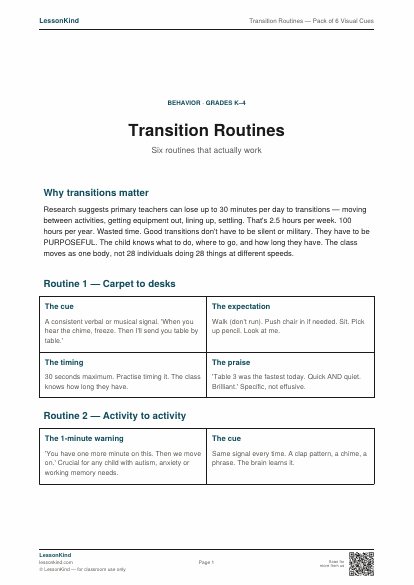
Transition Routines — Pack of 6 Visual Cues
Six classroom transition routines that genuinely work — from carpet to desks, between activities, lining up, end of day. Visual cues, scripts and timing.
Going deeper
Books on teaching children with ADHD
Books we'd recommend on the topics raised in this article.
Practitioner
Lived experience
Convenience links to Amazon. As an Amazon Associate we earn from qualifying purchases at no extra cost to you. Read our affiliate disclosure.
Keep reading
EAL & inclusion
ADHD Isn't a Lack of Attention — and Why That Matters
The label is the worst part of the diagnosis. ADHD is not 'attention deficit' — it's an attention regulation difference, and that distinction changes almost everything about how schools should respond.
8 min read
EAL & inclusion
Understanding the Autism Spectrum in Primary School
Most teachers will have at least one autistic child in their class. Most teacher training spends maybe an hour on autism. This article fills in the gap: what the spectrum actually looks like, what helps, and the things teachers commonly get wrong.
9 min read
Behavior & classroom management
When a Child's Behaviour Is Communication
Most adult responses to children's behaviour assume the behaviour IS the message. The trauma-informed reframe is simpler and more demanding: the behaviour is a SIGNAL of something underneath. The shift in response that follows is enormous.
8 min read