EAL & inclusion · 9 min read
Understanding the Autism Spectrum in Primary School
Beyond the stereotypes — what teachers actually need to know about autistic children in mainstream classrooms
Published 2026-08-25
Roughly 1 in 100 children meet the diagnostic criteria for autism, with current estimates trending higher (some studies put it closer to 1 in 30). In a primary school of 200, that's at least 2 children — and probably more, given that diagnosis rates lag actual prevalence, especially in girls. Most class teachers will have an autistic child in their class most years.
And yet, most teacher training programmes give about an hour to autism. The result is teachers who care deeply about doing right by these children but who carry a patchwork of half-true ideas, often picked up from a single training session or a colleague's strong opinions.
This article tries to fill that gap. It's not a clinical primer — for that, see the National Autistic Society or Autism Education Trust. It's the practical, classroom-level understanding most teachers I know wish they'd had earlier.
What the spectrum actually means
The phrase "autism spectrum" has been so widely used that it's lost meaning. People often imagine a line running from "barely autistic" to "very autistic" — with high-functioning autistic children at one end and non-speaking, profoundly disabled children at the other.
This is not what the spectrum is. A more accurate metaphor is a 360° wheel of traits, with each autistic person sitting at different points on different traits. One autistic child might be highly verbal, struggle massively with sensory overload, and have no real difficulty with social communication. Another might speak only single words, love sensory input, and find social rules extremely hard. Both are autistic. Neither is "more" or "less" autistic than the other.
The diagnostic criteria (in DSM-5, broadly mirrored in ICD-11) cluster autism around two domains:
1. Persistent differences in social communication and social interaction 2. Restricted, repetitive patterns of behaviour, interests, or activities — including sensory differences
Both must be present, in some form, for a diagnosis. But the way they show up varies enormously.
Common features in primary-aged autistic children
Some patterns are common enough that knowing them helps you recognise them. None are universal — autistic children differ as much from each other as non-autistic children do.
**Communication differences.** May take language very literally (the child who panics when a teacher says "I'll have your guts for garters" — they aren't joking, but the child can't tell). May not naturally use small talk or "filler" social language. May have rich, formal vocabulary but struggle with implied meaning. May echo back what was said (echolalia), particularly when stressed.
**Social interaction differences.** May find unstructured social situations (break, lunch, group work) much harder than structured ones. May not pick up on social cues other children take for granted. May have one or two close friends but not a peer group. May struggle with reading other people's emotions — including when their own behaviour is upsetting another child.
**Repetition and routine.** May get very upset when routines change. May line things up, organise things in particular ways, do the same activity for hours. May have intense special interests — dinosaurs, trains, a particular video game — that they can talk about with extraordinary depth.
**Sensory differences.** May find some sensations overwhelming (fluorescent lights humming, the sound of chairs scraping, certain food textures). May SEEK certain sensations (chewing things, spinning, deep pressure). May be hot or cold without noticing. May struggle with school uniform tags, certain fabrics, or specific smells.
**Emotional intensity.** May feel emotions very strongly. May have meltdowns when overwhelmed (different from tantrums — see the meltdown vs tantrum distinction in the SEND resources). May recover from upset more slowly than peers.
Girls and autism — the missed group
For decades, autism was thought to be largely a "boys' thing." This is now known to be wrong. The current best estimate is that autism in girls has been dramatically underdiagnosed, with the actual ratio probably closer to 2:1 male:female than the historic 4:1 figure.
Why are girls missed? Because their autism often presents differently:
- Girls are more likely to "mask" — consciously copying social behaviour from peers, hiding their natural responses, performing neurotypicality - Girls' special interests are more likely to be socially acceptable (horses, fashion, a particular band) rather than the stereotyped trains/dinosaurs - Girls' social difficulties may show as anxiety, perfectionism, and selective mutism rather than obvious social awkwardness - Girls' meltdowns may be quieter — withdrawing, refusing school, becoming very upset at home about things that happened at school
The cost of missing autistic girls is high. They often reach adolescence exhausted from years of masking, with mental health difficulties (anxiety, depression, eating disorders are all over-represented), and only then get diagnosed — sometimes in their twenties or thirties.
If you suspect a girl in your class might be autistic, even if she doesn't fit the stereotype, please mention it to the SENDCo. Early identification helps.
What helps autistic children in mainstream classes
The strategies are surprisingly consistent across the spectrum.
**Predictability.** A visual timetable. Same routines. Warning before transitions. Don't change things without notice. The world is more sensory and socially confusing for them; making it predictable is a relief, not a constraint.
**Clear, literal communication.** Say what you mean. Avoid sarcasm, idioms, vague instructions ("we'll start in a minute" — when?). One instruction at a time.
**Sensory accommodation.** Reduce noise where possible. Allow ear defenders. A quiet space available. Don't insist they wear scratchy uniforms if it can be avoided. Don't force eye contact (it actually impairs many autistic people's listening).
**Process time.** Autistic brains often process information differently — sometimes faster, sometimes slower. Wait at least 10 seconds after asking a question. Don't fill the silence. Their answer is coming.
**Use special interests.** A child obsessed with dinosaurs will engage with reading, writing, math, art if it's framed around dinosaurs. This isn't pandering — it's smart teaching. Their interest is fuel.
**Plan unstructured time.** Break, lunch, transitions, free choice — these are often the hardest moments. A specific role at break, a buddy who'll include them, a quiet alternative if they're overwhelmed.
**Recognise meltdowns aren't tantrums.** A meltdown is a nervous system response to overwhelm. It is not goal-directed behaviour. It cannot be punished out of existence. The right response is to reduce input, lower your voice, give space, and wait.
What teachers commonly get wrong
A few common mistakes that even well-intentioned teachers make.
**Assuming autism = low cognitive ability.** Many autistic children are highly intelligent. The presentation can mislead. A child who isn't making eye contact and isn't joining in groupwork may be operating at a higher intellectual level than half the class. Don't lower expectations based on social presentation.
**Forcing eye contact.** Generations of teachers have insisted "look at me when I'm talking to you." For autistic children, this is actively counterproductive. Eye contact is socially demanding and uses cognitive resources that should be going to listening. They CAN listen without looking at you. Insisting on eye contact gets you compliance, not comprehension.
**Treating meltdowns as bad behaviour.** A meltdown looks like behaviour, but it's a sensory or emotional overload response. Punishing it is like punishing a fever. The child can no more help it than you could help yours.
**Trying to make them more neurotypical.** A lot of older autism education focused on "normalising" autistic behaviour — eye contact, social scripts, suppression of stimming. Modern thinking (and increasingly, autistic adults' own testimony) suggests this approach trains masking, which is exhausting and contributes to mental health problems. Better to teach skills the child needs to navigate the world AND let them be themselves.
**Public attention, even positive.** "Look at Sam, he's done such a good job!" might delight a neurotypical child. For an autistic child, public spotlight — even praise — can be intensely uncomfortable. Quiet, private praise is usually better.
The role of language
How we talk about autism matters. Some quick guidance.
**Identity-first language ("autistic child") is preferred by most autistic adults** over person-first language ("child with autism"). The reasoning: autism is not a disease the child has, it's part of who they are. That said, families differ. Ask. Use what the family prefers.
**"On the spectrum"** has become so vague it's almost lost meaning. Either say "autistic" or be more specific.
**"Autism spectrum disorder" (ASD)** is the formal medical term but many autistic adults dislike the word "disorder," preferring "autism" or "autism spectrum condition." Schools that use ASD aren't wrong, but using "autistic" or "autism" tends to be more aligned with the autistic community.
**Avoid Asperger's** unless the family uses it. The term has fallen out of use in formal diagnosis (folded into autism spectrum disorder in DSM-5) and has historical associations many find uncomfortable.
When parents are still in the dark
You may have a child you suspect is autistic, with parents who don't recognise it or who are anxious about labelling. This is delicate territory.
A few principles:
- It is not the class teacher's job to diagnose. Don't say "I think Sam is autistic." Say "I've noticed some things I'd like to discuss." - Lead with what you observe, neutrally. Not "Sam has autism," but "Sam finds it really difficult when the lesson plan changes — he gets very upset, and it takes him a while to recover." - Frame as wanting to support the child better, not labelling them. "I'd really like to know if there's more we could be doing." - The SENDCo can take the next step. They're trained for this. Loop them in early. - Don't push. Some families need months or years to be ready. Plant seeds, support the child anyway.
A final note
I have been a teacher for many years. The autistic children I've taught are some of the children I remember most clearly. They have been some of the most thoughtful, original, deeply-caring children I've known. They have also been some of the children who needed me to do my job with the most care.
If you're new to teaching an autistic child, my advice is simple: assume good faith. They are not being difficult on purpose. They are not being rude. They are not lazy. They are navigating a world that often doesn't quite fit them, with a brain that processes things differently from yours.
Make the world fit them a little better, where you can. Be patient when it doesn't. And trust that the work you put in will matter — sometimes in ways you'll never see.
Free bundle for this topic
SEND Inclusion Toolkit
7 essential SEND resources covering autism, ADHD, dyslexia and emotional regulation.
Practical resources for this
Take this further
Printable, classroom-ready resources for the topics in this article.
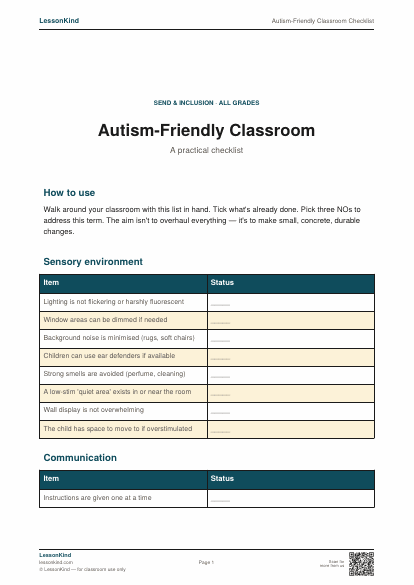
Autism-Friendly Classroom Checklist
A practical audit of the things that make a classroom genuinely welcoming for autistic children — sensory, communication, predictability, social.
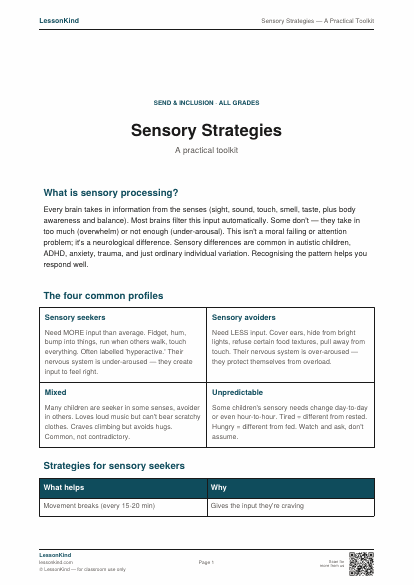
Sensory Strategies — A Practical Toolkit
Practical sensory strategies for the four common patterns — sensory seekers, sensory avoiders, mixed and unpredictable. With low-cost classroom kit ideas.
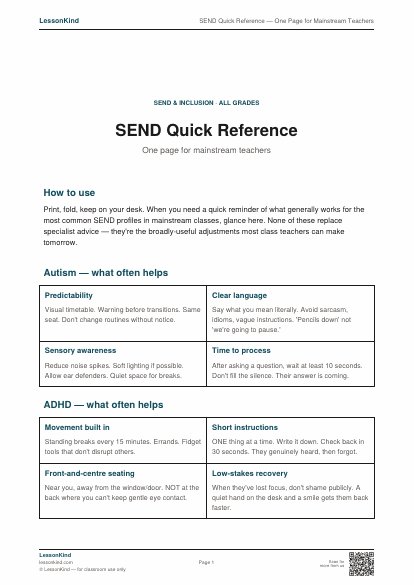
SEND Quick Reference — One Page for Mainstream Teachers
A one-page reference summarising the most useful adjustments for the four most common SEND profiles — autism, ADHD, dyslexia, anxiety. Print and stick on your desk.
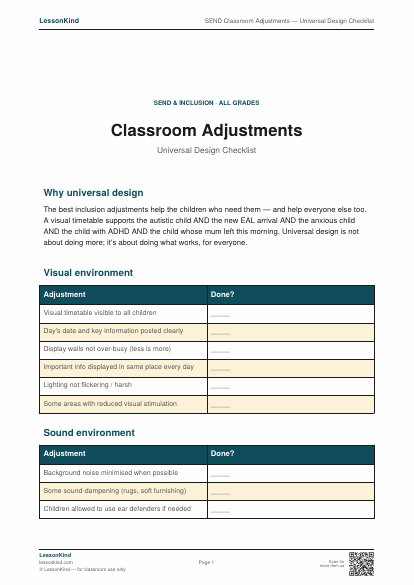
SEND Classroom Adjustments — Universal Design Checklist
A walk-through audit of adjustments that benefit children with SEND but help everyone else too. Audit your classroom in 15 minutes.
Going deeper
Autism — recommended reading
Practitioner books that have shaped current UK primary autism practice — from the lived experience of autistic people.
Foundational
Practitioner
Convenience links to Amazon. As an Amazon Associate we earn from qualifying purchases at no extra cost to you. Read our affiliate disclosure.
Keep reading
EAL & inclusion
ADHD Isn't a Lack of Attention — and Why That Matters
The label is the worst part of the diagnosis. ADHD is not 'attention deficit' — it's an attention regulation difference, and that distinction changes almost everything about how schools should respond.
8 min read
Behavior & classroom management
What Trauma-Informed Teaching Actually Means in Year 4
'Trauma-informed' has become a school slogan, sometimes deployed by leadership without actually changing anything. This article is about what genuinely changes when the framework is taken seriously — and what doesn't.
9 min read
Behavior & classroom management
Anxiety in Primary Children: What's Normal and What's Not
Most primary-aged children worry. Some of them worry in ways that affect their lives. The line between these is the most consequential thing for parents to get right — and the most often blurred by anxiety culture going in both directions.
9 min read
EAL & inclusion
How SENDCos Actually Run Their Cases
SENDCo is one of the most demanding roles in primary, done by people on a fraction of a day's release. This is what the role actually looks like from the inside — the cycles, the decisions, the difficult conversations, and the rhythms that separate the SENDCos who burn out from the ones who last.
9 min read