Math · 9 min read
Teaching primary maths the mastery way: a practical guide
What 'mastery' actually means, what works, and the things that quietly go wrong.
Published 2026-12-10
'Mastery' is now the dominant approach in UK primary maths, spreading internationally through Common Core in the US, the Australian Curriculum, and similar reforms elsewhere. The term gets used a lot, often without clear meaning. So it's worth being precise about what it is, what good practice looks like in the classroom, and where the common implementation mistakes happen.
This article won't tell you which scheme to use. There are several mastery-aligned schemes available — your school will have chosen one, or be choosing between several. The choice matters less than what teachers actually DO with it. The same scheme can produce excellent teaching in one classroom and weak teaching in another. So instead of comparing brands, this piece is about the underlying practice.
What mastery actually means
Mastery in primary maths comes from East Asian teaching traditions — particularly Singapore and Shanghai — adapted for Western primary contexts. The core idea is that all children should reach a deep understanding of each topic before moving on. Not just procedural fluency. Not just getting answers right on a worksheet. Real conceptual understanding, with multiple representations.
In practice, mastery teaching has several recognisable features:
**Concrete-pictorial-abstract progression (CPA).** Children meet a new idea first with physical objects (counters, base-ten blocks, fraction bars). Then they see pictures or diagrams representing the same idea (bar models, arrays, number lines). Only then do they work with abstract numerical symbols. The CPA progression isn't optional — abstract symbols only mean something to children who have built understanding through concrete and pictorial work first.
**Small-step progression within topics.** Each topic is broken into small, sequential steps. Place value isn't taught in one lesson — it might span twelve small steps over several weeks. Each step builds carefully on the last. Skipping steps creates gaps that show up later as 'they just don't get fractions' or 'they can't do reasoning.'
**Same task, varied access.** Rather than three differentiated worksheets at three levels, children typically work on the same task with appropriate scaffolding. Strugglers get more concrete materials, more adult support, smaller numbers in the same problem structure. Stronger children get the same task with deeper questions, harder examples, more open extensions. The unifying task lets all children participate in the same mathematical conversation.
**Variation theory.** Within practice questions, surface features change but the underlying structure stays the same — or vice versa. A page of questions on column addition might vary the digit positions while keeping the carrying pattern constant. The point is to make children attend to the structure, not just pattern-match to surface features.
**Fluency, then reasoning, then problem solving.** Each lesson typically moves through these three phases. Fluency builds the procedural foundation. Reasoning asks children to explain, justify or compare. Problem solving applies the skills to non-routine contexts. Many schemes use this three-phase structure explicitly; many primary teachers use it implicitly.
**Bar models as a consistent representation.** Bar models — rectangles drawn to represent quantities — are used across most mastery teaching as a visual scaffold for word problems. A child who has met bar models in Year 2 will keep encountering them every year. By Year 6 they've developed bar-model thinking that applies to ratio, percentages, fractions and algebra.
What good practice looks like
If you walked into a classroom doing mastery well, here's what you'd see.
**A teacher pausing for genuine thinking time.** When a question is asked, the teacher waits. Five seconds. Ten if needed. They don't rescue children with hints in the first three seconds. The silence feels uncomfortable; it's where the thinking happens. Teachers new to mastery often find this the hardest single change to make.
**Concrete materials available, not just on display.** A maths lesson with base-ten blocks unused in a tray on the side isn't mastery — it's mastery scenery. Children should be reaching for the manipulatives whenever they help, including older children who don't 'need' them but are working with new concepts.
**Children explaining their thinking, not just giving answers.** 'Tell me how you worked that out.' 'Could you show that with the counters?' 'Is there another way to see this?' The explanation is part of the learning — it forces children to articulate their understanding, which exposes any gaps.
**Mistakes treated as useful, not as failure.** A child who says '3/8 is bigger than 1/2 because 8 is bigger' has not failed. They've just shown a misconception that the whole class can learn from. The good mastery teacher pauses, says 'that's interesting, lots of people think that — let's see what happens with the bar model,' and turns the mistake into the lesson.
**Bar models drawn during problem solving.** Not every problem, but when a word problem appears, you'd often see children drawing bar models almost automatically before reaching for calculation. By upper KS2, this should be habitual.
**Daily retrieval practice from earlier topics.** A short starter — three to five questions — that pulls from previous units, not just the current one. This isn't usually built into the scheme; it's added by good teachers because the cognitive science shows it's necessary.
Where mastery teaching goes wrong
Implementing mastery is hard. Several common failure modes show up in classrooms across the country.
**Pace is too fast.** This is the most common single problem. The scheme of learning typically allocates one lesson per small step. For a strong class with secure prerequisites, this works. For a class with mixed ability or significant SEND, it's often unrealistic. Teachers find themselves moving on before children have consolidated, because the calendar says it's time. The scheme will tell you it's fine to take longer where needed; school planning culture often makes that hard to defend.
**'We use mastery' becomes the answer.** Schools sometimes adopt a mastery scheme and assume their maths teaching is now sorted. SLT is happy, planning is structured, observations look organised. But the actual quality of teaching depends on what teachers DO with the scheme — and the scheme cannot substitute for subject knowledge, careful questioning, formative assessment, or skilful pivots when children don't understand. A teacher who follows the small steps faithfully but doesn't notice when children are confused will produce a class that performs in lessons and forgets within weeks.
**Linear, not spiral, without retrieval added.** Most mastery schemes teach each topic in a block — fractions in one term, then they move on. Without deliberate retrieval practice between blocks, children's knowledge of the old block decays. This isn't a fault of the mastery model; it's a fault of implementation. Schools that don't add retrieval practice often find children regressing on topics they 'mastered' six months ago.
**No scaffolding for differentiation.** The mastery model says all children should access the same content with appropriate scaffolding. This is a fine ideal but most schemes don't tell you HOW. Teachers are left to differentiate the same task themselves, often without explicit support. Less-experienced teachers can find this overwhelming.
**Repetitive fluency questions.** Many fluency worksheets follow nearly identical patterns across small steps — twelve near-identical questions. This produces high success rates in the lesson but limited transferable understanding. Teachers usually need to supplement with more varied practice that asks the same skill in different surface forms.
**Reasoning questions pitched wrong.** The reasoning sections of published materials vary enormously in difficulty. Some are well-pitched; others assume understanding the child won't have until next year. Teachers end up cherry-picking questions and ignoring the published progression.
The single biggest factor
Across all of this, the most important factor is teacher subject knowledge.
A teacher who deeply understands the underlying mathematics — what fractions really are, why long division works, how ratio relates to proportion — can teach mastery in any scheme. They can spot misconceptions, ask probing questions, choose the right manipulative, sequence small steps even if the scheme didn't.
A teacher whose own maths is shaky may follow a scheme accurately but cannot pivot when children are confused. The scheme becomes a script. Children get answers right in the lesson and don't really learn.
This is why CPD on maths subject knowledge — not on schemes — is the highest-leverage investment a school can make. The Maths Hubs network in England, the Mastery Specialists programme, NCETM resources — these all focus on building teacher knowledge, because that's what actually moves outcomes.
What good practice with mastery looks like, step by step
If you're new to mastery teaching, or just want to do it better, here's what to focus on:
**Build retrieval practice into every lesson.** Five mixed questions every day at the start. Include this term's topic, last term's, and one from earlier in the year. This is the single highest-leverage habit you can build.
**Slow down deliberately when children need it.** A small step that's marked for one lesson sometimes takes three. Make this call based on your assessment of the children, not the planning calendar.
**Vary your fluency questions.** Beyond the worksheet's near-identical questions, give children questions that require the same skill applied differently — missing-number versions, word-problem versions, 'is this correct?' versions. Same skill, varied surface features, deeper learning.
**Teach bar models explicitly.** Don't just slip them into worksheets. Direct teaching of when and how to draw a bar model is its own skill. Children need to internalise: when I see a problem like this, I draw it like that.
**Do your own retention checks.** Don't rely on end-of-block assessments. A child who scores well in March on fractions and can't do them in November hasn't really learned them. Quick mid-year checks reveal whether knowledge is sticking.
**Read carefully and adapt.** Not every published small step is right for your class. Some are unnecessary; some skip prerequisites. The scheme is a starting point, not a script.
The takeaway
Mastery is a strong approach to teaching primary maths. The pedagogy is well-evidenced, the underlying principles are sound, and the practical structures — small steps, CPA, bar models, fluency-reasoning-problem-solving — work when used well.
But mastery isn't a scheme you adopt and tick off. It's a way of thinking about teaching that requires teacher subject knowledge, deliberate retrieval practice, careful pacing, and willingness to pivot when children are confused. The best mastery classrooms aren't the ones following the scheme most faithfully — they're the ones where the teacher genuinely understands the maths, watches the children carefully, and adjusts in the moment.
That's the harder, slower work. It's also the work that actually changes children's understanding. The scheme is the scaffold. The teaching is what builds the maths.
Free bundle for this topic
KS2 Maths Pack
10 favourite maths resources — times tables, fact families, mental maths, fractions.
Practical resources for this
Take this further
Printable, classroom-ready resources for the topics in this article.
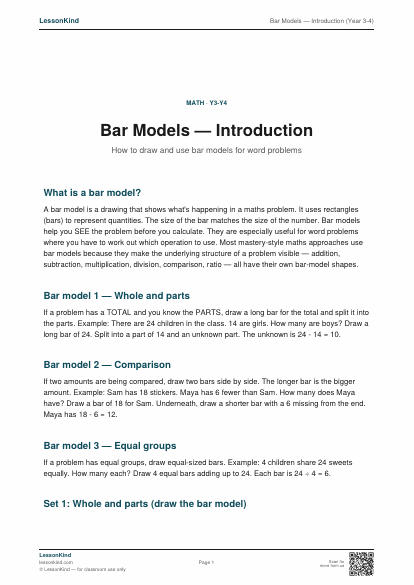
Bar Models — Introduction (Year 3-4)
A clear introduction to bar models for KS2 children. Concrete-pictorial-abstract approach, with worked examples and 24 practice problems.
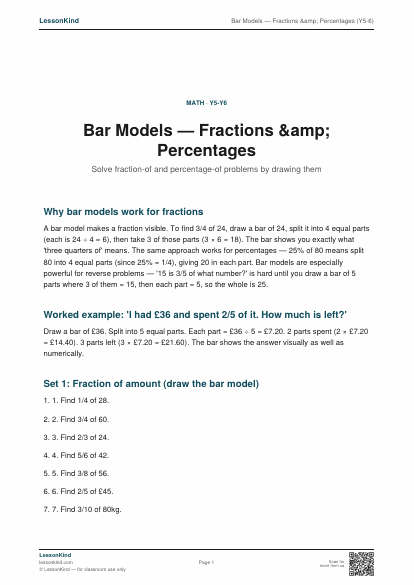
Bar Models — Fractions & Percentages (Y5-6)
Use bar models to solve fraction-of-amount and percentage-of-amount problems. The most reliable method for SATs reasoning questions involving fractions and percentages of quantities.
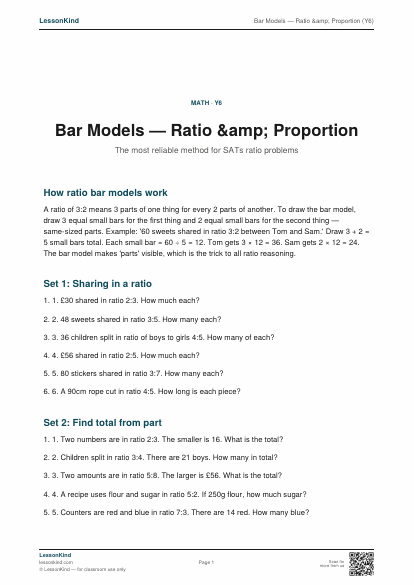
Bar Models — Ratio & Proportion (Y6)
Year 6 ratio and proportion problems solved using bar models. Includes part-to-part ratios, sharing problems, and SATs-style reasoning questions.
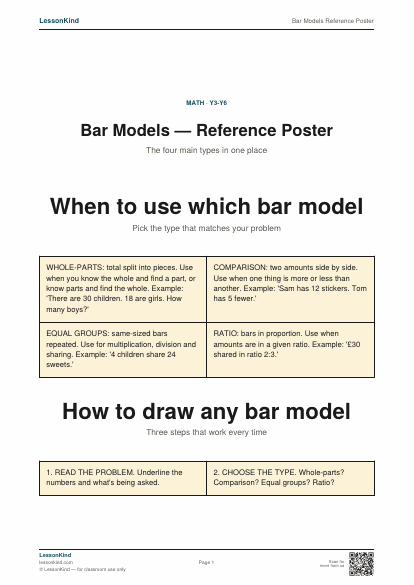
Bar Models Reference Poster
Single classroom poster showing the four main bar-model types: whole-parts, comparison, equal groups, ratio. Display reference for KS2 maths classrooms.
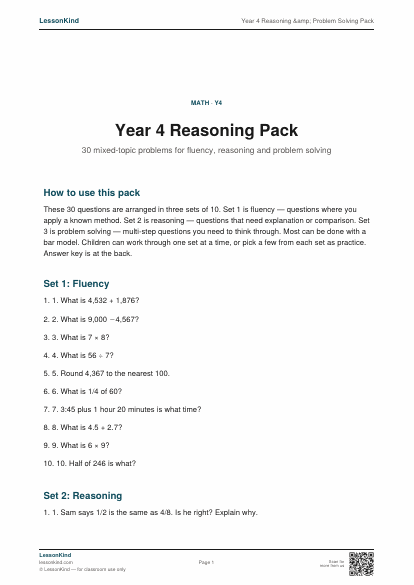
Year 4 Reasoning & Problem Solving Pack
30 mixed reasoning questions for Year 4, covering place value, four operations, fractions, time, and measure. Three difficulty stages — fluency to deeper reasoning.
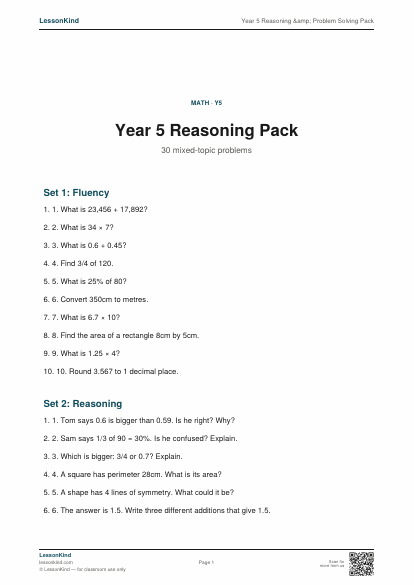
Year 5 Reasoning & Problem Solving Pack
30 mixed reasoning questions for Year 5 — covering decimals, fractions, percentages, area/perimeter, multiplication, time. Three difficulty stages from fluency to deeper reasoning.
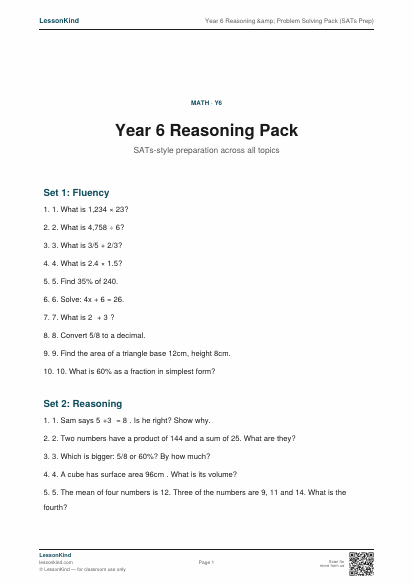
Year 6 Reasoning & Problem Solving Pack (SATs Prep)
30 SATs-style reasoning questions for Year 6 — algebra, ratio, percentages, decimals, geometry, multi-step problems. Designed as preparation for the SATs Reasoning papers.
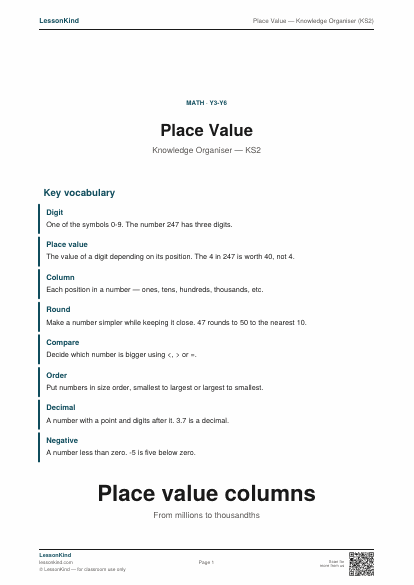
Place Value — Knowledge Organiser (KS2)
One-page reference for all KS2 place value: digits, columns, rounding, comparing, ordering, and decimals. Aligns with Autumn Block 1 in most primary maths schemes.
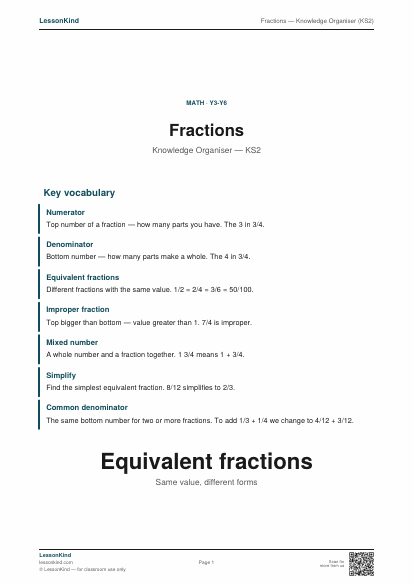
Fractions — Knowledge Organiser (KS2)
One-page reference for all KS2 fractions: equivalent fractions, comparing, ordering, adding/subtracting, multiplying, fractions of amounts, mixed numbers and improper fractions.
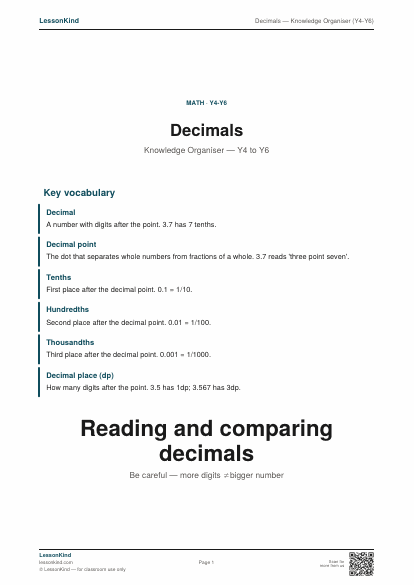
Decimals — Knowledge Organiser (Y4-Y6)
One-page reference for KS2 decimals: place value, comparing and ordering, rounding, four operations with decimals, converting fractions to decimals.
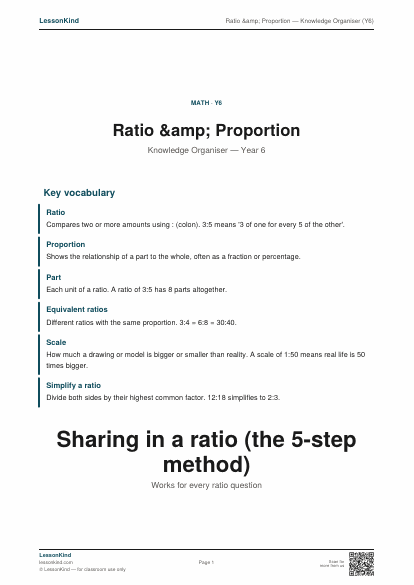
Ratio & Proportion — Knowledge Organiser (Y6)
One-page reference for Year 6 ratio and proportion — sharing in a ratio, finding amounts from ratios, scaling, percentage as proportion. Aligned with the Year 6 ratio block in mastery schemes.
Going deeper
Books on teaching maths well
If you're teaching with a mastery approach, these books will sharpen your subject knowledge and pedagogy.
On teaching primary maths
On bar models and the Singapore approach
On the cognitive science of practice
Convenience links to Amazon. As an Amazon Associate we earn from qualifying purchases at no extra cost to you. Read our affiliate disclosure.
Keep reading
Math
Why kids hate maths (and what actually changes their mind)
When children say 'I hate maths,' they're rarely talking about numbers. They're talking about a feeling — confusion, embarrassment, the sense of being slow. The good news: that feeling is fixable, and the fix isn't more rote practice.
7 min read
Math
How to teach times tables that actually stick
Times tables are the foundation of every other maths skill, but the way most schools teach them — Friday tests, marathon practice sessions — is what cognitive science would tell you NOT to do. Here's what works.
8 min read
Math
The trouble with maths 'tricks'
Every staffroom has its favourite maths tricks — KFC for fractions, BIDMAS, the butterfly method. They feel like they're helping. They aren't, mostly. Here's why, and what to do instead.
6 min read
Math
Why kids 'forget' maths overnight (and what's actually happening)
If you've ever taught something on Monday and found half the class can't do it on Tuesday, you're not alone. The 'forgetting curve' isn't really forgetting — it's the gap between performance and learning. Here's the difference, and why it matters.
7 min read