Behavior & classroom management · 6 min read
The Child Who Disrupts Everything
Why a single dysregulated child can derail a class, and what actually helps
Published 2026-11-16
Every teacher who's been in the profession a few years can name them: the child who, on a bad day, can derail an entire lesson. Tom in Year 4. Eden in Year 2. Jamie in Year 6. Their disruption isn't continuous — they have good days, sometimes good weeks. But on the bad days, they consume the teacher's attention, exhaust everyone, and pull the rest of the class into chaos.
The standard advice for these children — be consistent, have clear consequences, build relationships — is correct but insufficient. Anyone who's actually taught one of these children knows the standard playbook only works partially. Here's what actually helps.
What's going on under the surface
Children who disrupt persistently almost always have a reason. The reasons cluster:
**1. Undiagnosed neurodevelopmental conditions.** ADHD, autism, sensory processing difficulties. These children aren't choosing to disrupt — their brains are responding to demands they can't easily meet.
**2. Trauma or attachment difficulties.** Children who've experienced significant adversity often present with disruptive behaviour because their nervous systems are dysregulated. The behaviour is communication: "I don't feel safe."
**3. Unmet sensory or physical needs.** Hunger, tiredness, undiagnosed eye or ear problems, constipation (genuinely — affects more children than people realise). The child can't articulate why they're irritable but they are.
**4. Social rejection or bullying.** A child who's being excluded by peers may "act out" rather than report. The disruption is sometimes a way of getting noticed, even negatively.
**5. Genuine boredom — work too easy.** Some disruptive children are bright and chronically under-challenged. Their behaviour is a response to mental restlessness.
**6. Trauma from school itself.** Children who've had bad experiences with previous teachers — public humiliation, harsh discipline, repeated failure — sometimes disrupt because school feels unsafe.
The reasons matter because the response should match. A child with ADHD needs different support than a child with attachment difficulties, who needs different support than a bored gifted child.
What "consequences" miss
The standard behavioural model — clear rule, clear consequence — works well for the 90% of children whose behaviour responds to it. For the 10% who don't, escalating consequences just makes the relationship worse.
A child whose ADHD is causing impulsivity isn't going to stop being impulsive because they got a yellow card. The yellow card might add to their sense of failure and trigger more dysregulation. The system designed to teach them is teaching them they're bad at school.
This is why some classes have one child who's been on report for three years. The reports aren't working. The system doesn't know what else to try.
What actually helps
**1. Assume need first, defiance second.**
The instinctive frame for disruptive behaviour is "they're choosing to misbehave". Try the opposite: "they're struggling with something". Almost every disruptive behaviour episode looks different through this lens.
A child who throws a pencil and shouts isn't being cheeky. They're dysregulated. The intervention question changes from "what consequence do I give?" to "what need isn't being met?"
**2. Find the function of the behaviour.**
Behaviour analysts use a concept called "function" — what does the disruption achieve for the child?
- Attention seeking → child gets more attention from disrupting - Escape → child gets removed from a task they don't want to do - Sensory → child needs movement, the disruption provides it - Tangible → child gets access to something (e.g. the iPad) by disrupting
Identify the function and you can design alternatives. Attention-seeking? Build in scheduled positive attention so they don't have to disrupt to get it. Escape? Make the work more achievable. Sensory? Build in movement breaks.
**3. Build a co-regulation relationship.**
Some children genuinely cannot regulate themselves yet. They need an adult to do it for them, repeatedly, until the regulation pattern internalises.
This is hard work. It looks like staying calm when they shout, sitting next to them quietly when they're upset, naming what they're feeling when they can't, modelling slower breathing without telling them to breathe.
Co-regulation produced over months changes neural development. Children who experienced this consistently with one teacher often have observably better self-regulation by Year 5 or 6.
**4. Reduce the demand temporarily, then build it back.**
If a child can't sit still for 30 minutes, don't insist they do — that just produces failure. Aim for 5 minutes of real engagement, then a movement break. Then 7. Then 10. Build the muscle.
This feels like lowering standards. It isn't. It's building capacity. The standards stay; the route to them adjusts.
**5. Catch them early — both warning signs and good moments.**
Children who disrupt usually escalate gradually. Watch for the early signs: fidgeting, distraction, inability to make eye contact. Early intervention (a quiet word, a job, a brief outside task) can head off escalation.
Equally, catch the good moments. The child who sat through 10 minutes today instead of 5. The 30-second positive interaction with a peer. The one piece of work they engaged with. Naming these moments builds the positive identity that erodes the "disruptive child" self-image.
**6. Loop in expertise early.**
If a child's behaviour is consistently disruptive, get the SENCo involved by half-term, not in the spring. Get the Educational Psychologist if the school can. Get a private assessment if the parents can.
Children whose underlying difficulties are identified can access support that genuinely helps. Children whose underlying difficulties are missed often spend years being treated as "naughty" when they're actually struggling with something the system could have addressed.
What to be honest about
**1. It's exhausting.** Working with one child like this for a full year takes a real toll on a teacher. Burnout in primary often traces back to one or two children whose needs exhaust the teacher's capacity.
**2. You can't always reach them.** Some children, despite your best efforts, don't transform under your watch. They might transform later — but not while you have them. That's not your failure. Some children's difficulties are bigger than what one teacher can solve in one year.
**3. The class suffers too.** The other 29 children in a class with a persistently disruptive peer get less of you, learn less consistently, and live with daily disruption. Their needs matter too. Sometimes a child's needs are big enough that they require provision the mainstream class can't realistically provide.
**4. You'll need help.** TA support, smaller groups, alternative provision, external specialists. If you're trying to manage a profoundly dysregulated child alone with 29 others, you've been set up to struggle. Asking for help isn't failure — it's appropriate.
The longer view
Children who were profoundly disruptive in primary often, with the right support, become functional adults. Sometimes thriving ones. The teacher who saw the child rather than the behaviour, who held the line calmly while building the relationship, who got the right help in early — that teacher made a difference that's invisible at the time and enormous later.
It is one of the hardest parts of the job. It's also, when it works, one of the most meaningful.
Free bundle for this topic
Cover Day Survival Pack
9 resources for any cover day, including behavior strategies and morning meeting scripts.
Practical resources for this
Take this further
Printable, classroom-ready resources for the topics in this article.
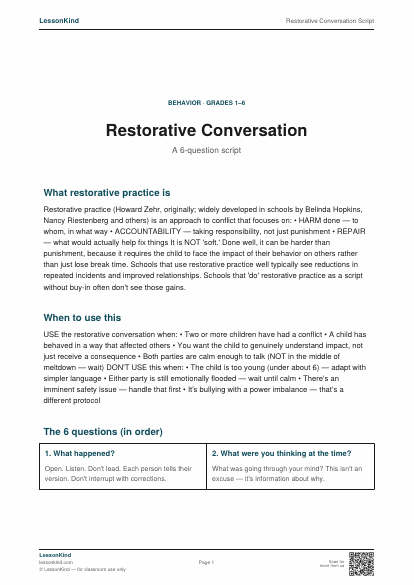
Restorative Conversation Script
A simple 6-question script for restorative conversations after a behavior incident. Follows the standard restorative practice format — focused on harm, accountability, and repair.
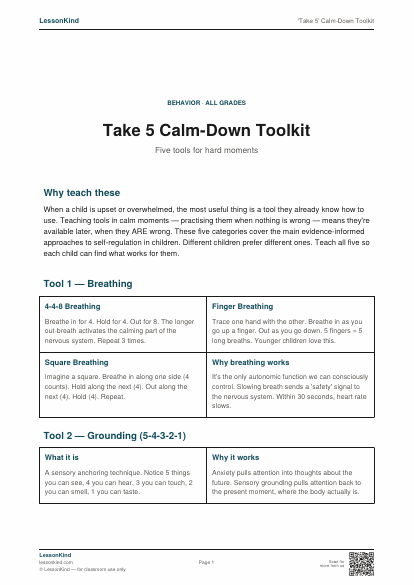
'Take 5' Calm-Down Toolkit
Five evidence-informed calming techniques children can use independently — breathing, grounding, movement, sensory, and cognitive. With age-appropriate adaptations and a take-home card.
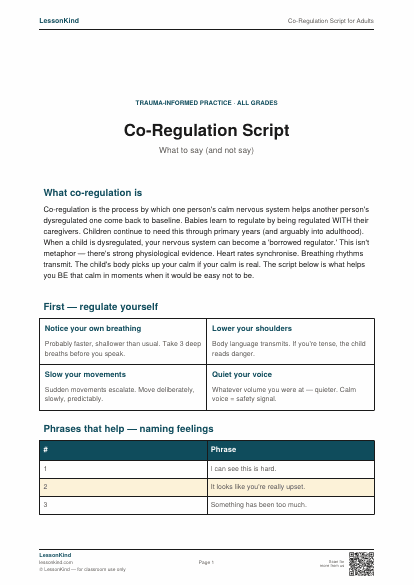
Co-Regulation Script for Adults
What to actually say (and not say) when a child is dysregulated. Phrase by phrase, based on the principles of co-regulation. Useful for the staff briefing.
Going deeper
Books on dysregulated behaviour
Books we'd recommend on the topics raised in this article.
Practitioner
Convenience links to Amazon. As an Amazon Associate we earn from qualifying purchases at no extra cost to you. Read our affiliate disclosure.
Keep reading
Behavior & classroom management
When a Child's Behaviour Is Communication
Most adult responses to children's behaviour assume the behaviour IS the message. The trauma-informed reframe is simpler and more demanding: the behaviour is a SIGNAL of something underneath. The shift in response that follows is enormous.
8 min read
EAL & inclusion
ADHD in Primary Classrooms (What Actually Helps)
ADHD is one of the most common SEND diagnoses in primary, and one of the most misunderstood. Here's what teachers can actually do to help children with ADHD thrive.
6 min read
Classroom culture
The Classroom Rules Paradox
Many classrooms have detailed rules covering every situation. The research suggests this approach actively backfires. Here's what works instead.
5 min read