First-year teaching · 6 min read
The First Week of School (and How Not to Wreck It)
What experienced teachers do differently in week one
Published 2026-11-04
The first week of school is one of the most important weeks of the year. It's also the week when most NQTs and ECTs panic-prioritise the wrong things.
If you watch experienced teachers in week one, they're not racing to start the curriculum. They're not handing out pre-made resources. They're not telling the children about themselves. They're doing four specific things that compound over the coming year.
What experienced teachers prioritise
**1. Routines, taught explicitly.**
Where to put your bag. How to line up. What to do when you've finished work. How to ask to go to the toilet. How to put your hand up. Where the pencils live. How to enter the classroom in the morning. How to leave it at break.
Each of these gets practised, multiple times, until the children can do them without thinking. The class chants the rules. The teacher praises children who follow them precisely. Children who don't get re-taught, not told off.
This feels like wasted curriculum time to a new teacher. It isn't — it's investment that pays back every week of the year. A class with rock-solid routines has 50+ extra teaching minutes per week vs a class without.
**2. Names, names, names.**
By Friday of week one, an experienced teacher knows every child's name fluently. They use it in the line, in the corridor, when handing out books, when calling on them, when greeting them at the door.
NQTs often make the mistake of waiting for names to "stick". They don't. You learn names by deliberately using them — repeatedly, awkwardly, while looking at the child's face — until they're automatic. Spend the first week looking like a fool calling kids by the wrong name. By week two, you'll be flawless.
Children whose names you know consistently outperform children whose names you don't. It's a tiny intervention with a measurable effect.
**3. The boundaries get tested, calmly.**
In week one, every class tests their new teacher. Not maliciously — they're checking what the rules really are. The child who calls out without putting their hand up is checking. The child who walks slowly to their place is checking. The child who pushes a friend is checking.
Experienced teachers respond to every test, calmly, immediately, without escalation. "We put our hand up." (Pause. Wait.) Reset. Move on.
NQTs often miss the tests, then become inconsistent later. The cost is enormous: a class that learned in week one that the teacher doesn't always notice spends the rest of the year testing more. A class that learned in week one that the teacher always notices, calmly, gives up testing by week three.
**4. Building relationships, lightly.**
Every child wants to be seen. Experienced teachers find one specific thing about each child to acknowledge in the first week — a sticker, a haircut, a book they're reading, a football team. Not a long conversation, just a 30-second acknowledgement.
By Friday, every child has had a positive interaction with the teacher. This is the strongest predictor of cooperation in the term ahead.
What new teachers spend week one on instead (and shouldn't)
**Over-elaborate "About me" displays.** Your photo, your hobbies, your favourite colour. Children don't care. They want to know if you're fair, if you're calm, if you smile when they look at you.
**Lessons that are too ambitious.** Week one is not the time for your best maths investigation. It's the time for routines and consolidation. Pitch lessons low; impress yourself by getting brilliant work from achievable tasks.
**Too much speaking from the front.** New teachers often talk for too long because they're nervous. Children stop listening. Less is more. Short, clear instructions; let them get on with it.
**Worrying about Ofsted-friendly displays.** Walls don't matter in week one. Routines do. Get the routines and the walls can come later.
**Marking everything in detail.** You're learning who's who. Light marking is enough. Save the detailed marking for week three when you actually know what each child can do.
The structural priorities
Plan your first week around these structural priorities (in order):
**Day 1**: Routines (entry, register, lining up, asking to leave seats, ending the day). Names. One short low-stakes lesson per subject.
**Day 2**: Reinforce routines. More names. Establish behaviour expectations gently. One slightly more substantial task.
**Day 3**: Continue routines. Identify the children who need extra structure. Notice them positively when they meet expectations.
**Day 4**: Routines should be running smoothly. Now you can start real curriculum content.
**Day 5**: Reset anything that's slipped. End the week with a clear "we're a class now" feeling — a circle time, a class photo, a shared moment.
By end of week one, your class should have routines that are mostly automatic, names you mostly know, and a sense that you're calm and consistent. That's it. That's the whole goal.
The mindset that helps
A senior colleague once told a struggling NQT: "You don't have to be a brilliant teacher in week one. You have to be a calm one. The brilliance comes once they're listening."
She was right. Calmness in week one buys you the conditions for everything else. Most weeks of struggle later in the year trace back to a frantic, inconsistent first week. Most strong terms trace back to a steady, methodical one.
Slow week one down. The rest of the year is faster as a result.
Free bundle for this topic
The Starter Pack
18 free resources spanning every subject — the universal new-teacher starter.
Practical resources for this
Take this further
Printable, classroom-ready resources for the topics in this article.
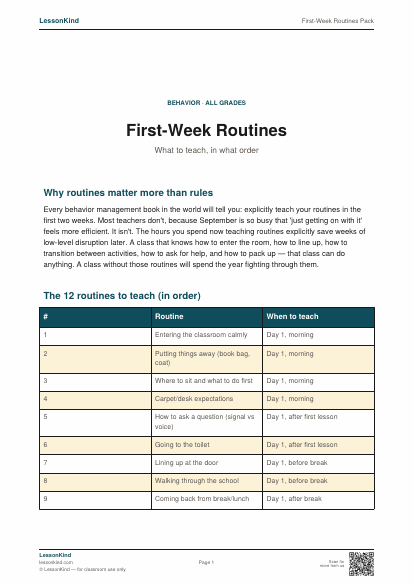
First-Week Routines Pack
The 12 routines you must establish in the first two weeks — entry, transitions, lining up, asking for help, finishing work, end of day. With explicit teaching scripts.
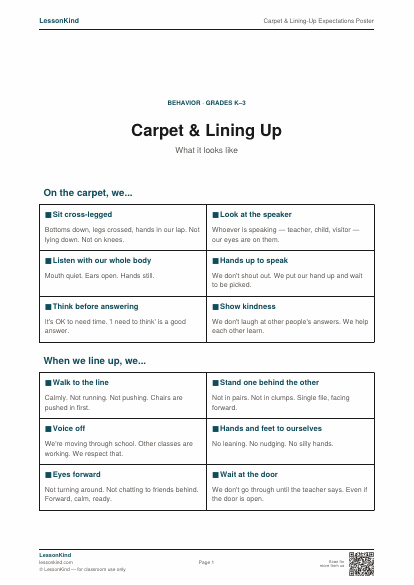
Carpet & Lining-Up Expectations Poster
A two-poster set showing exactly what 'good carpet' and 'good lining up' look like. Visual support for younger children — print A3, mount where children can see.
Going deeper
Books for the first weeks of teaching
Books we'd recommend on the topics raised in this article.
Practitioner
Convenience links to Amazon. As an Amazon Associate we earn from qualifying purchases at no extra cost to you. Read our affiliate disclosure.
Keep reading
Classroom culture
The Most Important Week of the Year
Most teachers think the first week is for getting to know the children. The teachers whose classrooms run beautifully use it for something quite different.
6 min read
First-year teaching
What They Don't Tell You in Teacher Training
Teacher training prepares you for lesson planning. It does not prepare you for what your first term as a class teacher actually feels like. Here's the honest version.
7 min read
Classroom culture
Why Your Routines Matter More Than Your Lesson Plans
First-year teachers spend hours on lesson plans and almost no time on routines. The teachers whose classrooms run beautifully have it the other way around.
6 min read