EYFS & early years · 5 min read
The Importance of the Mark-Making Area
Why scribbles, drawings and pretend writing matter more than they look
Published 2026-11-08
Walk into a Reception classroom and you'll usually find a mark-making area. Pencils, paper, perhaps some chalkboards, sometimes magnetic letters. It looks like a craft station.
It isn't. It's where literacy starts.
What's actually happening when a child mark-makes
When a four-year-old draws a circle and then a curving line and confidently announces "That says cat", something significant has happened cognitively. They've grasped, perhaps for the first time, that:
1. Marks on paper can stand for something else 2. The marks they make can communicate to other people 3. Writing is a system, not just imitation
This is more important than it sounds. Children who develop this insight in the early years go on to read and write more easily. Children who don't often struggle with literacy for years afterwards.
The technical term is **emergent literacy** — the long, gradual development of writing-readiness that happens before children can technically write. The marks look like scribbles. They aren't.
The progression to watch for
Children's mark-making goes through recognisable stages, roughly:
**1. Random marks (around age 2-3).** Lines, dots, scribbles. The child enjoys the physical act of making marks but the marks don't represent anything.
**2. Controlled marks (3-4).** The child can produce specific shapes deliberately — circles, lines, crosses. They might say "This is mummy" pointing at a circle. The mark represents something meaningful to them.
**3. Pretend writing (4-5).** The child produces wavy lines or letter-like shapes in a row, often left-to-right, and confidently 'reads' it: "Once upon a time the dragon went to the shops". They've grasped that writing is sequenced and goes somewhere.
**4. Letter-like forms (4-5).** The child includes recognisable letter-shapes mixed with invented ones. They often start with letters from their name.
**5. Initial sounds (5).** "C" for cat. "M" for mummy. "D" for dog. The child has connected sound-to-letter for some words.
**6. Phonetic spelling (5-6).** "kat" for cat. "luvs" for loves. The child is sounding out and writing what they hear. This is messy but represents huge cognitive progress.
**7. Conventional spelling (6+).** Recognisable spelling, increasingly accurate.
What it looks like when adults get it wrong
Two common mistakes:
**Mistake 1: Treating scribbles as failure.** "That's not how you write your name. Let me show you the right way." This corrects too early. The child needs to scribble-write for hundreds of attempts before conventional writing emerges. Correcting the early efforts kills motivation and slows the process.
**Mistake 2: Pretending all scribbles are equally meaningful.** The opposite extreme — over-praising every random mark. "Wow, you wrote a story!" when the child has just doodled. This isn't really better. It teaches children that we'll celebrate anything, removing the genuine joy of communicating something specific.
The middle path: notice what they've done specifically. "I see you've made marks all the way across the page. Are you telling a story?" Open question, lets them explain. If they say "yes, it's about a dinosaur", you've learned they're at the pretend-writing stage. If they say "I just made marks", you've learned they're at the controlled-marks stage. Either is fine.
What good mark-making provision looks like
**1. Real reasons to write.**
The most powerful prompts give children real purposes. A "register" by the door for them to sign in. A "shopping list" pad in the home corner. A "patient notes" clipboard in the doctor's role-play. Birthday cards to make for actual classmates. Children mark-make far more readily when there's a reason.
**2. Variety of tools.**
Pencils, but also chalk on chalkboards, finger-paint on big paper, sticks in wet sand, water on outdoor walls (it dries and they can write again). Different tools work different muscles and feel different in the hand. Variety keeps it interesting.
**3. Permission to write at any developmental stage.**
The four-year-old doing scribbles and the five-year-old doing initial sounds should both be welcome at the writing table. No "this is for kids who can already write".
**4. A practitioner who notices.**
Adults who watch and narrate without correcting do the most good. "I see you started at the top. Where are you going next?" That kind of question scaffolds without imposing.
What to tell parents
Parents often worry their pre-schooler can't "really write yet". The honest reassurance:
- Scribbles are writing-in-development, not absence of writing - Pretend reading and pretend writing are huge cognitive achievements - Forcing letter formation too early can slow the process down - The most important thing parents can do is read aloud daily — that builds the foundation faster than any direct teaching
Parents who relax about writing and prioritise reading aloud often see their child's writing develop more rapidly than parents who push letter practice from age 3.
Why this matters beyond Reception
Children who arrive at Year 1 with strong emergent literacy — confident with mark-making, used to producing writing for purposes — find conventional writing far easier to acquire. Children who don't, can struggle for years.
This is one of those areas where the early-years curriculum looks like play but is doing serious cognitive work. The settings that take it seriously — that build mark-making provision into the daily fabric of every area, not just one table — set children up for KS1 in ways that are visible across the school.
The scribbles aren't decoration. They're the foundation of literacy.
Free bundle for this topic
EYFS Essentials Pack
8 essentials for Reception and Kindergarten — provision, observation tools and activity cards.
Practical resources for this
Take this further
Printable, classroom-ready resources for the topics in this article.
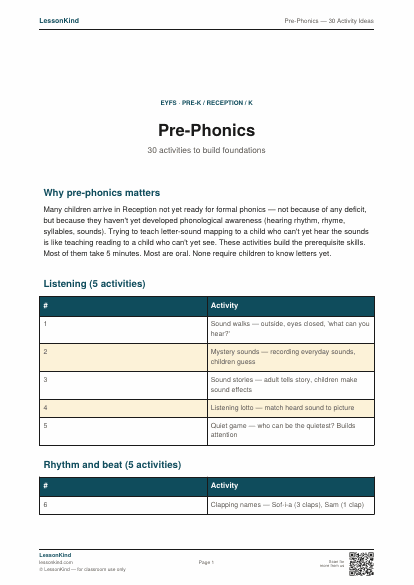
Pre-Phonics — 30 Activity Ideas
30 activities to develop the foundations BEFORE introducing letters — listening, rhythm, rhyme, alliteration, oral blending. The skills that determine how well phonics will land later.
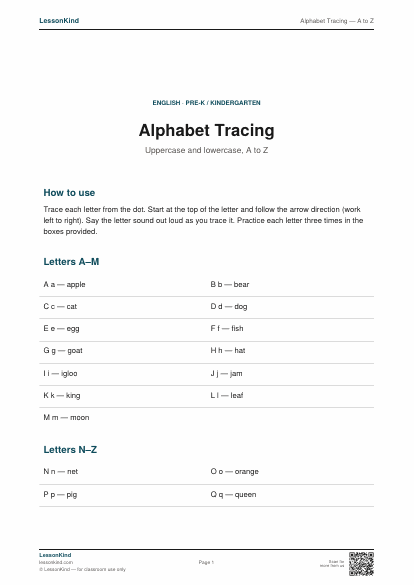
Alphabet Tracing — A to Z
Trace each letter of the alphabet, uppercase and lowercase. One picture cue per letter.
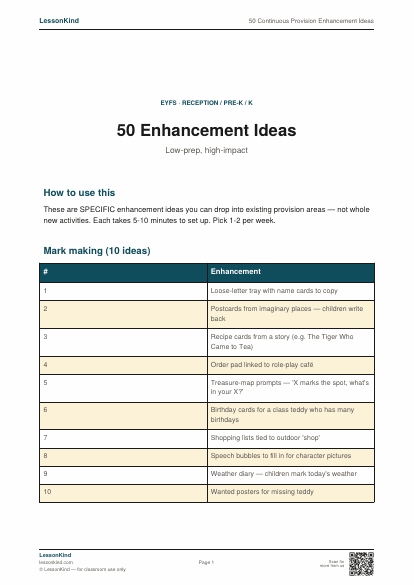
50 Continuous Provision Enhancement Ideas
50 specific, low-prep enhancements for the main provision areas — by area, by season, by skill. Useful for the Sunday-night moment when you're staring at the planning sheet.
Going deeper
Books on early writing development
Books we'd recommend on the topics raised in this article.
Practitioner
Convenience links to Amazon. As an Amazon Associate we earn from qualifying purchases at no extra cost to you. Read our affiliate disclosure.
Keep reading
EYFS & early years
What Good Continuous Provision Actually Looks Like
Continuous provision is the heart of EYFS practice. But many settings end up with beautiful-looking provision that doesn't actually teach much. Here's what separates the two.
6 min read
Reading & literacy
Phonics vs Whole Language: The Fight Is (Mostly) Over
The 'reading wars' tore at education for decades. Here's where the science of reading has actually landed — and what it means for your classroom.
8 min read
Reading & literacy
Why Children Hate Writing (And What Actually Helps)
Most children love drawing and storytelling. Many start to hate writing somewhere around Year 3. Here's why, and what teachers can do about it.
6 min read