EYFS & early years · 6 min read
What Good Continuous Provision Actually Looks Like
Beyond pretty trays — what makes provision genuinely educational rather than just busy
Published 2026-10-19
Walk into ten different Reception classrooms and you'll see ten different versions of "continuous provision". Some are stunning — natural materials, beautiful trays, calm spaces. Some are chaotic — overflowing baskets, plastic everywhere, three-day-old water trays.
But the really interesting thing is that the *most beautiful* provision often isn't the most educational. And the most educational often isn't the most photogenic.
What separates good continuous provision from decorative continuous provision?
Provision is meant to teach
The clue is in the name. Continuous *provision* — what is being provided, and what does it teach? If you can't articulate what a child learns by visiting an area, the area probably isn't doing its job.
Good provision answers four questions for every area:
1. **What is the learning intent?** ("Children will mark-make for a purpose" — not "children will be busy at the writing table".) 2. **What does engagement look like?** (How will I know learning is happening when I observe?) 3. **What progresses the play?** (What's the gentle adult prompt that takes a child from where they are to slightly beyond?) 4. **How does this connect to focus teaching?** (Was today's mark-making provision linked to the phonics input from this morning? Or is it free-floating?)
If those four questions have clear answers, the provision is purposeful. If not, you've got pretty trays that don't go anywhere.
The signs of provision that's not working
**Children rotate without engaging.** They visit an area for 90 seconds, scatter the resources, move on. Often a sign that the area has too much choice (paralysis) or no challenge (boredom).
**The same children dominate the same areas.** The construction area becomes "where the boys go". The home corner becomes "where the girls go". Provision should *invite* underrepresented children, not just permit them.
**Resources stay the same all term.** A water tray with the same yellow bowl in October as in February. Children stop investigating because there's nothing new to investigate.
**The teacher and TA never go to certain areas.** Provision that adults never visit drifts away from learning into chaos. Adults need to be present in provision — observing, narrating, gently extending.
What good provision actually looks like in practice
**The malleable area in October.** Wet sand, three different sized scoops, four containers of different volumes, and one challenge card with a question: "How many small scoops fill the medium pot?" A child who arrives spontaneously starts comparing. The TA, doing observation, notes which children compare without prompting and which need scaffolding.
**The mark-making area linked to focus teaching.** Today's phonics input was 'sh'. The mark-making area has a basket of objects starting with 'sh' (shell, shoe, ship), small whiteboards, and chalk pens. Children who want to write 'sh' words can; children who don't just play with the objects, hearing the sound. Both are progress.
**The reading nook designed for two.** Cushions for two children. Books open at the page that two children were on yesterday. A teddy who "needs to be read to". Children naturally pair-up because the space is designed for two, modelling reading-as-shared-activity.
**The construction area with a challenge that changes weekly.** Last week: "build something taller than you". This week: "build something with a bridge in it". Next week: "build something a small toy can hide inside". The challenge gives children a *reason* to engage at depth, not just a place to play.
The role of the adult
In good provision, the adult is doing one of three things:
1. **Observing** (silently noting what children can do, what they choose, how they cooperate) 2. **Narrating** ("I notice you're stacking those three cups. They're getting taller.") 3. **Extending** ("I wonder what would happen if we used the bigger blocks for the bottom?")
What the adult is *not* doing:
- Teaching from the front of the room - Asking questions to test what children know ("What colour is this?") - Stopping play to redirect to "the right way" to use materials
The hardest skill for adults new to EYFS is the silent observation. Most adults feel they should be doing something. In provision, observing *is* the thing.
The provision audit
Once a half-term, do this 20-minute audit:
- Stand in your classroom for 5 minutes and watch where the children are. - Walk around each area. For each one, ask: what's the learning here today? Could I name it in one sentence? - Note which areas are dead. Refresh them or remove them. - Note which areas always have the same children. Plan a way to invite different children in.
The settings with the strongest EYFS outcomes aren't the ones with the most beautiful provision. They're the ones where the practitioners can articulate, area by area, what the provision is teaching.
Free bundle for this topic
EYFS Essentials Pack
8 essentials for Reception and Kindergarten — provision, observation tools and activity cards.
Practical resources for this
Take this further
Printable, classroom-ready resources for the topics in this article.
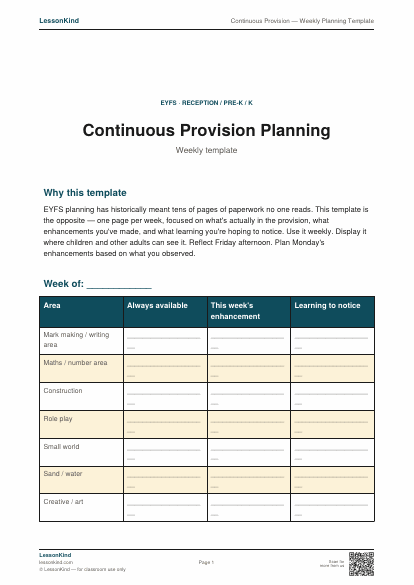
Continuous Provision — Weekly Planning Template
A simple weekly planning template for continuous provision — what's available where, what's been enhanced, what learning is being noticed. Replaces 30-page planning documents with one page that actually gets used.
Continuous Provision — Weekly Planning Template
A simple weekly planning template for continuous provision — what's available where, what's been enhanced, what learning is being noticed. Replaces 30-page planning documents with one page that actually gets used.
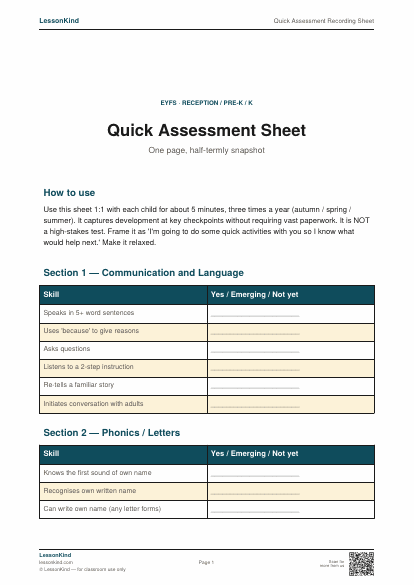
Quick Assessment Recording Sheet
A one-page recording sheet for quick formative assessments — phonics, number, fine motor, name writing. Use as a snapshot every half-term.
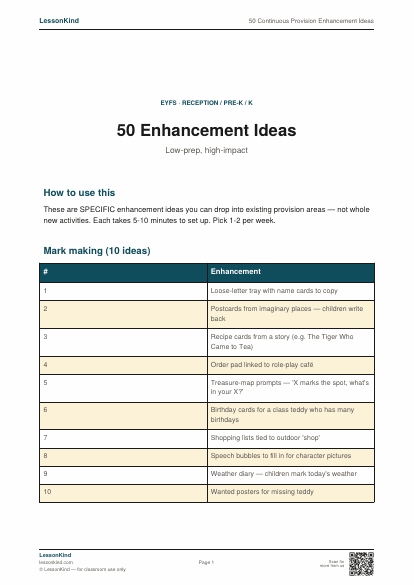
50 Continuous Provision Enhancement Ideas
50 specific, low-prep enhancements for the main provision areas — by area, by season, by skill. Useful for the Sunday-night moment when you're staring at the planning sheet.
Going deeper
Foundational EYFS reading
Books we'd recommend on the topics raised in this article.
Continuous provision
Convenience links to Amazon. As an Amazon Associate we earn from qualifying purchases at no extra cost to you. Read our affiliate disclosure.
Keep reading
EYFS & early years
Play-Based Learning Isn't Lower Expectations — It's Different Expectations
Walk into a Reception classroom and you'll see children playing. Walk into a Year 3 classroom and you'll see children working. The mistake most adults make is assuming the second is more rigorous than the first.
8 min read
EYFS & early years
What 'School Readiness' Actually Means (And What It Doesn't)
Every year, parents worry about whether their 4-year-old is 'ready for school.' Schools advertise 'school readiness' programmes. Politicians make speeches about it. Most of what gets said about school readiness is wrong.
7 min read
EYFS & early years
How EYFS Leads Actually Run Their Settings
EYFS leadership is one of the least-discussed roles in primary, despite running the foundational years that shape everything that comes after. This is what the role actually looks like from the inside — the planning, the parent conversations, the OFSTED preparation, and the rhythms that separate sustainable EYFS leads from burned-out ones.
9 min read