EYFS & early years · 5 min read
The Quiet Power of Storytime in Early Years
Why daily read-aloud is the most underrated EYFS practice
Published 2026-11-09
Walk into ten Reception classes during their daily read-aloud and you'll see ten different versions. Some children sit cross-legged, transfixed. Some fidget. Some chime in. Some are pretending to listen. The teacher reads with varying degrees of energy.
It looks like a calm transition activity. It isn't. It's one of the most cognitively dense moments in the EYFS day, and the settings that take it seriously see results across reading, writing, and oral language for years.
What's actually happening cognitively
When a four-year-old listens to a picture book read aloud, several things are happening at once:
**1. Vocabulary acquisition.** Picture books contain words children almost never hear in conversation — "scuttled", "magnificent", "indignant". A child listening to one picture book a day accumulates thousands of rare words a year that they wouldn't otherwise meet.
**2. Sentence-pattern absorption.** Children are exposed to written-language sentence structures, which differ from spoken English. "Once upon a time, deep in the dark forest, there lived..." is a structure children won't hear in everyday speech but will need to read fluently later.
**3. Story grammar.** The brain is learning that stories have shapes — beginnings, problems, attempts, resolutions. This grammar later becomes a scaffold for both reading comprehension and original writing.
**4. Inference practice.** "Why do you think Mummy Bear was sad?" The child has to hold information in mind, draw on what they've heard, and produce an inference. This is the core cognitive skill of all later reading comprehension.
**5. Joint attention.** Sitting with an adult and other children, focusing on a shared object (the book), is itself a form of social-cognitive practice that supports learning across the curriculum.
A 15-minute read-aloud is doing five separate kinds of cognitive work. Almost no other 15-minute slot in the day is this dense.
What separates good storytime from average storytime
**1. Read with genuine energy.**
Children mirror the reader. A flat, transactional reading produces flat, transactional listening. A reader who does voices, pauses for tension, slows for sad moments, and visibly enjoys it produces engaged listeners.
This isn't theatricality for its own sake — it's modelling how engaged readers experience text. Children who only ever hear flat reading often become flat readers themselves.
**2. Don't skip the rich words.**
If the book uses "indignant", read "indignant". Briefly explain: "indignant means really cross because something feels unfair." Then continue. Don't substitute easier words to "match" the children. They can absorb words ahead of their productive vocabulary if they hear them in context.
**3. Use the same book multiple times.**
Read-aloud research consistently shows children get more from second, third, and fourth readings than from first ones. The first reading is processing the basic story; the third reading is when they notice the language, the patterns, the things you can really discuss.
In good Reception settings, children might hear the same book six or seven times across a half-term. Far from being bored, they typically demand the favourites repeatedly. Each reading goes deeper.
**4. Talk about it briefly afterwards.**
Not a comprehension test. Just "What was your favourite part?" or "Why do you think she did that?" 60 seconds of discussion. This converts passive listening into active engagement and reveals what children actually understood.
**5. Let them touch the books.**
Story books read aloud should also be available afterwards on the bookshelf. Children who fell in love during the reading should be able to revisit the pictures, attempt re-reading, "read" it to a teddy. The book becomes a friend, not just a one-off experience.
Choosing books well
The quality of the books matters. A poorly-written book read enthusiastically does less than a brilliantly-written book read averagely.
**The hallmarks of a great EYFS read-aloud:**
- Rhythm and rhyme that invites joining in (Julia Donaldson is the gold standard here) - Language that's slightly above the children's productive level - Pictures that reward looking, not just illustrate - Characters with clear emotions - A story shape children can grasp but that has substance - Re-readable — gets better with repetition
**Names worth knowing:**
Julia Donaldson, Eric Carle, Mo Willems, Maurice Sendak, Michael Rosen, Jill Murphy, Anthony Browne, Eileen Browne, Beatrix Potter, Helen Oxenbury, Allan Ahlberg.
If your shelf is mostly licensed-character books (Peppa Pig, Paw Patrol), the read-aloud isn't doing as much work as it could. Mix them in if children love them, but the heavy lifting comes from genuine children's literature.
What to avoid
**Reading books too quickly.** Storytime taking only 5 minutes signals that nobody really cares about it. 15-20 minutes for a good picture book is right.
**Reading without preparation.** Even a familiar book benefits from a quick scan beforehand — knowing where the punchlines are, where to slow down, where to pause for predictions.
**Asking too many questions.** Some teachers, anxious to "make it educational", interrupt every page with a question. This breaks the spell. One or two prompts before, one or two afterwards, is plenty.
**Letting it slide when the day is busy.** When the day is packed, storytime is often the first thing cut. This is exactly backwards — on busy days, when children are dysregulated, storytime is often the most calming and productive thing you can do.
The longitudinal evidence
Children read aloud to daily in EYFS settings consistently outperform peers across the primary years. The effect is largest for vocabulary, comprehension, and writing — three of the four foundational literacy skills.
The effect compounds. A child read to daily from age 3 to 6 has heard tens of thousands more words than a child read to occasionally. Those words become the foundation everything else is built on.
This is why some EYFS practitioners describe daily story time as "the most important fifteen minutes of the day". They're not exaggerating. It's just one of those things that looks like calm at the end of the morning but is actually doing more cognitive work than half the structured activities you ran earlier.
Don't skip it. Don't rush it. Read it like you mean it.
Free bundle for this topic
EYFS Essentials Pack
8 essentials for Reception and Kindergarten — provision, observation tools and activity cards.
Practical resources for this
Take this further
Printable, classroom-ready resources for the topics in this article.
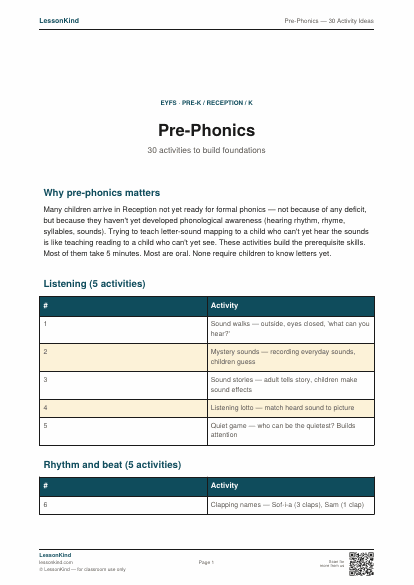
Pre-Phonics — 30 Activity Ideas
30 activities to develop the foundations BEFORE introducing letters — listening, rhythm, rhyme, alliteration, oral blending. The skills that determine how well phonics will land later.
Reception Classroom — Essential Picture Books
The 30 picture books every Reception classroom should have — read-aloud favourites, repeat-read classics, and the books that build the foundational vocabulary, rhythm, and story-sense Reception children need.
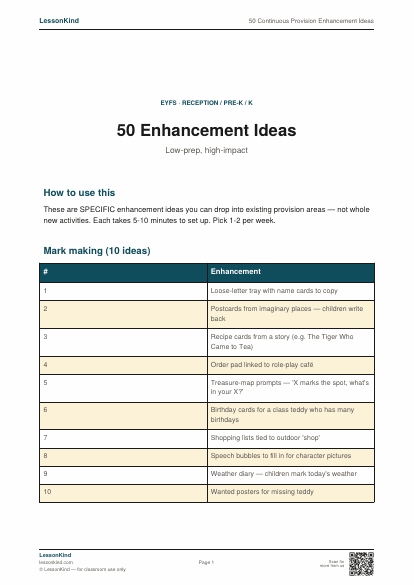
50 Continuous Provision Enhancement Ideas
50 specific, low-prep enhancements for the main provision areas — by area, by season, by skill. Useful for the Sunday-night moment when you're staring at the planning sheet.
Going deeper
Foundational reading on read-aloud
Books we'd recommend on the topics raised in this article.
Practitioner
Convenience links to Amazon. As an Amazon Associate we earn from qualifying purchases at no extra cost to you. Read our affiliate disclosure.
Keep reading
Reading & literacy
The Vocabulary Gap (And How to Close It)
Vocabulary size at age 5 is one of the strongest predictors of academic outcome at 16. Here's why the gap exists, and what teachers can do to close it.
6 min read
Reading & literacy
Reading Comprehension Isn't a Skill
Schools spend enormous time teaching 'reading comprehension'. The cognitive science says they're often teaching the wrong thing entirely.
6 min read
EYFS & early years
What Good Continuous Provision Actually Looks Like
Continuous provision is the heart of EYFS practice. But many settings end up with beautiful-looking provision that doesn't actually teach much. Here's what separates the two.
6 min read