EYFS & early years · 5 min read
The Reception Baseline (And What It Actually Tests)
What the RBA is, what it isn't, and how to talk to parents about it
Published 2026-10-20
Every September, Reception teachers across England spend the first six weeks running short, one-to-one assessments with each new child. This is the Reception Baseline Assessment (RBA). And every September, parents misunderstand it.
Here's what's actually going on.
What the RBA is
The RBA is a short, on-screen assessment that measures very early skills in two areas:
1. **Mathematics** — counting, recognising numbers, comparing quantities, basic shape and pattern. 2. **Literacy, communication and language** — early reading, vocabulary, knowledge of stories.
It's administered one-to-one by a familiar adult (usually the class teacher or TA), takes 10-20 minutes per child, and is done within the first six weeks of Reception starting.
What the RBA is NOT
It's not:
- A test the child passes or fails - An assessment that produces a result the child or parents see - An assessment of how "ready" the child is - A test of behaviour, social skills, or emotional development - The basis for any class grouping or intervention
It's a *progress measure for the school*, not a diagnostic tool for the child.
Why does it exist then?
The RBA exists for one reason: to provide a starting point that the government can compare against the child's KS2 SATs in Year 6. The "progress score" of a school in 7 years time is the difference between RBA result and SATs result for each child.
This means the RBA's main purpose is *accountability for the school*, not assessment of the child. The school cares about it because it determines progress measures. The child barely interacts with it.
What it doesn't tell you about your child
Some parents understandably worry that a low RBA result means their child is "behind". This is a misreading of what the assessment is for.
The RBA is taken at age 4 — when some children have had three years of nursery, library visits, and adult conversation, and others have had a few months of group provision and are still settling. The variation between children at age 4 is enormous, and almost none of it predicts long-term academic outcomes.
What does predict long-term outcomes? Engagement in learning, oral language development, parental involvement in reading, and emotional security at school. None of these are tested by the RBA.
The strongest predictor of where your child will be at the end of primary school
It isn't the RBA. It's whether the child:
- Has been read to regularly at home - Talks freely with adults about their day, ideas, and feelings - Develops good attendance habits (above 96%) - Forms positive relationships with peers - Becomes a fluent reader by end of KS1
A child who scores below average on the RBA but has all of those things will outperform a child who scored well but lacks them.
What the RBA actually feels like for the child
In a well-run setting, the child is barely aware they're being assessed. The teacher sits on a child-sized chair with a tablet, talks naturally to the child, asks them to do a few games (count some pictures, look at numbers, listen to a story).
The child sees it as "a chat with the teacher". This is by design — formal testing of 4-year-olds produces unreliable results, so the assessment is designed to feel as informal as possible.
What to tell parents who ask
When parents ask about the RBA, here's what to say:
- "It's a quick assessment we do with all children in the first few weeks. It helps us understand where to start with each child." - "It doesn't go on a record card or determine groupings. It's mainly used by the government to track school progress over time." - "You won't get a result — there isn't a meaningful one to share. What we'll share with you instead is observations of how [child] is settling in and what we're noticing about their learning." - "If you're worried about something specific — like talking, listening, social skills — please mention it directly to me. The RBA wouldn't catch most of those things."
The actual signal worth watching for
In the first half-term, do watch for:
- Whether your child is happy going to school - Whether they have a friend or two - Whether they can put on their own coat and go to the toilet alone - Whether they're exhausted (normal — six-week curve)
Those are the things that matter at this age. The RBA result is a number that exists in a government database for school accountability. Your child's flourishing is what actually matters.
Free bundle for this topic
EYFS Essentials Pack
8 essentials for Reception and Kindergarten — provision, observation tools and activity cards.
Practical resources for this
Take this further
Printable, classroom-ready resources for the topics in this article.
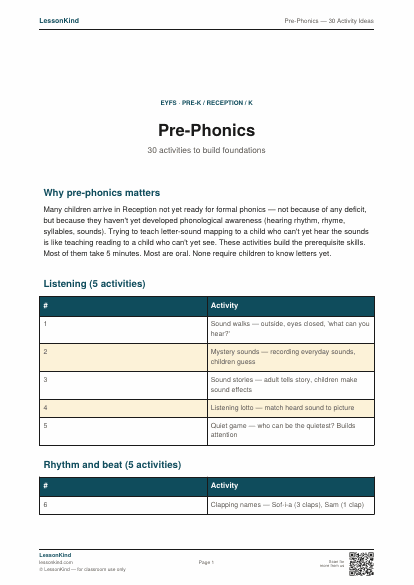
Pre-Phonics — 30 Activity Ideas
30 activities to develop the foundations BEFORE introducing letters — listening, rhythm, rhyme, alliteration, oral blending. The skills that determine how well phonics will land later.
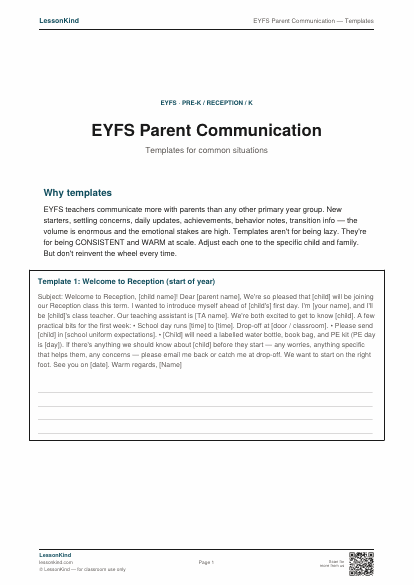
EYFS Parent Communication — Templates
Pre-written email and note templates for the most common EYFS parent comms — settling-in updates, behavior notes, achievement notes, transition info, end-of-day pickup messages.
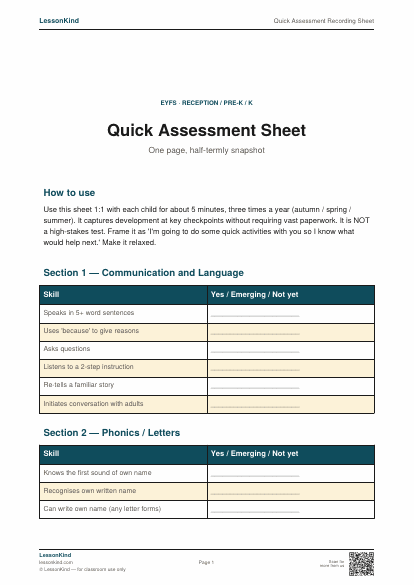
Quick Assessment Recording Sheet
A one-page recording sheet for quick formative assessments — phonics, number, fine motor, name writing. Use as a snapshot every half-term.
Going deeper
Reading on assessment in EYFS
Books we'd recommend on the topics raised in this article.
Practitioner
Convenience links to Amazon. As an Amazon Associate we earn from qualifying purchases at no extra cost to you. Read our affiliate disclosure.
Keep reading
EYFS & early years
What 'School Readiness' Actually Means (And What It Doesn't)
Every year, parents worry about whether their 4-year-old is 'ready for school.' Schools advertise 'school readiness' programmes. Politicians make speeches about it. Most of what gets said about school readiness is wrong.
7 min read
EYFS & early years
Play-Based Learning Isn't Lower Expectations — It's Different Expectations
Walk into a Reception classroom and you'll see children playing. Walk into a Year 3 classroom and you'll see children working. The mistake most adults make is assuming the second is more rigorous than the first.
8 min read
EYFS & early years
What Good Continuous Provision Actually Looks Like
Continuous provision is the heart of EYFS practice. But many settings end up with beautiful-looking provision that doesn't actually teach much. Here's what separates the two.
6 min read