EYFS & early years · 5 min read
The Reception-to-Year-1 Jump
Why this transition is harder than people expect, and what to do
Published 2026-11-14
A child who flourished in Reception — confident, articulate, drawing brilliantly, building elaborate imaginative play — arrives in Year 1 in September. By half-term, the child is anxious, refusing school, struggling with handwriting, and the parents are baffled.
This is the Reception-to-Year-1 jump. It's bigger than the curriculum changes suggest, and it catches a lot of children — and their parents — by surprise.
What's actually changing
Reception is structured around play-based learning, child-initiated activities, continuous provision, and adult-as-facilitator. A child can spend 80% of their day moving around, choosing activities, and learning through engagement.
Year 1 (in most schools) shifts dramatically toward: - Sitting at a table for sustained periods - Whole-class teaching from the front - Adult-directed tasks rather than chosen ones - Specific outputs (write this, complete this worksheet) - Less movement during the day - More demands on handwriting, sustained attention, fine motor stamina
This is, biologically and developmentally, a big ask. Children's bodies and brains aren't all ready at the same age. Some five-year-olds can sit and concentrate for 45 minutes. Others physically cannot. The traditional Year 1 environment expects all children to manage what only some are developmentally ready for.
Why this is worth knowing
Several reasons it matters:
**1. Children labelled as "struggling" might just be developing.** A boy who finds Year 1 hard isn't necessarily behind. He might just need another year to catch up developmentally. Some of the strongest Year 6 students were "behind" in Year 1.
**2. Parents often blame themselves or the child.** "He was doing so well. What went wrong?" Often nothing went wrong — the demands changed faster than the child's readiness.
**3. Some children develop school anxiety they didn't have before.** A previously cheerful child starts dreading Mondays. Stomach aches. School refusal. This is often the body protesting demands it isn't ready for.
**4. The fix is usually patience, not intervention.** Most "struggling Year 1s" catch up by Year 2 or 3 if the response is supportive rather than punitive.
What good Year 1 practice looks like
Some Year 1 settings have moved closer to a "Year R-Year 1 continuum" approach where the transition is gradual and developmentally appropriate. Markers of good practice:
**1. Continuous provision continues, partially.** Not the full Reception model, but pockets of it. A construction area still available at certain times. A reading corner. Sand and water some days. The transition is gradual, not abrupt.
**2. Movement breaks throughout the day.** Year 1 children physically need to move. Settings that build in stretch breaks, brain breaks, daily mile, outdoor learning, are working with the biology rather than against it.
**3. Handwriting is taught explicitly and gradually.** Recognising that pencil grip, hand strength, and stamina are physical skills that develop. Not expecting a perfectly seated child writing a paragraph in November.
**4. Phonics is delivered in shorter, energetic bursts.** 20 minutes max, with pace variety, not a single long session. Children's attention spans are short — work with that.
**5. The classroom layout supports movement.** Tables for sitting, but also areas where children can stand or sit on the floor. Not a row of desks all facing forward.
**6. Adults notice the "wobble" early and respond gently.** A child showing signs of struggle in October isn't punished or pressured — they're given space and adjustment.
What gets it wrong
**Treating Year 1 as a mini-Year 2.** Settings that treat 5-year-olds as junior 6-year-olds expect skills the children don't yet have. The result is anxiety and avoidance.
**Insisting on output over engagement.** A teacher fixated on completed worksheets misses what the child is actually capable of in conversation, in physical demonstration, in role-play.
**Comparing children to each other.** Five-year-olds vary enormously. The girl who can write a sentence in October isn't more advanced than the boy who can't — she's just developmentally further along on this specific skill. The boy might be ahead on other things.
**Pressuring parents to "do more at home".** Most struggling Year 1 children don't need more academic work at home. They need to play, be read to, and have time for development to catch up.
What parents can do
If your child is struggling with the Year 1 transition, the boring truth is:
**Don't panic.** Most "struggling Year 1s" catch up by Year 2 or 3. The wobble is often temporary.
**Don't add academic pressure at home.** Pushing a developmentally-not-ready child harder makes it worse. Read to them, talk with them, play with them — but don't force handwriting practice if they hate it.
**Talk to the teacher early.** Most Year 1 teachers are understanding. A conversation in October can lead to small adjustments that make the term easier.
**Watch for school anxiety.** Stomach aches before school, reluctance, withdrawal — these warrant attention. Often the answer is supportive listening rather than diagnosis.
**Trust development.** A child who is loved, read to, talked with, and given time to grow will get there. The Year 1 wobble is rarely a permanent setback.
What teachers can tell parents
The conversation Year 1 teachers most need to have with worried parents:
> "What you're describing is really common. Year 1 is genuinely a big jump from Reception. Some children take half a term to settle. Some take a full term. A few take longer. None of this is a sign that something's wrong with your child. > > What I'd watch for is engagement and energy. Is she happy at home? Is she still curious? Is she sleeping? Those are the indicators I care about — much more than whether she can write a paragraph yet. > > The handwriting and writing volume will come. Right now, what she needs from me is a calm, steady classroom where she's not pressured to perform. What she needs from you is reassurance, plenty of reading aloud, and not too much focus on academic output at home. > > Let's check in again at half-term. Most of the time, by then, things have moved on."
That conversation, said honestly, calms more parents and saves more children than any specific intervention.
The wider point
The Reception-to-Year-1 jump is one of those things schools could do more about, structurally. Some are. Some aren't. As a teacher in the system you've inherited, the question is what you can do within your classroom.
The answer is: a lot. The Year 1 teachers who recognise the developmental reality, build in movement and play, take the pressure off, and trust development tend to produce children who land softly in Year 2 — and remember Year 1 fondly rather than as the year they started hating school.
Those are the teachers worth being.
Free bundle for this topic
EYFS Essentials Pack
8 essentials for Reception and Kindergarten — provision, observation tools and activity cards.
Practical resources for this
Take this further
Printable, classroom-ready resources for the topics in this article.
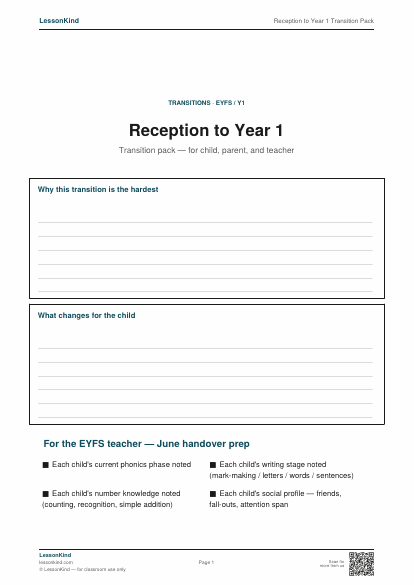
Reception to Year 1 Transition Pack
The single biggest transition in primary — from play-based EYFS to a more structured Year 1 classroom. Activities, parent letter, classroom routines, and EYFS-to-KS1 staff handover sheet for the gentlest possible move.
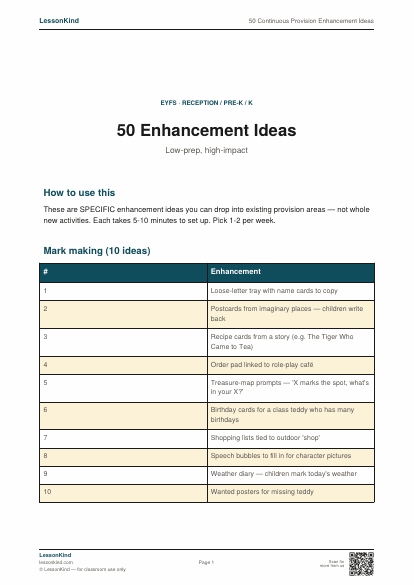
50 Continuous Provision Enhancement Ideas
50 specific, low-prep enhancements for the main provision areas — by area, by season, by skill. Useful for the Sunday-night moment when you're staring at the planning sheet.
Going deeper
Books on early years and KS1 development
Books we'd recommend on the topics raised in this article.
Practitioner
Convenience links to Amazon. As an Amazon Associate we earn from qualifying purchases at no extra cost to you. Read our affiliate disclosure.
Keep reading
EYFS & early years
What Good Continuous Provision Actually Looks Like
Continuous provision is the heart of EYFS practice. But many settings end up with beautiful-looking provision that doesn't actually teach much. Here's what separates the two.
6 min read
EYFS & early years
The Quiet Power of Storytime in Early Years
Daily read-aloud is doing more cognitive work than almost any other activity in the EYFS day. Here's what the science says, and how to make it count.
5 min read
EYFS & early years
Play-Based Learning Isn't Lower Expectations — It's Different Expectations
Walk into a Reception classroom and you'll see children playing. Walk into a Year 3 classroom and you'll see children working. The mistake most adults make is assuming the second is more rigorous than the first.
8 min read