
About this resource
Adverse Childhood Experiences — what they are, how they affect children's brains and behaviour, and what teachers can actually do. Based on the original Felitti and Anda research and subsequent decades of follow-up.
What's included
- Print-ready PDF — A4 and US Letter compatible
- No sign-up required — download instantly
- Free to use in your classroom
More like this
More Trauma-Informed Practice resources

Trauma-Informed Teaching — A One-Page Introduction
What trauma-informed teaching actually is, what it isn't, and the four shifts that make a classroom safer for children with trauma backgrounds. Useful as a CPD opener.

The Brain Under Stress — Classroom Application
What happens neurologically when a child is in fight-flight-freeze, why reasoning doesn't work, and the practical implications for classroom response. Based on Bruce Perry's neurosequential model.

Building Safety — Daily Routines Checklist
The small daily routines that build felt safety for children with trauma backgrounds — entry rituals, transitions, exits. Audit your day.

The 'Safe Person' Role — A Practical Guide
What it means to be a child's 'safe person' at school — for vulnerable children, this single relationship can be the difference between thriving and not. With practical guidance and what NOT to do.

Predictability — A Staff-Room Poster
A poster for the staff room reminding adults of what predictability looks like in practice — and why it's the cheapest, most powerful intervention for vulnerable children.
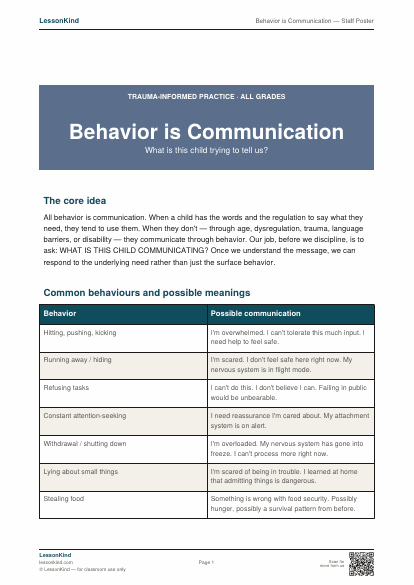
Behavior is Communication — Staff Poster
A staff-room poster reframing common 'difficult' behaviours as communications. The shift in lens is often the most powerful intervention there is.
This page contains affiliate links. We may earn a commission at no extra cost to you. Full disclosure →
Stay Safe Online with NordVPN
Protect your connection on school networks and at home — trusted by millions. Recommended for teachers and students.
Get NordVPN →