Assessment & feedback · 9 min read
How Assessment Coordinators Actually Run the Annual Cycle
What the role actually looks like — the calendar, the moderation, the data-collection windows, and the work of keeping assessment proportionate
Published 2026-11-10
Most primary schools have someone running assessment, even if the title varies. Assessment Coordinator. Assessment Lead. Sometimes the role is held by an assistant head, sometimes by a deputy, sometimes by a senior teacher with a specific TLR. Some schools run it under a "Data and Assessment" hat which combines assessment leadership with line management of the school office's data work.
What the role looks like from the outside is mostly invisible. Children take tests. Reports go home. Numbers appear on the SLT spreadsheet. What happens between the test and the spreadsheet — and what happens between the spreadsheet and the next round of intervention — is the actual work, and it's the Assessment Coordinator who carries it.
This article is about what the role actually looks like from the inside. It's written for Assessment Coordinators themselves, for class teachers who work alongside one, and for school leaders deciding what the role actually needs.
The role from the inside
The Assessment Coordinator holds the school's annual assessment cycle. This includes statutory events (Reception Baseline, Phonics Screening Check, Y4 Multiplication Tables Check, KS2 SATs, EYFS Profile), school-based termly assessment cycles, moderation events (internal and external), parent communication windows (parents' evenings, written reports), the digital tracking system, the relationship with the LA, and the cohort-level analysis that feeds intervention decisions.
The job is structurally different from English Lead or Maths Lead. Those roles are about LEARNING — building children's reading, writing, calculation skills. The Assessment Coordinator's job is about KNOWING — making sure the school knows where children are, how they've progressed, and what to do next. The two roles are interdependent: assessment without good teaching produces bad data; teaching without good assessment produces blind spots.
The role can feel quietly bureaucratic. Most days are spent on calendars, spreadsheets, meeting prep, and follow-up emails. Most weeks contain at least one conversation that's harder than expected — a parent challenging a level, a colleague disagreeing with a moderation outcome, an LA query about timing. The work needs precision but also tact, structure but also flexibility.
The annual cycle
Assessment work is more calendar-driven than any other primary leadership role. The cycle has rhythms that anyone in the role for two or more years has internalised.
**September.** Confirm statutory dates from DfE for the year. Update the school's assessment calendar. Brief new staff on the system. Schedule moderation slots with year groups. Make sure the digital tracking system is up to date. Run a quick informal Y1 phonics readiness check. Identify Y6 children at risk for SATs and start intervention planning.
**October-November.** Reception Baseline window closes mid-October — submit data. First termly data collection point at the end of October half-term. Parent-evening preparation (briefing teachers, agreed format, language guide). Pupil Progress Meetings cycle 1.
**December-January.** End-of-autumn data collection. Reports prep. End-of-term parent communication. Moderation meeting cycle 1.
**February-March.** Mid-year data collection. Y6 SATs prep diagnostic week (typically February). Pupil Progress Meetings cycle 2. Moderation meeting cycle 2. Spring parents' evening prep.
**April-May.** Final SATs prep. Confirm Y6 access arrangements. KS2 SATs week (May). Phonics Screening Check (May/June). Y4 Multiplication Tables Check (June). EYFS Profile completion. Pupil Progress Meetings cycle 3.
**June-July.** Final data collection. Annual reports to parents. Statutory data submitted to LA. Phonics, MTC, SATs, EYFS results communicated. Plan next year's calendar. Many Assessment Coordinators do their best strategic work in July when the operational pressure lifts.
The cycle repeats every year. The skill is making each cycle slightly better — embedding what worked, adjusting what didn't.
The moderation problem
Moderation — teachers comparing their judgements about pupil work to check that "expected" or "greater depth" mean the same thing across classrooms — is one of the most useful CPD a school runs. Done well, it's the most important hour of teacher development each term. Done badly, it's an hour of disagreement that nobody enjoys.
The Assessment Coordinator's job is making moderation productive. This means:
- Anonymised work (children's names removed; bias creeps in otherwise) - Printed criteria; everyone working from the same document - 3 pieces per teacher (one judged "working towards expected", one "expected", one "greater depth") - A structured agenda that prevents free-form drift - Equal voice — SLT shouldn't dominate - Specific evidence-led discussion ("this piece meets criterion 3 because…") not opinion-led ("I just feel…") - A follow-up summary email within 48 hours documenting the agreed standards
Without these, moderation becomes either rubber-stamping (everyone agrees with each other to avoid conflict) or unproductive disagreement (people argue without resolving). With them, moderation builds shared judgement that improves the school's assessment over years.
The "we test too much" problem
Every primary school has the conversation. Some teachers feel children are over-assessed. Some leadership feels assessment is the only way to know what children know. Both are partly right.
The Assessment Coordinator's job is making the distinction operational. Formative assessment — checking understanding during learning to adjust teaching — should happen constantly but invisibly. It's mini-whiteboards, exit tickets, no-hands questioning, thumbs-up checks. It shouldn't feel like testing. Summative assessment — measuring learning at the end of a unit or term — should happen proportionally. Once a half-term per subject for most year groups is enough.
If a school is collecting summative data that nobody uses for intervention, parent reporting, or transition handover, it's collecting it for no reason — and that's where the "we test too much" feeling comes from. The fix isn't more assessment or less assessment; it's making sure assessment that happens is actually useful.
This is harder than it sounds. SLT often request data "just in case." The Assessment Coordinator's job is sometimes politely pushing back: what will this data be used for? If the answer is unclear, don't collect it.
The data-into-decisions translation
Assessment data sitting on a spreadsheet doesn't help anyone. The Assessment Coordinator's most important meeting is the Pupil Progress Meeting (PPM) — termly, 30-45 minutes per year group, attended by class teacher, SENDCo, Assessment Coordinator, sometimes head.
PPMs translate data into decisions. Each flagged child gets discussed: what's the data picture? What's been tried? What's next? Who's leading? When do we review? The output is a list of actions with named owners and review dates.
PPMs done well shift the school's intervention work from ad-hoc to coordinated. PPMs done badly are 45 minutes of "we should do more for these children" that produce no specific actions.
The discipline of leaving every PPM with named owners and review dates — and following up in 48 hours with a summary email — is what makes the difference. Most Assessment Coordinators learn this within their first year in the role.
The hardest parts
Three things make the role uniquely demanding.
**The unforgiving statutory calendar.** Reception Baseline, Phonics Screening, Multiplication Tables Check, KS2 SATs, EYFS Profile — each has fixed dates, specific access arrangements processes, LA submission deadlines. Missing one is a real problem. The Assessment Coordinator carries the responsibility for not missing them.
**The data-vs-teaching tension.** Every day spent on assessment paperwork is a day not teaching. Every day not on assessment paperwork is a day of unmet statutory obligation. The Assessment Coordinator lives in this tension. Doing the role well means making assessment work as light as possible while still doing what's needed.
**The visibility paradox.** Good assessment work is invisible — children's progress is captured accurately, parents get clear information, intervention is well-targeted. Bad assessment work is highly visible — missed deadlines, parent complaints, OFSTED scrutiny. The work is mostly noticed when something has gone wrong.
What helps
For Assessment Coordinators navigating the role, a few things consistently help:
- Protected non-contact time. Ideally a full day a week for substantial schools. - A digital tracking system that's actually fit for purpose. Target Tracker, ScholarPack, Insight, Arbor — pick one and use it consistently. - A printed annual calendar. The role lives on the calendar; make it visible. - Clear permissions on data access. Class teachers see their class. SENDCo sees SEND children specifically. Head sees cohort summaries. Don't share data more widely than needed. - A peer network. Local Assessment Coordinator networks, Twitter education community, LA-led briefings.
For class teachers reading this
If your Assessment Coordinator seems firm about deadlines, it's because they have to be. Statutory obligations don't move. Three things class teachers can do that genuinely help:
- Submit data on time. The data-collection window exists because the cumulative downstream work depends on it. - Be honest in your judgements. Over-judging doesn't help children; it produces gaps that get exposed later. Under-judging doesn't help either. - Engage with PPMs as conversations, not as audits. The point is making good intervention decisions for your children.
For headteachers
If your Assessment Coordinator is reading this, three things you can do that genuinely help:
- Protect their time. The role can't run on goodwill. Adequate non-contact is the difference between coherent assessment and missed deadlines. - Don't request data "just in case." Every data request creates work. Be specific about what it'll be used for. - Back the assessment calendar. When teachers push for an extension on data submission, back the Assessment Coordinator's "no" — or all deadlines become negotiable.
The role in one sentence
An Assessment Coordinator's job is to make sure the school knows where every child is, communicates that accurately to parents and the LA, and translates the knowing into intervention decisions that actually help.
Done well, the work is invisible. Done badly, you find out the hard way.
Free bundle for this topic
KS2 Maths Pack
10 maths resources designed for retrieval practice and low-stakes review.
Practical resources for this
Take this further
Printable, classroom-ready resources for the topics in this article.
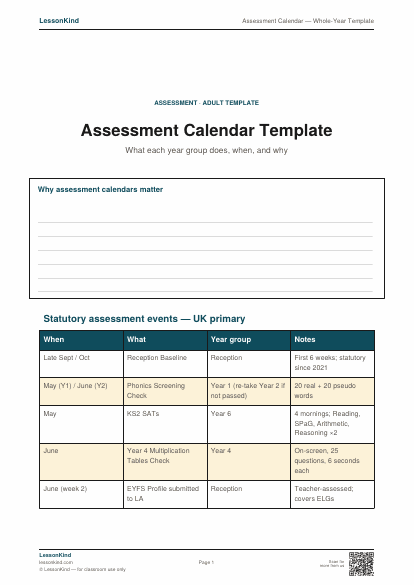
Assessment Calendar — Whole-Year Template
A whole-school assessment calendar template — when each year group does what, how it links to reporting, and how to keep assessment proportionate. The reference document an assessment coordinator builds in September and refers back to all year.
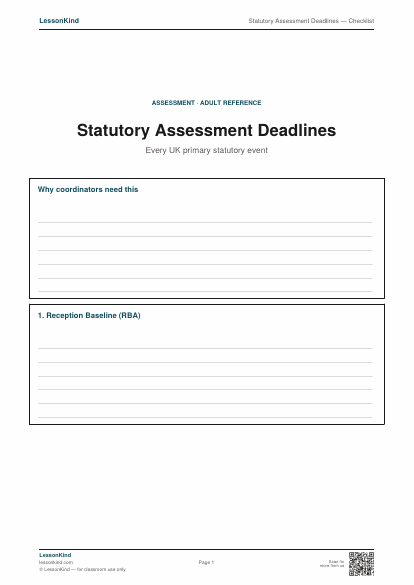
Statutory Assessment Deadlines — Checklist
Every statutory assessment deadline UK primary schools face — Reception Baseline, Phonics Screening, Y4 Multiplication Check, KS2 SATs, EYFS Profile. With prep timelines, coordinator's actions, and what gets flagged when.
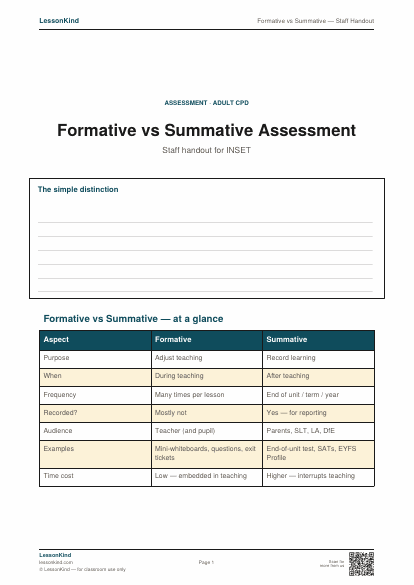
Formative vs Summative — Staff Handout
A 4-page staff handout explaining the difference between formative assessment (during learning) and summative assessment (at the end), with specific classroom techniques for each. For staff INSETs and new-teacher induction. Designed to settle the 'we test too much' / 'we don't test enough' debate.
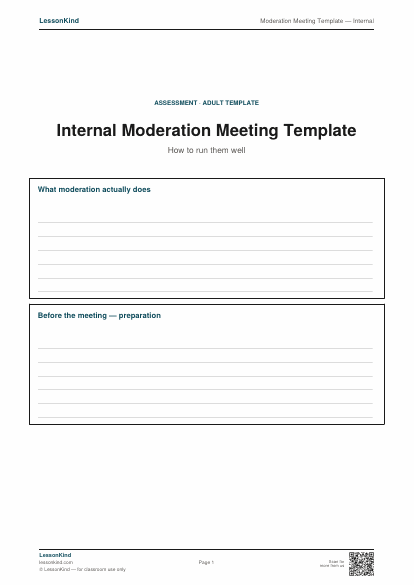
Moderation Meeting Template — Internal
How to run an internal moderation meeting — agenda, prep checklist, sample work selection, structured discussion prompts, and how to follow up. For assessment coordinators trying to bring consistency to teacher judgements without creating tension.
Pupil Progress Meeting — Template
Template for pupil progress meetings (sometimes called 'progress and provision meetings') — the termly conversation between class teacher, SENDCo, and assessment coordinator about which children need what intervention. With agenda, prep checklist, and follow-up structure.
Light-Touch Tracking System — Setup Guide
How to set up a school assessment tracking system that's USEFUL and doesn't drown teachers in admin. Covers what to track, what to leave alone, paper vs digital, frequency, and the assessment data SLT actually need vs what they ask for.
Keep reading
Reading & literacy
How English Leads Actually Run Their Schools' Reading Culture
An honest account of what English Lead work actually involves at primary — the phonics scheme decision, building a school where children genuinely want to read, the staff team's varying confidence, and the long arc of cultural change that can take 3-5 years to embed.
9 min read
Math
How Maths Leads Actually Run Their Calculation Policy
An honest account of what Maths Lead work actually involves at primary — the calculation policy that depends on every teacher doing it the same way, the manipulatives that sit unused in upper KS2, the staff team carrying their own maths anxiety from school, and the long work of building fluency.
9 min read
EAL & inclusion
How SENDCos Actually Run Their Cases
SENDCo is one of the most demanding roles in primary, done by people on a fraction of a day's release. This is what the role actually looks like from the inside — the cycles, the decisions, the difficult conversations, and the rhythms that separate the SENDCos who burn out from the ones who last.
9 min read
EYFS & early years
How EYFS Leads Actually Run Their Settings
EYFS leadership is one of the least-discussed roles in primary, despite running the foundational years that shape everything that comes after. This is what the role actually looks like from the inside — the planning, the parent conversations, the OFSTED preparation, and the rhythms that separate sustainable EYFS leads from burned-out ones.
9 min read