First-year teaching · 5 min read
Managing the Class You Inherited
What to do when last year's teacher set patterns you don't agree with
Published 2026-11-05
You walk into your new classroom in September. The previous teacher has left you a class with patterns. Some are great — they line up beautifully, they know phonics routines, they self-regulate during reading. Some are not — they shout out, they argue with adults, they struggle with transitions.
The previous teacher might be a colleague you respect. Or they might have moved on. Either way, the question is the same: how do you build on what's good and reset what isn't, without making it into a comparison?
The trap of "in my class, we..."
The temptation is to start the year by announcing what's different now. "In my class, we don't shout out. In my class, we line up silently. In my class, we walk on the left."
This feels like setting standards. It's actually setting up a comparison children will resist. It implies their old teacher had it wrong. Children defend their previous teacher reflexively, even ones they had complicated feelings about. You'll get pushback you didn't anticipate.
A better framing: "In Year 4 / Grade 4, we..." No comparison. Just an expectation of the new year level.
The 'fresh slate' approach
Experienced teachers inheriting a class often use this opening:
"This is a fresh start. Last year is last year. This year, here's what I'm asking of you."
Then teach the routines you want, day one, as if no previous routines existed. Don't reference the previous teacher. Don't critique. Don't ask the children to compare.
Children adapt remarkably quickly when you're consistent. By week three, the previous teacher's patterns will have largely faded for the routines you've reset. The patterns you didn't address will persist.
This means: choose your battles. Reset 3-4 things you really want to change. Let the rest go for the first half-term. You can address them later once relationships are built.
The patterns worth resetting first
**1. How they enter the room.** This is the foundation. If they come in chaotic, the rest of the day starts behind. If they come in calm, the day has a chance.
**2. How they ask for help.** Last year's teacher might have allowed shouted "Miss!" across the room. You probably want hands up. Reset this in week one.
**3. How transitions work.** The 30 seconds between activities is where classes fall apart. If they previously got chatty, set up a quiet transition cue (countdown, freeze game, soft music).
**4. The feedback culture.** If they were marked harshly and avoid taking risks, you'll need to deliberately re-establish that mistakes are OK. This takes weeks of modelling.
The patterns to keep (and acknowledge)
Some of what they bring is great. Acknowledge it directly:
"I love how you came in this morning — that was brilliant lining up."
"You all knew exactly what to do at carpet time. Great."
This both reinforces the good patterns and signals that you notice. The children who were doing it badly under the previous teacher might step up because they want the praise too.
Don't tell them they're "great compared to other classes" or "well-trained" — both feel patronising. Just notice the specific thing.
Talking to the previous teacher (if you can)
If the previous teacher is still at the school, an early conversation is gold. Ask:
- Who needs careful watching? - Whose families are tricky? - Who has SEND, EAL, FSM, or social workers involved? - Who fell out with whom last year? - Who needed a particular approach?
This is information you can't get from records. It saves you weeks of figuring out who's who.
If the previous teacher has moved on, ask the year-group lead or SENCo. They usually know.
The thing nobody tells new teachers
You will sometimes inherit a class that the previous teacher genuinely struggled with. Senior leaders may have moved you in to "sort it out". They will not say this out loud.
If you sense this, ask quietly: "Anything I should know about this class historically?" If they hesitate or start describing the children as "challenging", you've inherited a tough one.
Don't take this as a slight. It's actually a vote of confidence — they put you with this class because they thought you could handle it. But it does mean you should:
- Front-load behaviour expectations more than usual - Document everything for the first half-term - Build a strong relationship with the year-group lead - Lean on the SENCo early - Not blame yourself when it's hard
A class that's been hard for one teacher is rarely transformed in two weeks by another. Aim for steady, consistent improvement over a term, not magic.
A note on the previous teacher's reputation
Avoid talking about the previous teacher with parents, students, or other staff. Even if they were genuinely poor, the appearance of slagging off a colleague never plays well. Stay scrupulously neutral.
If a parent asks "Was Mrs X really as bad as I heard?", the right answer is something like "I don't know about that — what I can tell you is what we're doing now."
The professional move is to make their year better, not to be seen criticising the previous teacher. Your reputation is being built every time you don't take the bait.
What success looks like
By half-term, an inherited class should:
- Run your routines, not the previous teacher's - Have stopped comparing you out loud - Be making visible progress in 1-2 areas - Trust you, even if grudgingly
You'll know it's working when a child says "we always..." referring to something you taught, not something the previous teacher did. That's the moment your class became your class.
Free bundle for this topic
The Starter Pack
18 free resources spanning every subject — the universal new-teacher starter.
Practical resources for this
Take this further
Printable, classroom-ready resources for the topics in this article.
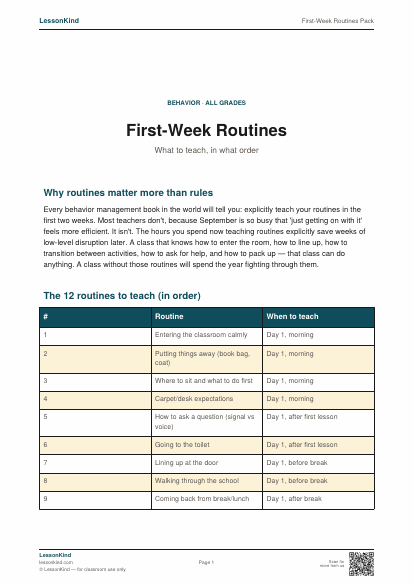
First-Week Routines Pack
The 12 routines you must establish in the first two weeks — entry, transitions, lining up, asking for help, finishing work, end of day. With explicit teaching scripts.
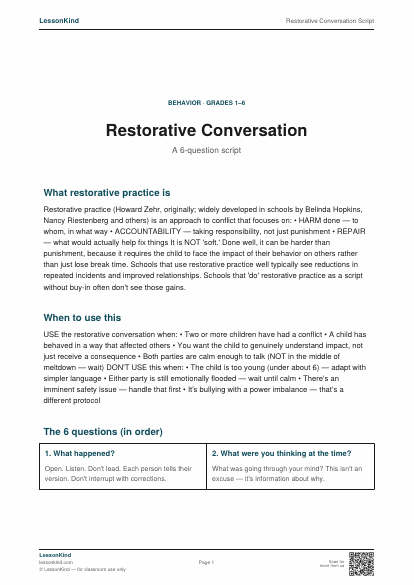
Restorative Conversation Script
A simple 6-question script for restorative conversations after a behavior incident. Follows the standard restorative practice format — focused on harm, accountability, and repair.
Going deeper
Books on classroom culture
Books we'd recommend on the topics raised in this article.
Practitioner
Convenience links to Amazon. As an Amazon Associate we earn from qualifying purchases at no extra cost to you. Read our affiliate disclosure.
Keep reading
First-year teaching
The First Week of School (and How Not to Wreck It)
The first week of school sets the tone for the entire year. Most NQTs spend it doing the wrong things. Here's what experienced teachers prioritise.
6 min read
Classroom culture
The Most Important Week of the Year
Most teachers think the first week is for getting to know the children. The teachers whose classrooms run beautifully use it for something quite different.
6 min read
Classroom culture
Why Your Routines Matter More Than Your Lesson Plans
First-year teachers spend hours on lesson plans and almost no time on routines. The teachers whose classrooms run beautifully have it the other way around.
6 min read