Behavior & classroom management · 7 min read
When to Worry About Your Child's Handwriting
What's developmental, what's a fine-motor issue, and what the pencil grip thing actually means
Published 2026-10-24
A common parents' evening conversation. The teacher pulls out the writing book. The pages are messy — letters that float above and below the line, inconsistent sizes, words that bunch together at the right margin. The teacher says something gentle. The parent goes home worried.
A common after-school conversation. The 7-year-old is doing homework. The pencil is held in a fist. Letters take ages. They give up halfway through. The parent tries to teach them to hold the pencil "properly" and it ends in tears.
Handwriting is one of the most visible bits of school work — and one of the most often misunderstood. Most concerns about it at primary age are about pace, not problem. But some genuinely warrant attention, and the pencil grip thing isn't quite what most adults think it is.
This article is about how to tell the difference, what's developmentally normal at each age, and what genuinely helps the children for whom handwriting is hard.
What developmentally normal looks like
Handwriting development is gradual and individual. Wide variation between children is normal. Roughly:
**Ages 3-4.** Scribbles, lines, circles. Beginning to copy letter shapes from their name. Pencil held in a whole-hand grip (palmar grasp) is fine. Most letters not yet recognisable.
**Ages 4-5.** Most letters of name written. Other letters attempted. Often reversed, sometimes upside down. Pencil grip starting to refine — fingers more involved, but still not adult-style. Letter sizing all over the place.
**Ages 5-6 (Reception/Y1).** Most letters formed individually. Many still reversed (especially b/d, p/q). Sizing inconsistent. Lines from the page often ignored. Names and short familiar words written. Effort visible.
**Ages 6-7 (Year 2).** More consistent letter forms. Most letters on the line. Reversals reducing but still happening. Spacing between words emerging. Pencil grip usually refined to a tripod or quadrupod (three or four fingers).
**Ages 7-8 (Year 3).** Joined writing introduced in many schools. Letters more uniform. Speed slowly increasing. Some children's writing remains laboured.
**Ages 8-10 (Years 4-5).** Joined writing established in most. Speed and fluency improving. Personal style emerging. Some children still write very slowly.
**Ages 10-11 (Year 6).** Adult-recognisable handwriting in most. Genuine fluency in most. A small minority still finding it hard.
The key word again is ROUGHLY. Normal variation between children is enormous. A child whose handwriting at 6 looks like the average 5-year-old's is not necessarily behind in any meaningful sense.
What's not actually a problem (despite what people say)
A list of common worries that usually don't matter.
**"Their letters are reversed."** Almost universal at 5-6. Common at 7. By 8, mostly resolved. Persistent reversal past 8 is worth flagging, but at 5-6 it's normal development, not a sign of dyslexia.
**"They hold the pencil wrong."** This is the big one. The "tripod grip" (thumb, index finger, middle finger pinching the pencil) is the conventional ideal — but research increasingly shows that grip variation has SURPRISINGLY LITTLE effect on writing legibility, speed, or quality. Some excellent writers use unconventional grips their whole lives. Forcing a child to change a comfortable grip often makes things worse, not better.
What matters more than grip TYPE is grip TENSION. A child who white-knuckles the pencil — fingers bent stiffly, hand cramping — is going to find writing exhausting. A child who holds the pencil loosely with whatever finger configuration they prefer is fine.
**"Their writing is messy."** Most primary-age handwriting is messy. The neat, consistent, ruled-line writing that some adults remember from their own childhood is usually a curated memory. The bar for "neat enough" at primary should be: an adult can read it. Period.
**"They press too hard."** Common at 5-7. Often resolves on its own. Worth offering softer pencils (HB or B) and letting them experiment.
**"Their writing is slow."** At primary age, speed is a poor predictor of anything. Slow but neat is fine. Fast but illegible is more concerning. By Year 6, speed becomes more important (for SATs, secondary work) — but in early years, stop pushing for speed.
**"They mix capitals and lowercase."** Very common at 5-7. Resolves with practice and modelling. Don't drill it.
**"Letters float above the line."** A specific issue, often resolves with explicit teaching. Lined paper helps. So does a brief reminder ("letters sit on the line, like on a chair") rather than constant correction.
**"They can't write neatly fast."** Almost no primary child can. The skill is sequential — neat first, fast later. Pushing both at once usually fails at both.
What's worth paying attention to
Some patterns are worth taking more seriously.
**Persistent very-tight grip past age 6-7.** A child who's still white-knuckling the pencil at 7, with visible hand fatigue or cramping, may have weak fine-motor control. Worth talking to the teacher and possibly an occupational therapist.
**Effort disproportionate to output.** A child who works hard for 20 minutes and produces three messy lines, while peers produce a paragraph, may be struggling with fine-motor coordination, working memory, or both. Not lazy; not careless. Working harder than peers for less.
**Avoidance of writing tasks.** Most children would rather not do writing. A child who SIGNIFICANTLY avoids — refuses, melts down, becomes distressed — is telling you something more is wrong. The avoidance is usually justified from their perspective. Pushing through it doesn't usually help.
**Significant gap between thinking and writing.** A child who can tell you a great story orally but writes three sentences when they're asked to write the same story has a writing-specific bottleneck. Sometimes this is fine-motor; sometimes it's working memory; sometimes both. Worth investigating.
**Letter formation that hasn't progressed for a year.** At 5-6, most children are improving fast. A child whose handwriting looks identical at the end of Year 1 to the start of it has been stuck — worth a closer look.
**Family history of dyspraxia, dyslexia, or significant learning difficulties.** These are heritable. If a parent or sibling has one, your child's chance is elevated. Worth flagging early to the SENDCo.
If two or more of these patterns are present, raise it with the teacher. Specifically the SENDCo, who can advise on whether occupational therapy referral or specialist assessment is appropriate.
The pencil grip thing — explained
The conventional ideal is the "dynamic tripod grip" — thumb, index, middle finger pinching the pencil; ring and little fingers tucked into the palm. This is what most adults learn and most teachers correct toward.
What the research actually shows:
**Grip type has weak correlation with writing quality.** Studies that look at how children with different grips perform find that legibility and speed are not strongly predicted by grip type. Some children with "wrong" grips write beautifully. Some with textbook tripod grips write badly.
**What matters more is grip TENSION.** A relaxed grip — whatever the finger configuration — produces better writing than a tense one. A child holding the pencil so hard their fingers go white will tire fast and write less well, regardless of which fingers are doing the pinching.
**Forced grip changes often backfire.** Children who are made to change a comfortable grip often produce WORSE writing afterwards. They're concentrating on holding the pencil instead of on what they're writing. The intervention can entrench the problem.
**Some grip variations are actively fine.** Quadrupod grips (four fingers) are common and produce normal writing. Lateral tripods (where the thumb wraps over the pencil) are also fine. Even more unusual grips can work if the child is comfortable.
**A few grip variations DO cause problems.** Whole-hand fist grips past age 6-7 usually need addressing — they prevent the precise finger movements writing requires. Grips that involve the entire arm (writing from the shoulder rather than the fingers) similarly need work. These are rare.
The practical takeaway for parents and teachers: if your child's grip is unconventional but they write legibly without obvious fatigue, leave it alone. If their grip is producing visibly poor results AND showing signs of strain, have a conversation with the teacher. The line is "is this working for them?" not "does this match the textbook?"
What helps children for whom writing is genuinely hard
For the smaller group of children who do struggle, several things help.
**Build the foundations, not the writing.** Fine-motor strength comes from activities that build hand and finger muscles: Lego, threading beads, playdough, scissors, peg boards, junk modelling, finger crochet. Children who can't yet write well often need MORE of these and LESS direct writing practice. Counter-intuitive but true.
**Reduce demands during the early years.** A child struggling to write in Year 1 doesn't need MORE writing; they need DIFFERENT activities that build the underlying capacity. Many schools push too much writing too early. The result: tired, demoralised children who associate writing with failure.
**Use shorter writing sessions.** A child who struggles will produce more in three 5-minute bursts than in one 15-minute push.
**Try different pencils.** Triangular-shaped pencils. Chunky pencils. Pencil grips (the rubber sleeves). Different children find different things easier. No "one right answer" — experimentation helps.
**Try lined paper with a baseline.** Children who struggle to keep letters on the line often benefit from coloured baselines that visually anchor the writing.
**Give them content first, transcription later.** Let them dictate. Let them speak their stories. Let them type. Get the IDEA out, then work on capturing it on paper. Many children who can't yet write well have rich ideas blocked by the bottleneck of their hand.
**Don't correct everything in real time.** Pick one thing per piece. "This time, focus on letters sitting on the line." Multiple corrections at once paralyses.
**Praise effort, not output.** A child who's working hard but producing rough work needs to hear they're working hard. Praising the messy result feels false; praising the effort is true.
**Watch for OT referral indicators.** Persistent significantly-poor handwriting, with hand fatigue, weak grip strength, and effort disproportionate to output — these are reasons to ask about occupational therapy referral. OT can be transformative for the right child.
When to push for assessment
Some markers that suggest specialist input is worth pursuing:
- By end of Year 2, can't form most letters recognisably - By end of Year 3, hasn't progressed in 12 months - Hand fatigue / cramping during normal-length writing tasks - Significant avoidance of writing across all subjects - Family history of dyspraxia / fine-motor difficulties - Gap between oral and written ability is large and persistent
What support might look like:
**Occupational therapy referral.** OTs can assess fine-motor strength, hand control, postural support, sensory needs. They prescribe specific exercises and adaptations. Often transformative for the right child.
**SENDCo conversation.** For children with broader learning differences (dyspraxia, dyslexia, dyscalculia), handwriting can be one symptom of a wider profile. Worth investigating the whole picture.
**Adapted classroom approaches.** Larger pencils, different paper, reduced writing volume, alternative output methods (typing, scribing). These adjustments are reasonable and the school should support them.
**Don't drill.** Especially not at home. Children with handwriting difficulties drilled by anxious parents usually develop writing anxiety on top of writing difficulty. Worse, not better.
A final word
Most primary-age handwriting concerns are about pace, not problem. The bar should be "is the writing readable and progressing over time?" not "does it match a textbook ideal?"
For the smaller group who genuinely struggle, the answer is rarely more writing practice. It's usually building the underlying foundations (fine-motor strength), reducing demands, and getting specialist input when patterns persist.
The pencil grip thing matters less than most people think. Whether the grip is textbook or unconventional matters less than whether the child is writing without strain. If they're comfortable and producing readable work, leave the grip alone.
What matters most is the child's RELATIONSHIP with writing. A child who associates writing with failure becomes a worse writer over time. A child who associates writing with effort and progress becomes a better one. Whatever support you give, protecting that relationship is the goal.
Most children get there. Some take longer. A few need real help. The skill is telling which is which.
Free bundle for this topic
Cover Day Survival Pack
9 resources for any cover day, including behavior strategies and morning meeting scripts.
Practical resources for this
Take this further
Printable, classroom-ready resources for the topics in this article.
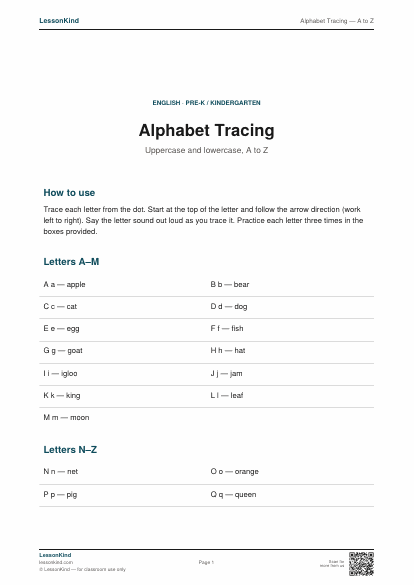
Alphabet Tracing — A to Z
Trace each letter of the alphabet, uppercase and lowercase. One picture cue per letter.
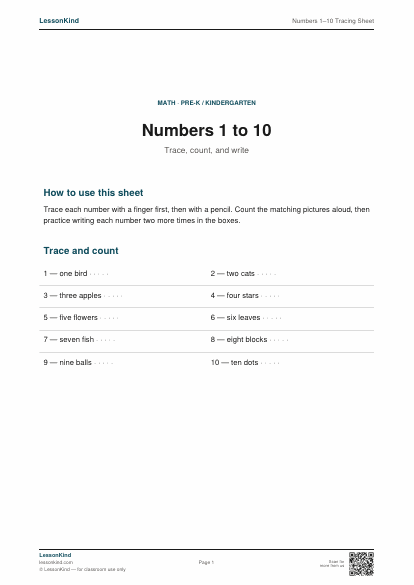
Numbers 1–10 Tracing Sheet
Trace each number from 1 to 10. Includes a quick counting picture for each.
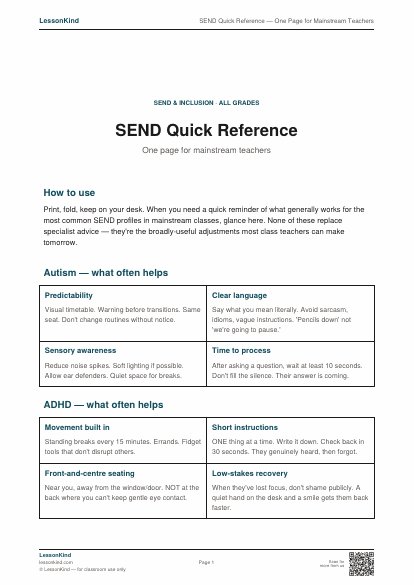
SEND Quick Reference — One Page for Mainstream Teachers
A one-page reference summarising the most useful adjustments for the four most common SEND profiles — autism, ADHD, dyslexia, anxiety. Print and stick on your desk.
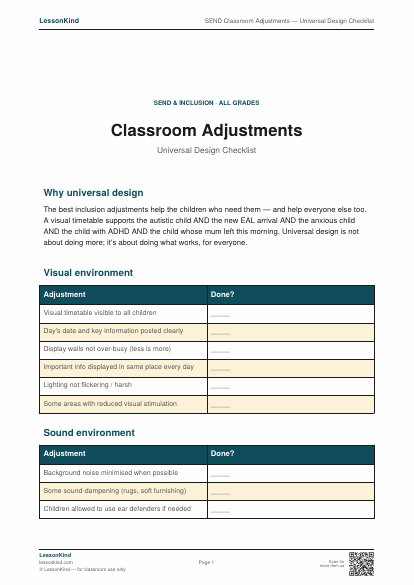
SEND Classroom Adjustments — Universal Design Checklist
A walk-through audit of adjustments that benefit children with SEND but help everyone else too. Audit your classroom in 15 minutes.
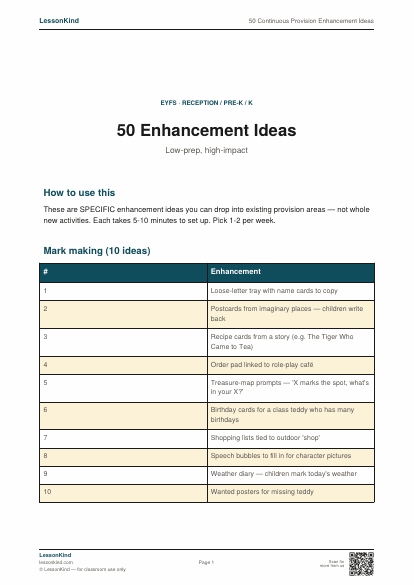
50 Continuous Provision Enhancement Ideas
50 specific, low-prep enhancements for the main provision areas — by area, by season, by skill. Useful for the Sunday-night moment when you're staring at the planning sheet.
Keep reading
Reading & literacy
When to Worry About a Five-Year-Old Who's Not Reading Yet
Reception and Year 1 parents worry constantly about their child's reading. Most of the worry isn't warranted. Some of it is. Here's how to tell the difference — and what to do about both.
8 min read
Behavior & classroom management
Anxiety in Primary Children: What's Normal and What's Not
Most primary-aged children worry. Some of them worry in ways that affect their lives. The line between these is the most consequential thing for parents to get right — and the most often blurred by anxiety culture going in both directions.
9 min read
EYFS & early years
Play-Based Learning Isn't Lower Expectations — It's Different Expectations
Walk into a Reception classroom and you'll see children playing. Walk into a Year 3 classroom and you'll see children working. The mistake most adults make is assuming the second is more rigorous than the first.
8 min read