First-year teaching · 6 min read
Working With Your Teaching Assistant
The relationship that shapes your classroom more than almost any other
Published 2026-05-12
In most primary classrooms, there is at least one other adult in the room for a significant part of the day. This person — a teaching assistant, paraeducator, or learning support assistant — has more daily contact with your students than almost anyone else in the building except you.
Almost no teacher training talks about this relationship in any depth.
The working relationship between a teacher and a TA is one of the biggest influences on what the classroom actually feels like for children. When it works well, you have a genuine teaching team. When it works badly — or when it's never been actively built — you have two adults in the same room operating in parallel without real coordination.
Here's what actually helps.
Start with a conversation, not an assumption
New teachers often assume TAs know their role and will simply slot into it. Experienced TAs have seen many teachers come and go, and most will take their cue from you.
In your first week, have an explicit conversation. Not a formal meeting — just a real one. What does the TA feel works well? What have they noticed previous teachers doing that helped? What do they find frustrating? What do they notice about particular children that might be useful to you?
This conversation does two things. It gives you genuinely useful information. And it signals that you see the TA as a professional colleague with knowledge, not as a resource to be directed.
Be clear about what you want — but not prescriptive
TAs need to know what you want from them in a given lesson. Not in a command-and-control way, but because without clarity, they'll default to whatever they were doing before, which may or may not suit what you're trying to achieve.
A two-minute briefing before a lesson — 'Today we're doing long division, I'd like you to sit with Maya's group and focus on the concrete stage before moving to the abstract, here's the progression I'm using' — is more useful than either leaving the TA to guess or micromanaging every interaction.
The key is giving the TA clear intent without removing their professional judgment. They are often better placed than you to notice mid-task whether a child needs a different approach.
Think carefully about where they sit
The research on teaching assistant deployment is fairly clear: TAs who sit next to specific children for most of the day — providing constant support — can actually impede learning. Children become dependent. They stop initiating. They wait for the adult to guide them.
More effective models involve TAs working with different groups, circulating, and providing support that withdraws as children gain confidence. Rather than 'TA stays with the learning support group,' consider 'TA focuses on whoever needs input right now across the room.'
This isn't always possible if a child has significant needs and one-to-one support is part of their provision. But it's worth thinking about as a default.
Share information, not just instructions
The best TA relationships involve genuine information sharing. If a child had a difficult morning before school, the TA probably knows. If a parent said something to the TA at the gate, you should know. If you've noticed a child's behavior has shifted over the past week, the TA's perspective might explain it.
Build a brief check-in into the start and end of the day. It doesn't need to be long. Thirty seconds of 'anything I should know?' before school, and 'anything you noticed today that we should talk about?' at the end, creates a loop that over time becomes one of your best sources of information about your class.
Acknowledge their expertise
TAs often know individual children extraordinarily well — sometimes better than the teacher, because they've been in the school for years while teachers rotate. A TA who has worked with a particular child for three years has information and insight that a new teacher cannot have.
Be explicit that you value this. Ask for their views. When they give you useful information, acknowledge it. Don't treat the TA as a deliverer of your instructions; treat them as a professional who has relevant expertise.
When it's difficult
Sometimes the TA relationship is genuinely difficult. Differences in style, competing views on how to handle behavior, a TA who has strong ideas about how things should be done — these situations do occur.
The rule in a difficult TA relationship is: address it directly and early. Letting discomfort sit until it's resentment helps no one. A calm, private conversation — 'I've noticed we sometimes approach behavior differently, I'd like us to get on the same page' — is far preferable to letting the tension play out in front of students.
If the difficulty involves something more serious — a TA saying inappropriate things to children, undermining your authority, or ignoring your guidance — that's a conversation for your mentor or principal. Don't try to manage significant professional issues alone in your first year.
The dividend
A good TA relationship is one of the highest-return investments you can make in your first year. An experienced TA who trusts you and is trusted by you extends your capacity enormously. They can notice things you miss, support children you can't reach at a given moment, and carry forward the culture of the classroom when your attention is elsewhere.
It's a relationship worth building deliberately.
Free bundle for this topic
The Starter Pack
18 free resources spanning every subject — the universal new-teacher starter.
Practical resources for this
Take this further
Printable, classroom-ready resources for the topics in this article.
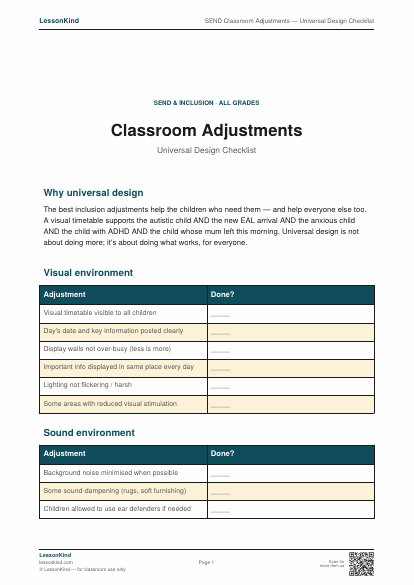
SEND Classroom Adjustments — Universal Design Checklist
A walk-through audit of adjustments that benefit children with SEND but help everyone else too. Audit your classroom in 15 minutes.
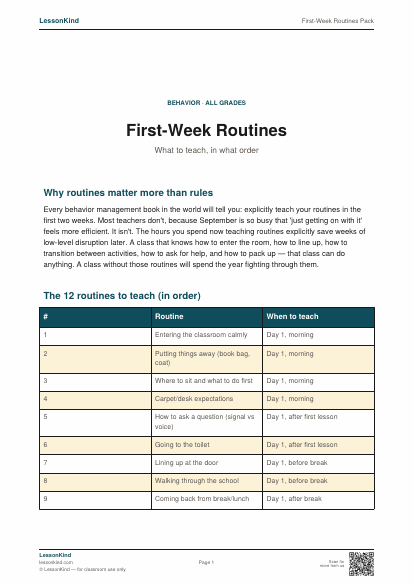
First-Week Routines Pack
The 12 routines you must establish in the first two weeks — entry, transitions, lining up, asking for help, finishing work, end of day. With explicit teaching scripts.
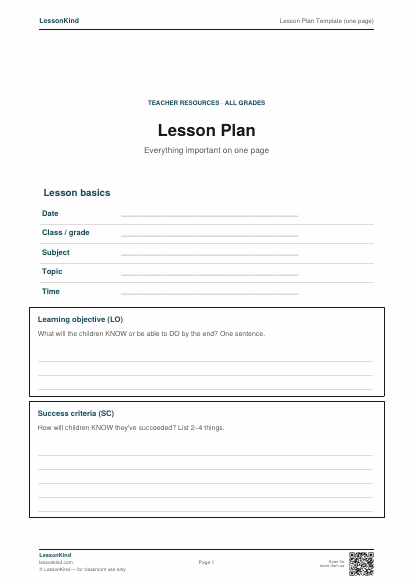
Lesson Plan Template (one page)
A one-page lesson plan template — objective, success criteria, hook, main task, assessment, plenary.
Keep reading
First-year teaching
Five Mistakes I Made as a New Elementary Teacher
If I could go back and shake my first-year teacher self by the shoulders, here's what I'd say.
7 min read
First-year teaching
The Paperwork Nobody Warned You About
Teacher training spends a lot of time on lesson planning and very little time on the administrative workload that will occupy hours of your week. Here's what's coming — and how to handle it.
7 min read
First-year teaching
What Nobody Tells You About Differentiation
Differentiation is one of the most talked-about concepts in teaching and one of the most misunderstood in practice. Here's what it actually looks like in a working classroom.
8 min read