English / Language Arts
English / Language Arts for 2nd
Phonics, sight words, spelling, grammar, reading comprehension and writing prompts.
All resources
English CPD Pack for Class Teachers
Six 20-minute CPD sessions for English Leads to deliver to class teachers — covering reading aloud, comprehension teaching, writing feedback, vocabulary teaching, phonics for non-specialists, and reading-for-pleasure leadership. Designed for twilight INSETs.
English Lead Handover Document
When an English Lead leaves a school, the next person inherits chaos by default. This handover template captures everything — phonics scheme, reading data, library status, CPD history, key children, statutory data trends. Mirrors the music and assessment coordinator handover docs.
English Lead — Professional Reading List
Professional books every primary English Lead should read — the research-grounded titles on phonics, reading-for-pleasure, comprehension, vocabulary, and writing teaching. Honest about which are essential and which are optional.
English Monitoring Walk — Prompt Sheet
What to look for during a 10-minute classroom monitoring walk for English. Specific prompts for reading lessons, writing lessons, phonics lessons, and book corner audits. Designed for English Leads doing learning walks without it feeling like inspection.
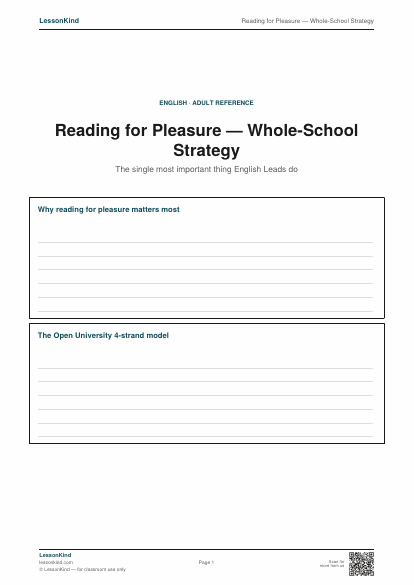
Reading for Pleasure — Whole-School Strategy
How English Leads build a school-wide reading culture. Covers the Open University's 4-strand model, library setup, daily read-aloud rituals, reluctant-reader strategies, parent engagement, and how to measure reading-for-pleasure (it's harder than measuring fluency). The most important single thing an English Lead does.
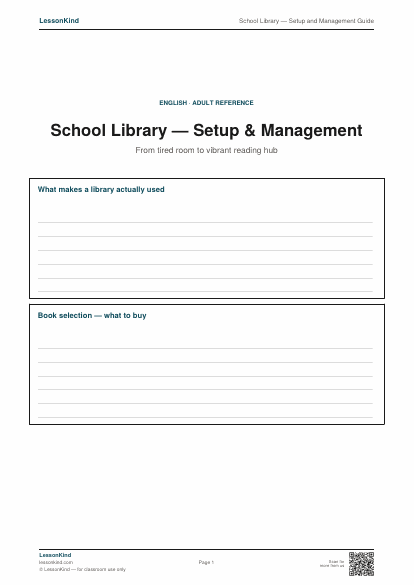
School Library — Setup and Management Guide
How to set up and run a primary school library — book selection, organisation, lending systems, refresh cycles, parent volunteer roles, and the difference between 'a room with books' and 'a library children actually use'. For English Leads inheriting a tired library or starting from scratch.
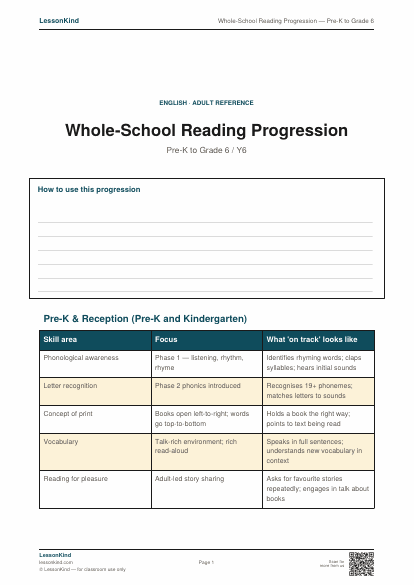
Whole-School Reading Progression — Pre-K to Grade 6
How reading skills develop across primary — phase 1 phonics through KS2 inference, summarisation, and critical reading. Includes year-by-year skill expectations, common misconceptions, and the assessment markers that show whether children are on track. The reference document an English Lead returns to most often.
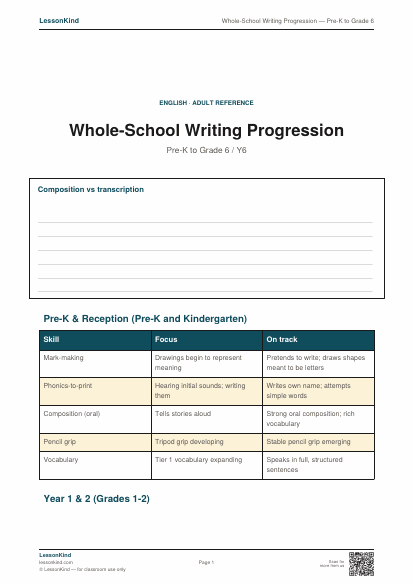
Whole-School Writing Progression — Pre-K to Grade 6
How writing skills develop across primary — emergent mark-making through KS2 sustained writing. Year-by-year skill expectations covering composition, transcription, vocabulary, sentence structure, and editing. Pairs with the reading progression as the English Lead's two foundational reference docs.
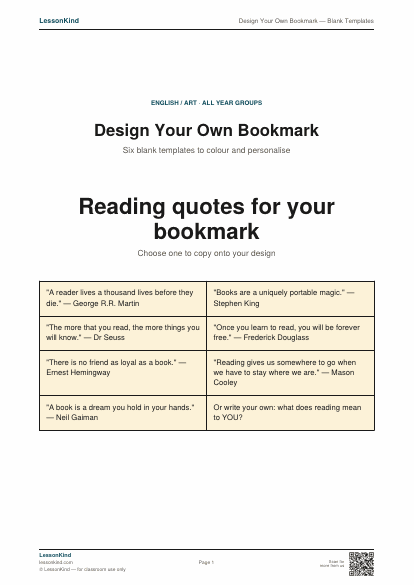
Design Your Own Bookmark — Blank Templates
Six printable blank bookmark templates in different shapes and sizes — for pupils to design, colour, and personalise. Includes motivational reading quote suggestions. Print on card, laminate, and use.
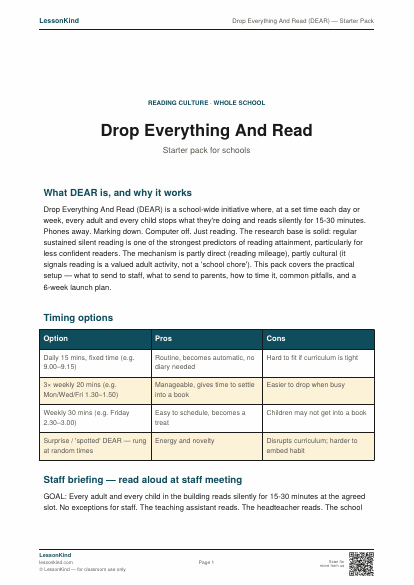
Drop Everything And Read (DEAR) — Starter Pack
Everything to launch a Drop Everything And Read programme — staff briefing, parent letter, signage, slot timing options, evidence base and FAQ. Ready to deploy in week 1.
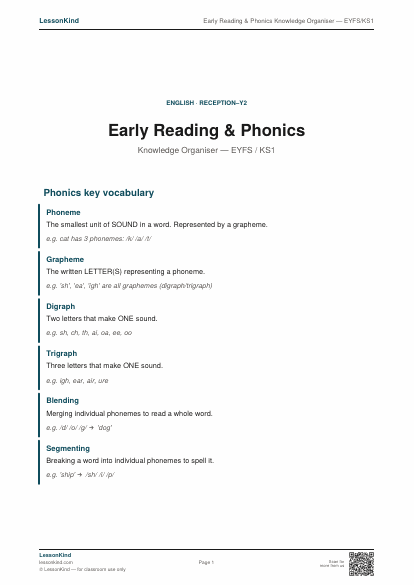
Early Reading & Phonics Knowledge Organiser — EYFS/KS1
A Reception and KS1 reference for early reading — phonics phases, common exception words, the alphabetic code, blending and segmenting, and early comprehension development.
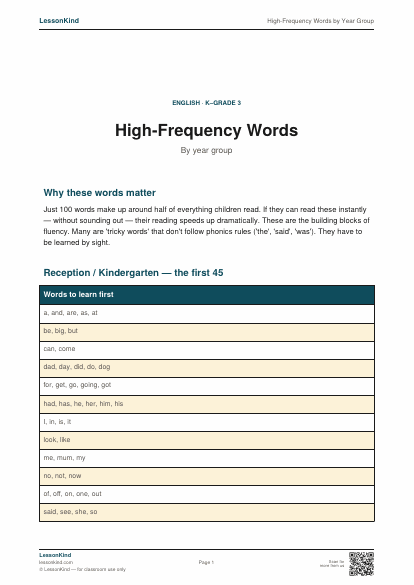
High-Frequency Words by Year Group
The most common words children need to read fluently — split by year group. Reception, Year 1, Year 2 and beyond. Print, display, practise.
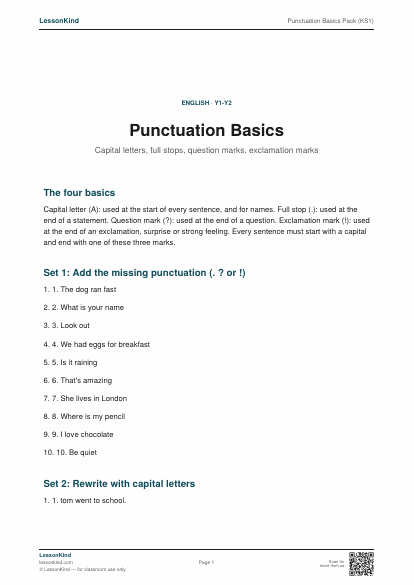
Punctuation Basics Pack (KS1)
KS1 punctuation pack — capital letters, full stops, question marks, exclamation marks. Ready-made print-and-go.
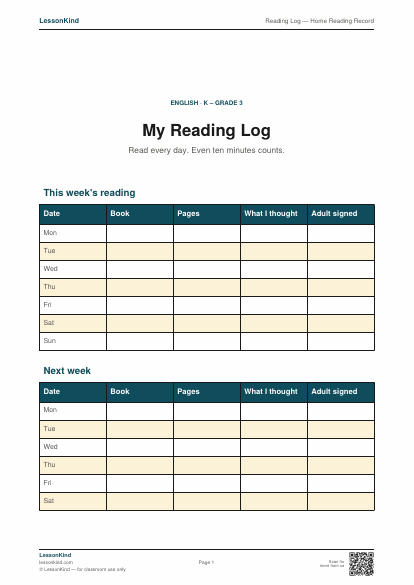
Reading Log — Home Reading Record
Two-week home reading log. Date, book, pages, parent signature, child reflection.
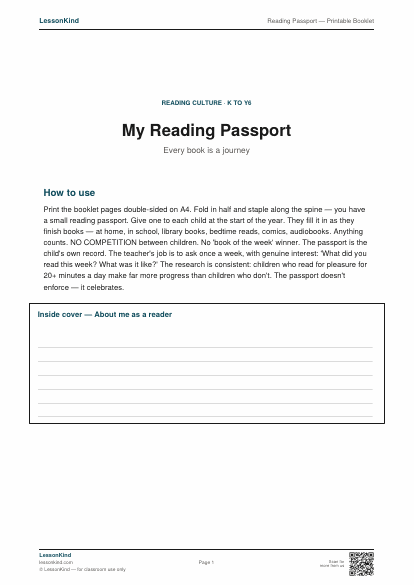
Reading Passport — Printable Booklet
A printable Reading Passport — a fold-and-staple A4 booklet where children record every book read, the country/genre, and a star rating. Builds reading culture without competition or pressure.
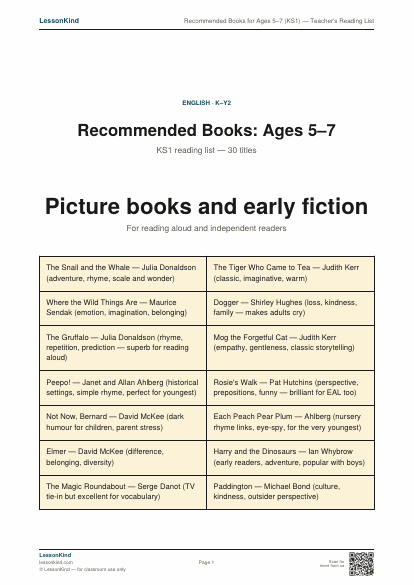
Recommended Books for Ages 5–7 (KS1) — Teacher's Reading List
A curated reading list of 30 picture books and early readers for KS1 — covering fiction, non-fiction, poetry, and diverse voices. With curriculum links and a brief annotation for each title.
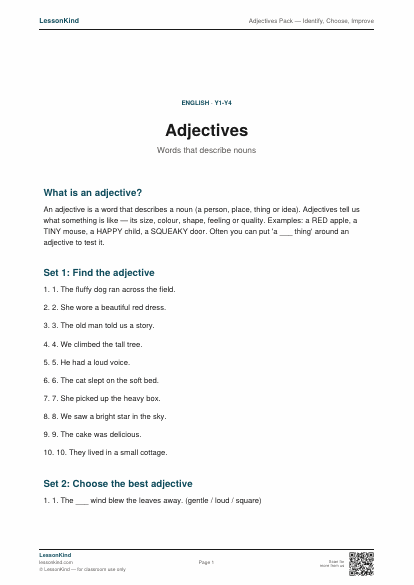
Adjectives Pack — Identify, Choose, Improve
Ready-made adjectives worksheet covering identification, choosing the best adjective, and using adjectives to improve writing. KS1 and lower KS2 friendly.
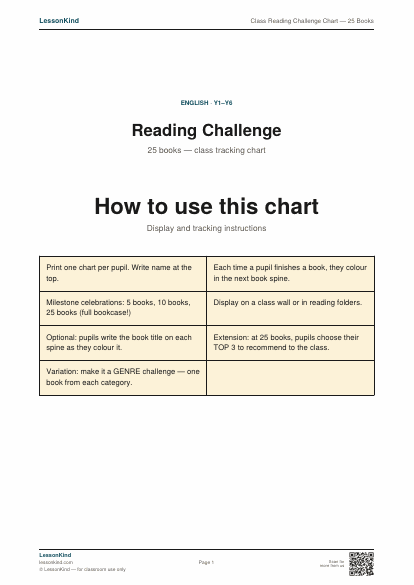
Class Reading Challenge Chart — 25 Books
A printable whole-class reading challenge chart for tracking 25 books per pupil over the year. Includes a pupil name strip and 25 numbered book spines to colour in. Doubles as a classroom display.
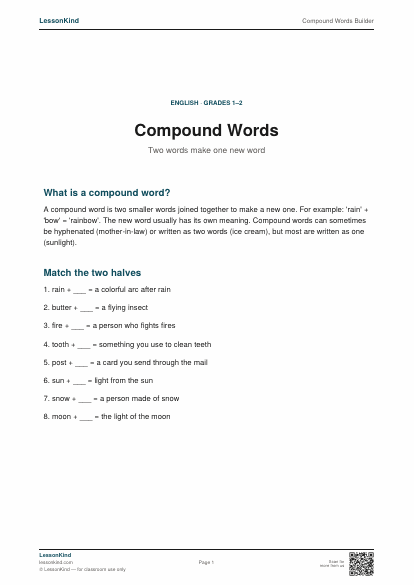
Compound Words Builder
Match two words to make a compound. Then build your own. Develops vocabulary and word play.
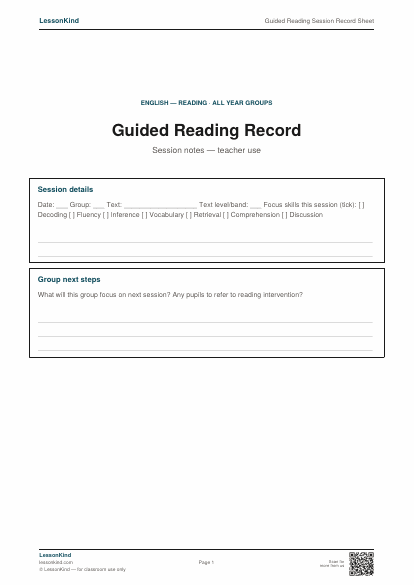
Guided Reading Session Record Sheet
A teacher-facing record sheet for guided reading sessions — group members, text level, focus skills, observations per pupil, and next steps. One sheet per session.
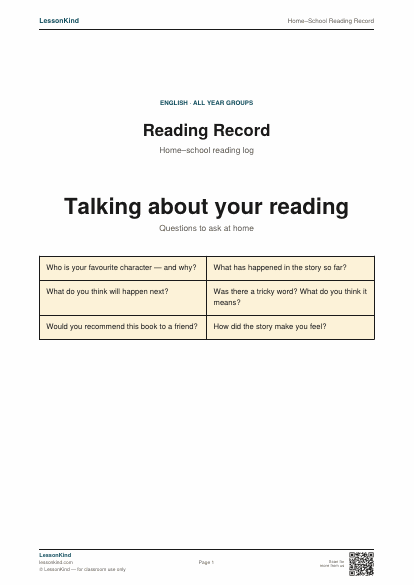
Home–School Reading Record
Printable reading record booklet for primary pupils — weekly log with book title, pages read, date, pupil comment, and parent/carer sign-off. Designed to travel between home and school.
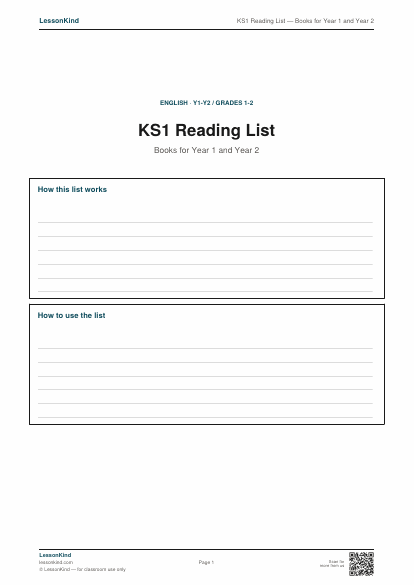
KS1 Reading List — Books for Year 1 and Year 2
Curated reading list for Year 1 and Year 2 children — picture books, early chapter books, poetry, and books for the children just becoming readers. Calibrated for the children who are decoding fluently and ready for richer stories.
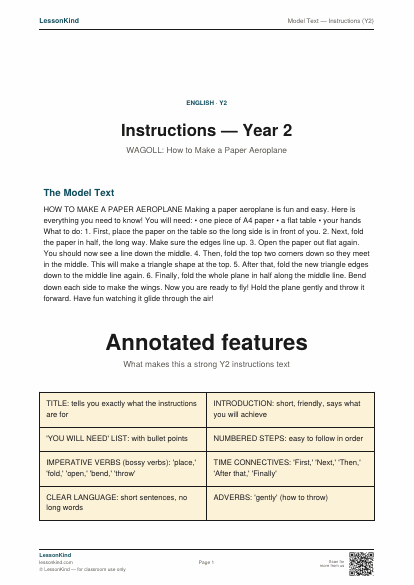
Model Text — Instructions (Y2)
WAGOLL example of a Year 2 instructions text — How to Make a Paper Aeroplane. Demonstrates imperative verbs, time-order connectives, numbered steps, and clear language for KS1 instructional writing.
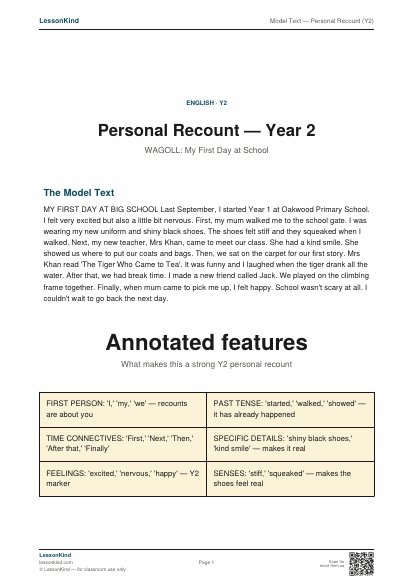
Model Text — Personal Recount (Y2)
WAGOLL example of a Year 2 personal recount — My First Day at School. Demonstrates first-person past-tense recount, simple time connectives, and feeling words for KS1.
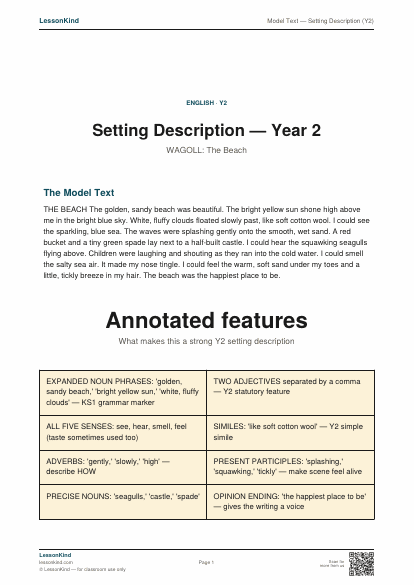
Model Text — Setting Description (Y2)
WAGOLL example of a Year 2 setting description — The Beach. Demonstrates expanded noun phrases, the five senses, and adjectives for descriptive writing in KS1.
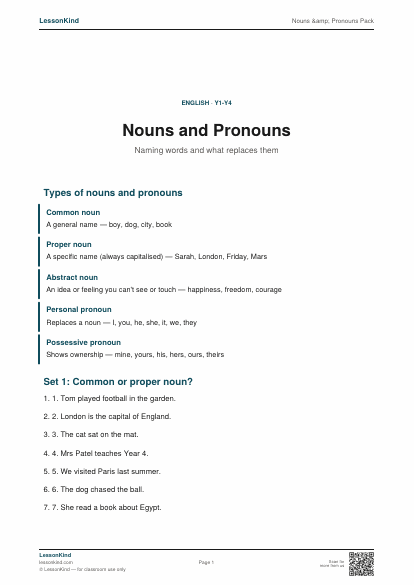
Nouns & Pronouns Pack
Ready-made nouns and pronouns worksheet — common, proper, abstract nouns plus personal and possessive pronouns. KS1 and KS2.
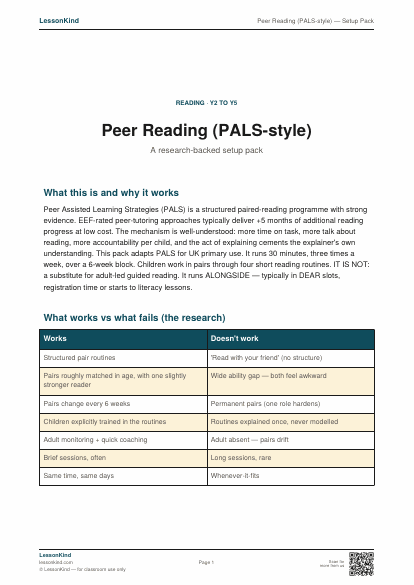
Peer Reading (PALS-style) — Setup Pack
A research-backed peer reading programme adapted from PALS — structured pairs, four reading routines (paired reading, retell, paragraph shrink, prediction), pairing rules, and a 6-week launch plan.
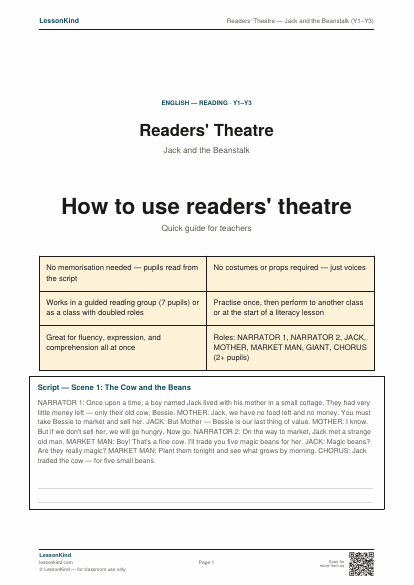
Readers' Theatre — Jack and the Beanstalk (Y1–Y3)
A 3-page readers' theatre script of Jack and the Beanstalk with 7 roles — Jack, Mother, Giant, Narrator (×2), and 2 chorus parts. No props or costumes needed. Perfect for guided reading or English.
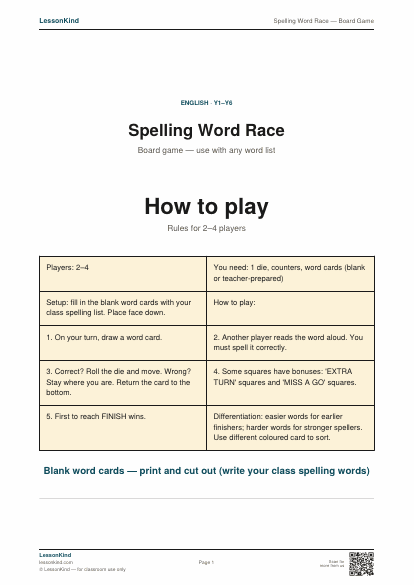
Spelling Word Race — Board Game
A printable board game where players draw a word card and must spell the word correctly to move. Blank word cards included so teachers can insert their own class spelling lists. For 2–4 players.
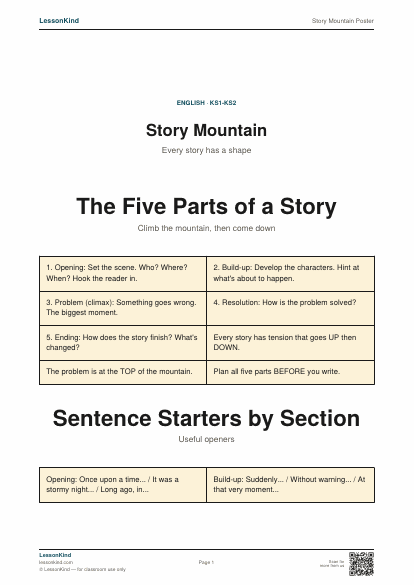
Story Mountain Poster
Visual structure of a story — opening, build-up, problem, resolution, ending. The classic primary writing scaffold.
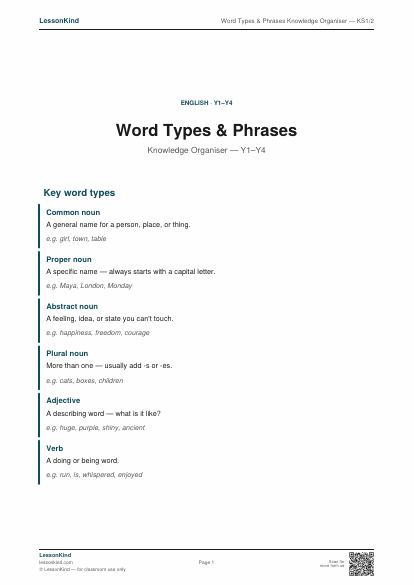
Word Types & Phrases Knowledge Organiser — KS1/2
A child-friendly reference for the key word types and phrase types encountered in primary English — nouns, verbs, adjectives, adverbs, conjunctions, and expanded noun phrases, with examples.
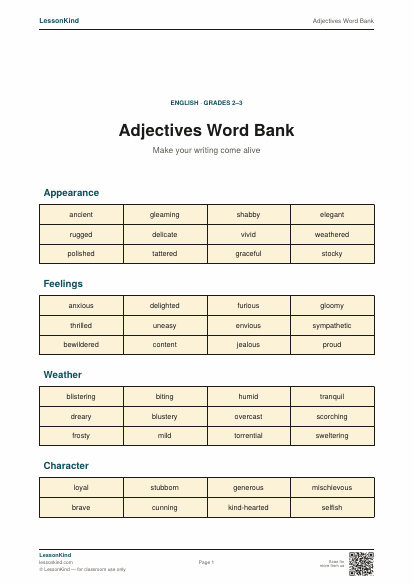
Adjectives Word Bank
Themed adjective banks (appearance, feeling, weather, character) for descriptive writing.
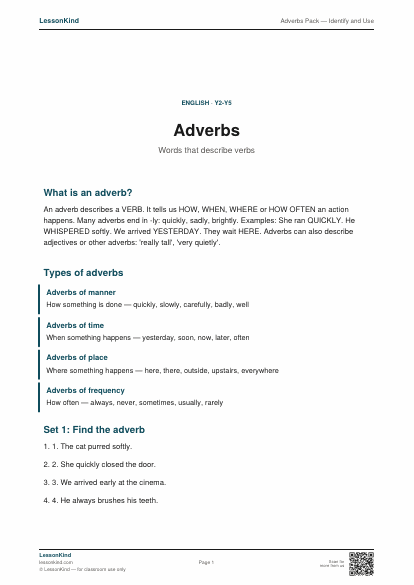
Adverbs Pack — Identify and Use
Ready-made adverbs worksheet covering manner, time, place and frequency adverbs. KS2 focused.
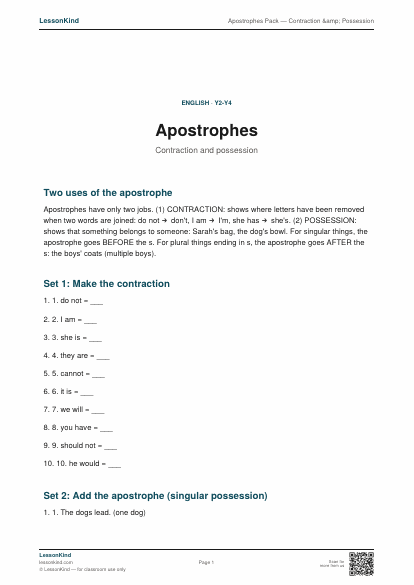
Apostrophes Pack — Contraction & Possession
Focused practice on the two uses of apostrophes — contractions (don't) and possession (Sarah's). Lower KS2 level.
Book Recommendation Display — Pupil Review Template
Printable A5 book recommendation cards for pupils to fill in and display — title, author, star rating, one-sentence summary, who they'd recommend it to. For classroom reading displays.
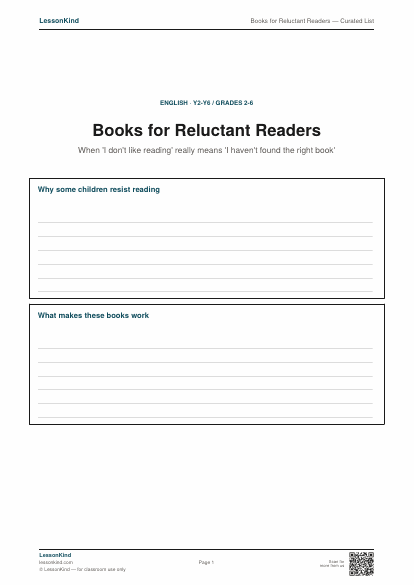
Books for Reluctant Readers — Curated List
Books specifically chosen to convert reluctant readers — short, accessible, often illustrated, always engaging. For the children who 'don't like reading' (because they haven't found the right book yet). Calibrated for Y2-Y6.
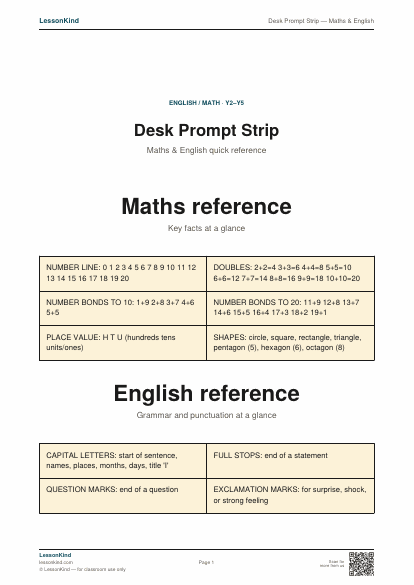
Desk Prompt Strip — Maths & English
A printable A4 desk prompt strip covering key maths and English reference points — number lines to 100, common spellings, punctuation rules, and grammar terms. Laminate for long-term use.
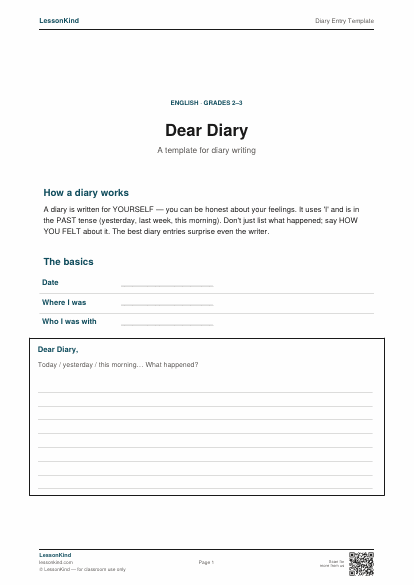
Diary Entry Template
First-person reflective writing template. Includes prompts for events, feelings and a closing thought.
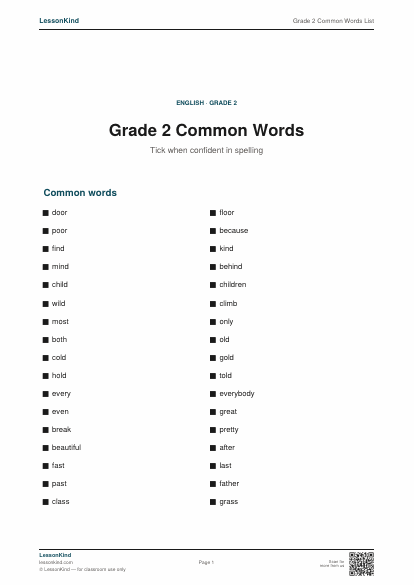
Grade 2 Common Words List
Tricky and common words for Grade 2, with tick boxes for spelling assessment.
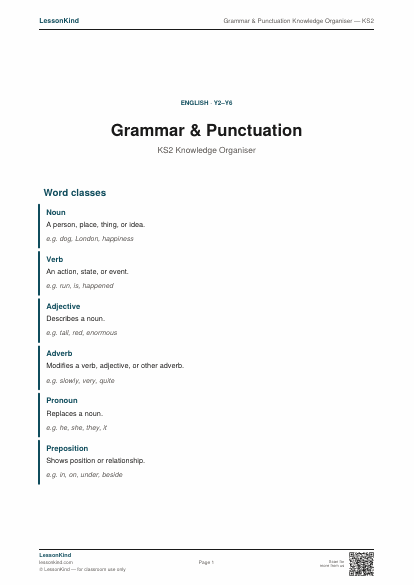
Grammar & Punctuation Knowledge Organiser — KS2
A complete KS2 grammar and punctuation reference — word classes, sentence types, punctuation marks, and key terminology. Covers the SPaG content children need to know from Y2–Y6.
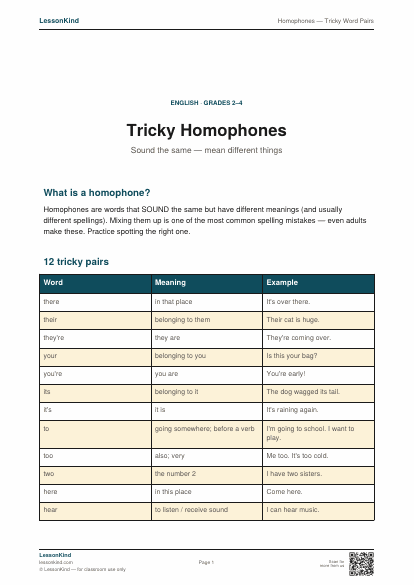
Homophones — Tricky Word Pairs
12 commonly-confused homophone pairs explained — there/their/they're, your/you're, to/too/two.
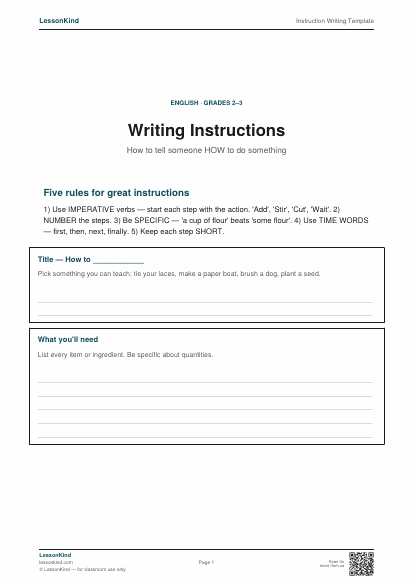
Instruction Writing Template
Write clear instructions — title, ingredients/equipment, numbered steps, top tip.
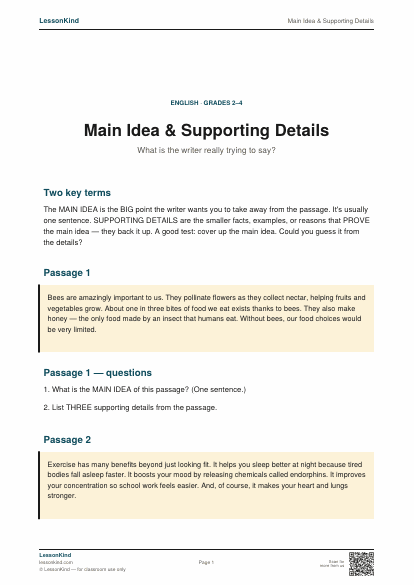
Main Idea & Supporting Details
Practice spotting the main idea of a short passage and identifying details that support it.
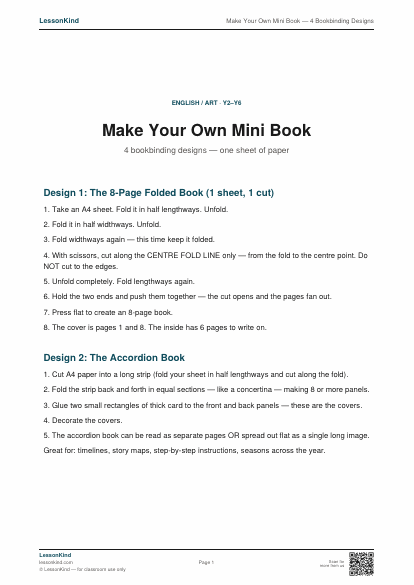
Make Your Own Mini Book — 4 Bookbinding Designs
Instructions for making 4 types of mini book from a single sheet of paper: the 8-page accordion, the 4-page folded book, the concertina, and the pocket staple book. Perfect for writing, topic work, and gifts.
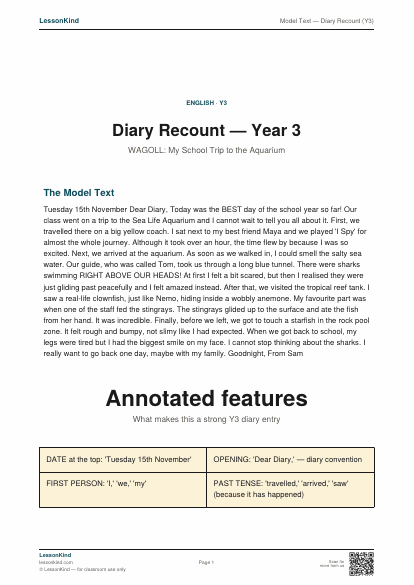
Model Text — Diary Recount (Y3)
WAGOLL example of a Year 3 diary entry recounting a school trip. Demonstrates first-person past-tense recount, time connectives, and emotional response — common Y3 writing genre.
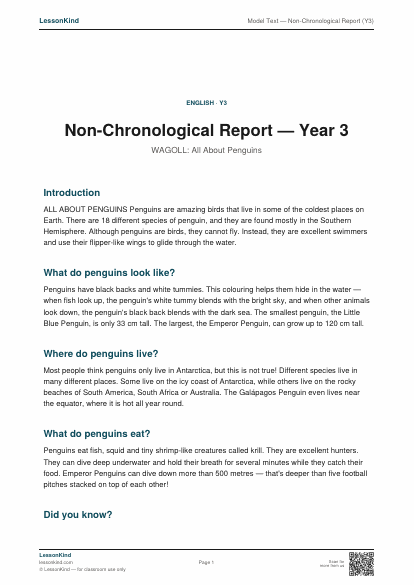
Model Text — Non-Chronological Report (Y3)
WAGOLL example of a Year 3 non-chronological report on penguins. Demonstrates clear sub-headings, factual present tense, technical vocabulary, and information organisation appropriate for Year 3.
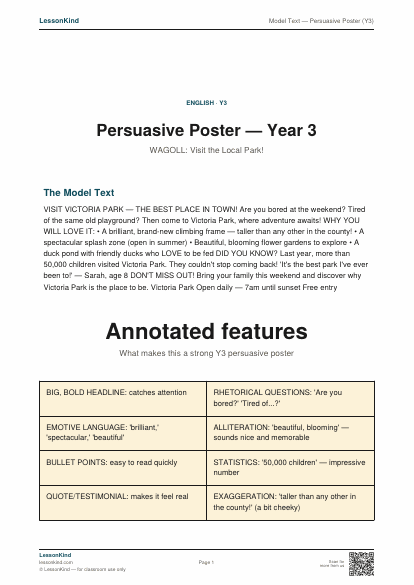
Model Text — Persuasive Poster (Y3)
WAGOLL example of a Year 3 persuasive poster — Visit the Local Park! Demonstrates rhetorical questions, emotive language, alliteration, and visual conventions of persuasive posters for younger writers.
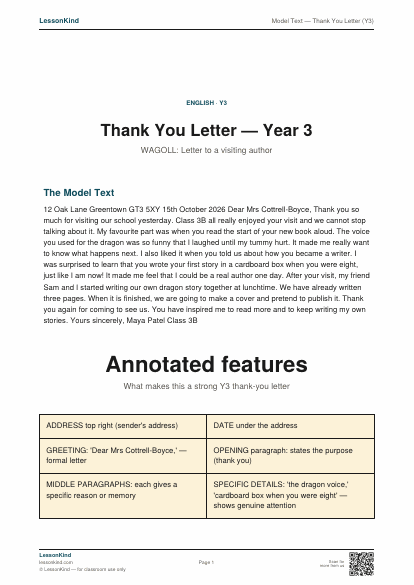
Model Text — Thank You Letter (Y3)
WAGOLL example of a Year 3 thank-you letter to a visiting author. Demonstrates letter conventions, paragraphing, and specific details that show genuine engagement.
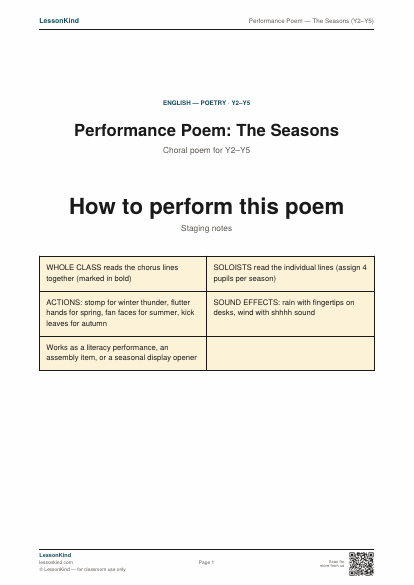
Performance Poem — The Seasons (Y2–Y5)
A four-stanza performance poem about the four seasons — one stanza per season, designed for whole-class choral reading with solos. Includes actions and sound effects guide. Suitable for assemblies and literacy.
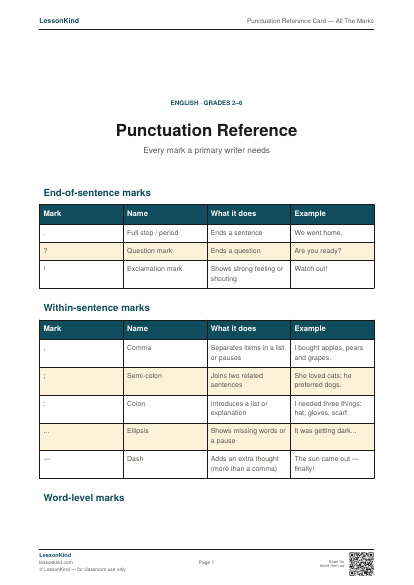
Punctuation Reference Card — All The Marks
Every punctuation mark a primary child needs — what it's called, what it does, and an example. Print, laminate, stick on every desk.
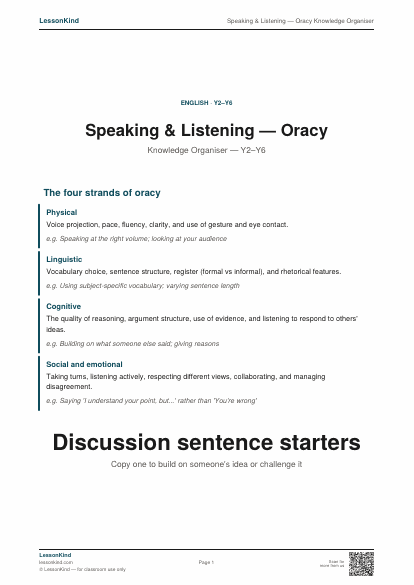
Speaking & Listening — Oracy Knowledge Organiser
A KS2 oracy reference — formal and informal speaking, features of effective talk, listening skills, vocabulary for discussion, and the four strands of oracy (physical, linguistic, cognitive, social/emotional).
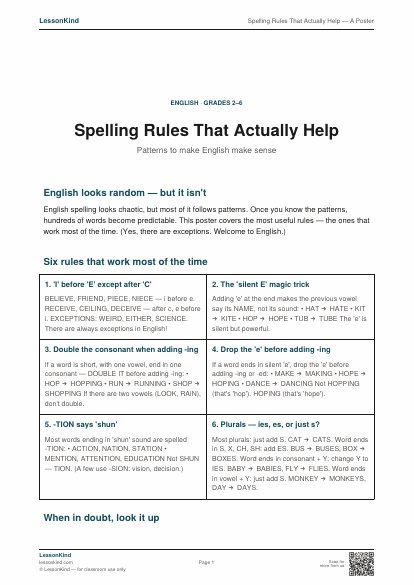
Spelling Rules That Actually Help — A Poster
The spelling rules that make English make sense — i before e, doubling consonants, dropping the e, and the magic of -tion. With clear examples.
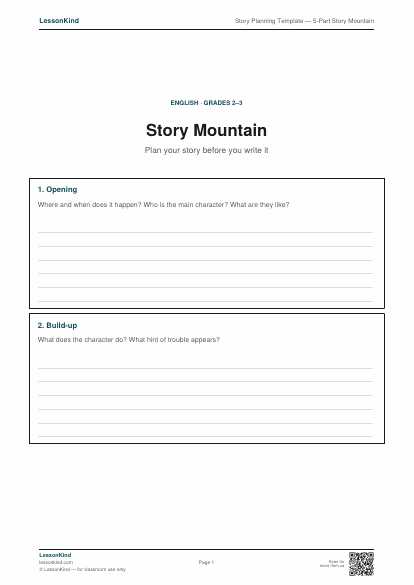
Story Planning Template — 5-Part Story Mountain
A printable story mountain with prompts for opening, build-up, problem, resolution and ending.
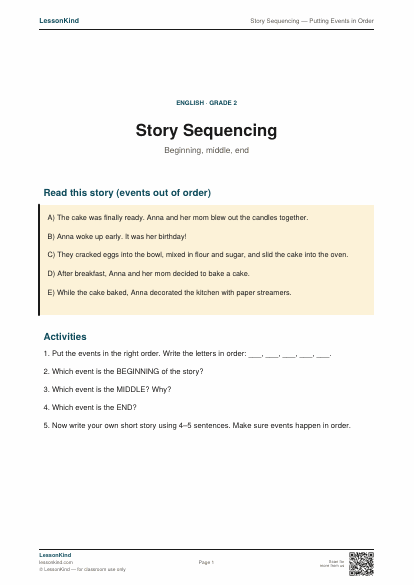
Story Sequencing — Putting Events in Order
Cut, mix and re-order story events. Builds narrative comprehension and writing structure.
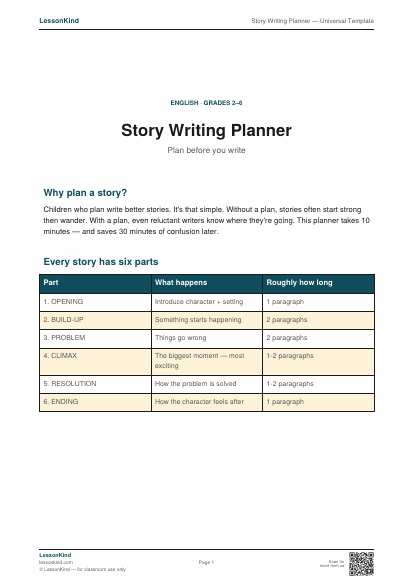
Story Writing Planner — Universal Template
A six-section story planner that works for any narrative — opening, build-up, problem, climax, resolution and ending. Print one per child before any story task.
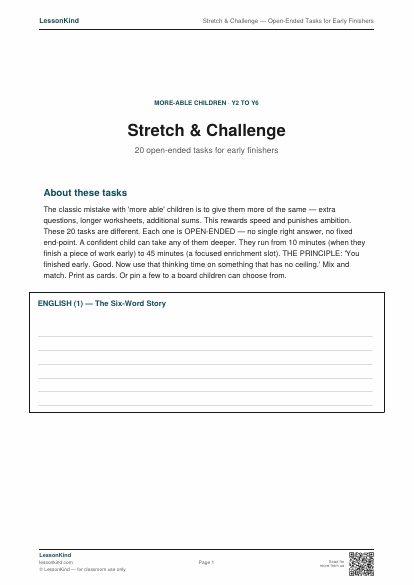
Stretch & Challenge — Open-Ended Tasks for Early Finishers
Twenty open-ended tasks designed for the children who finish first. No 'more of the same' — these are genuinely thinking-required tasks across English, maths, problem-solving and creative writing.
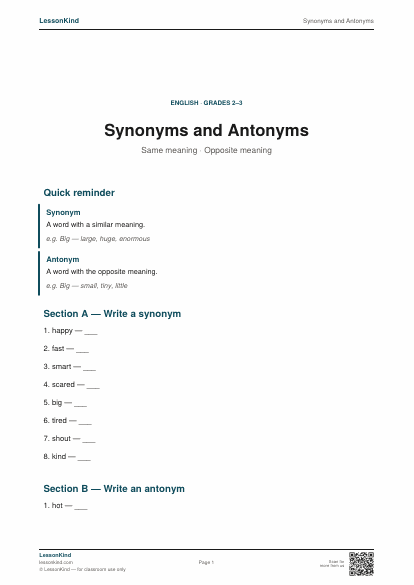
Synonyms and Antonyms
Match pairs and write your own. Builds vocabulary and word-choice flexibility.
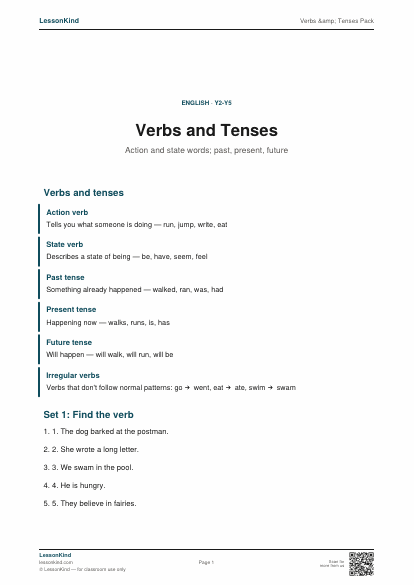
Verbs & Tenses Pack
Ready-made verbs worksheet covering action verbs, state verbs, and the three main tenses (past, present, future). KS2 focused.
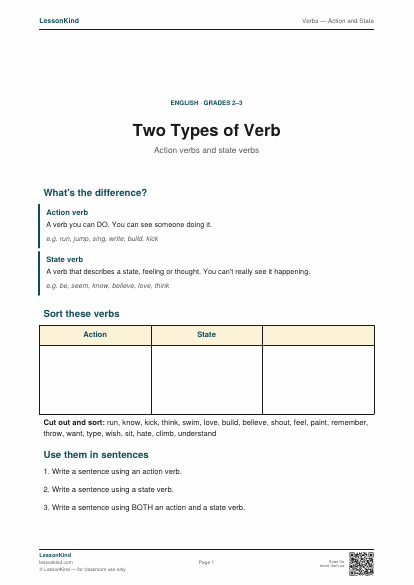
Verbs — Action and State
The two main types of verb explained. Sort 20 verbs into action vs state and write your own.
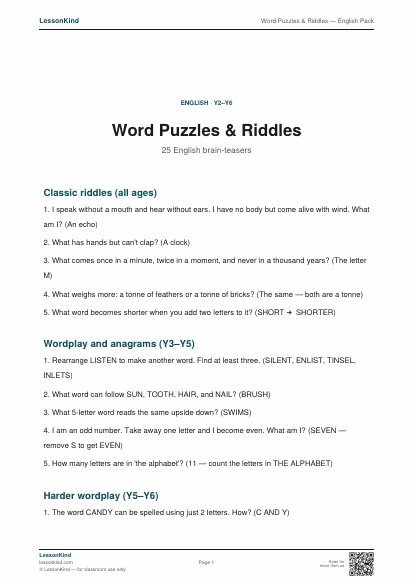
Word Puzzles & Riddles — English Pack
25 word puzzles and riddles for primary — homophones, anagrams, compound words, wordplay, and classic riddles. Great for literacy lessons, wet break, or as starters.